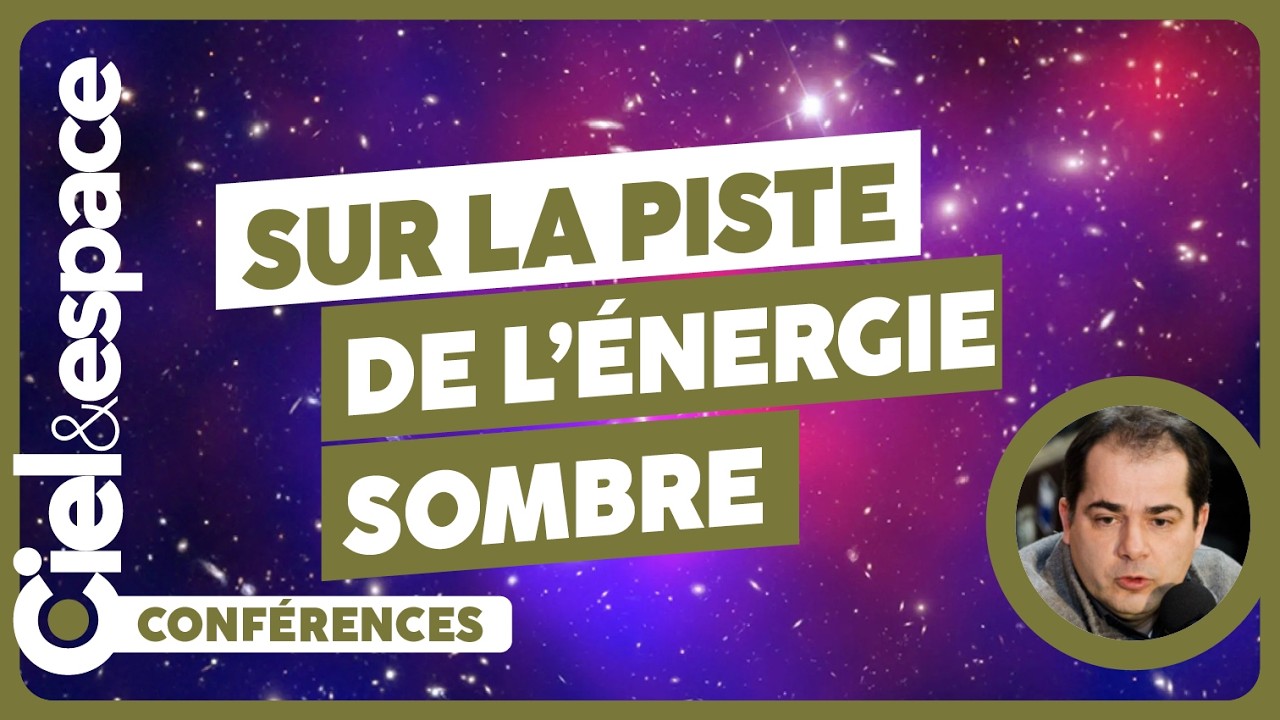
Le plus grand défi de la cosmologie
Keywords
dark energy
cosmological constant
modified gravity
cosmic microwave background
baryon acoustic oscillations
Summary
This conference by Francis Bernardeau, a cosmologist from the Institut d'Astrophysique de Paris, addresses the greatest challenge in modern cosmology: the nature of dark energy. The speaker reviews the observational evidence for dark energy, including Type Ia supernovae, cosmic microwave background anisotropies, and baryon acoustic oscillations, which all point to an accelerating expansion of the universe. He discusses the standard Lambda-CDM model, which incorporates a cosmological constant as the simplest form of dark energy, but also highlights its theoretical problems, such as the fine-tuning and coincidence problems. Bernardeau then explores alternative explanations, including dynamical dark energy models (e.g., quintessence) and modifications of general relativity (e.g., f(R) gravity). He emphasizes the need for more precise measurements to distinguish between these possibilities, and presents upcoming surveys like Euclid and LSST that aim to probe dark energy with unprecedented accuracy. The talk is technical but accessible to a master's-level audience, providing a comprehensive overview of the current state of research and the key observational tests that will shape our understanding of cosmic acceleration.
Critical Evaluation
The video presents a high-level overview of the dark energy problem by a leading expert in the field. Francis Bernardeau is a well-known cosmologist at IAP, and his talk reflects the current consensus in cosmology. The content is scientifically rigorous, covering both the observational evidence and theoretical models. However, the talk is a general overview rather than presenting new research; it is more of an expert opinion and science communication piece. The speaker does not cite specific references during the talk, which limits the ability to verify claims directly. The description mentions no sources, and the transcript is not provided in full, but the talk likely references standard cosmological results. The video has a moderate number of views (12,442) and likes (233), indicating a positive reception. Comments are not available for analysis, but the audience appears to be interested in cosmology. The technical level is appropriate for master's students in physics or astronomy, but may be challenging for a general audience. The talk does not engage with controversial or fringe ideas; it stays within mainstream cosmology. One limitation is the lack of discussion of potential systematic uncertainties in the data. Overall, the video is a valuable educational resource, but it does not offer original insights beyond what is available in standard textbooks or review articles. The presentation is clear and well-structured, making it useful for students seeking an introduction to dark energy. The speaker's authority and the institutional backing (Ciel & Espace) add to its credibility. However, for a more critical evaluation, one would need to compare with recent literature, which is not provided. The video's strength lies in its synthesis of complex topics, but it lacks depth in some areas, such as the theoretical motivations for modified gravity. The evaluation score of 8/10 for reliability reflects the speaker's expertise and the mainstream nature of the content, but the lack of explicit citations prevents a higher score.
Key Moments
- Introduction to the dark energy problem and the accelerating universe.
- Review of observational evidence: supernovae, CMB, BAO.
- Discussion of the cosmological constant and its problems.
- Alternative models: quintessence and modified gravity.
- Future surveys: Euclid, LSST, and their expected impact.
- Conclusion and open questions in cosmology.
Cited Sources
Contribution & Novelties
This video does not present new research but offers a synthesized overview of the dark energy problem from a leading expert. Its value lies in the clarity of explanation and the contextualization of current observational programs. For a master's student, it provides a concise update on the state of the field, but it does not introduce novel concepts beyond standard cosmological literature.
Radar Profile
The radar profile shows high scores in quality and reliability, reflecting the speaker's expertise and the mainstream nature of the content. The quantity of information is moderate, as the talk covers broad topics without deep detail. The technical level is high, suitable for a specialized audience. Overall, the video is a solid educational resource but not groundbreaking.
Reliability
/10