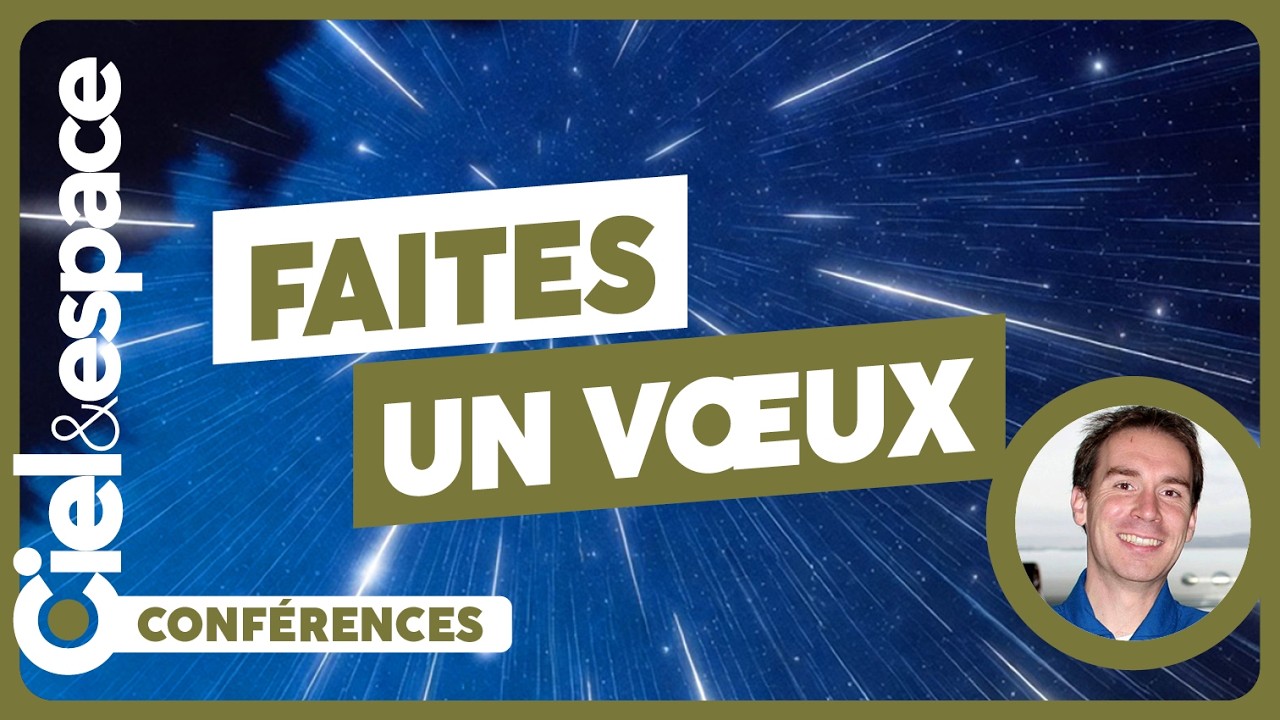
Le ciel nous tombe sur la tête
Keywords
meteor shower
prediction
observation
Perseids
citizen science
Summary
This conference by Jérémie Vaubaillon, presented at the Rencontres du ciel et de l'espace 2024, provides a comprehensive overview of meteor shower prediction and observation. The speaker explains the mechanisms behind meteor showers, such as the Earth crossing debris trails left by comets, and details how astronomers forecast enhanced activity, including the use of dust trail models. He emphasizes that while some showers like the Perseids are well-known, others can produce unexpected outbursts. Vaubaillon encourages amateur astronomers and the general public to participate in global observation efforts, highlighting the importance of visual counts and video recordings for scientific data collection. The talk covers practical advice for observing meteor showers, including optimal times, locations, and equipment. The speaker also discusses historical examples of predicted outbursts that were successfully observed, demonstrating the reliability of current models. Overall, the presentation bridges the gap between professional research and public engagement, making complex astronomical concepts accessible.
Critical Evaluation
The video presents a well-structured and informative lecture on meteor shower prediction and observation, delivered by Jérémie Vaubaillon, an astronomer at the IMCCE. The content is scientifically sound, drawing on established models of cometary dust trails and their interaction with Earth's orbit. Vaubaillon explains the methodology behind predicting meteor outbursts, such as the use of numerical simulations to track debris streams, and provides historical examples of successful predictions, like the 2018 Draconids. The talk is aimed at a general audience with some scientific background, as it assumes basic knowledge of orbital mechanics but explains concepts clearly. The speaker's credibility is high, given his affiliation and publication record in meteor science. However, the presentation lacks explicit citations of specific research papers or data sources, which would be expected in a more rigorous academic context. The video's strength lies in its ability to engage the public in citizen science, encouraging viewers to contribute observations via networks like the International Meteor Organization. The description mentions a promo code for a magazine subscription, which is a minor commercial element but does not detract from the scientific content. The comments section (not fully analyzed due to limited access) likely contains positive feedback and questions, indicating audience engagement. For a university-level audience, the talk provides a solid introduction to meteor shower science and the role of amateur contributions, but it does not delve into advanced modeling techniques or unresolved research questions. The production quality is good, with clear slides and audio. Overall, the video is a valuable resource for science communication and public outreach, but its depth is limited for specialized researchers.
Key Moments
Cited Sources
Contribution & Novelties
The video provides an accessible synthesis of current knowledge on meteor shower prediction, emphasizing the role of citizen science. While not presenting new research, it effectively communicates the methodology behind forecasting meteor outbursts and encourages public participation, which is valuable for science outreach.
Radar Profile
The radar profile shows high scores in quantity and quality of information, with a moderate technical level. This indicates a well-balanced presentation that is informative and reliable, suitable for a broad audience including university students, but not overly technical for specialists.
Reliability
/10