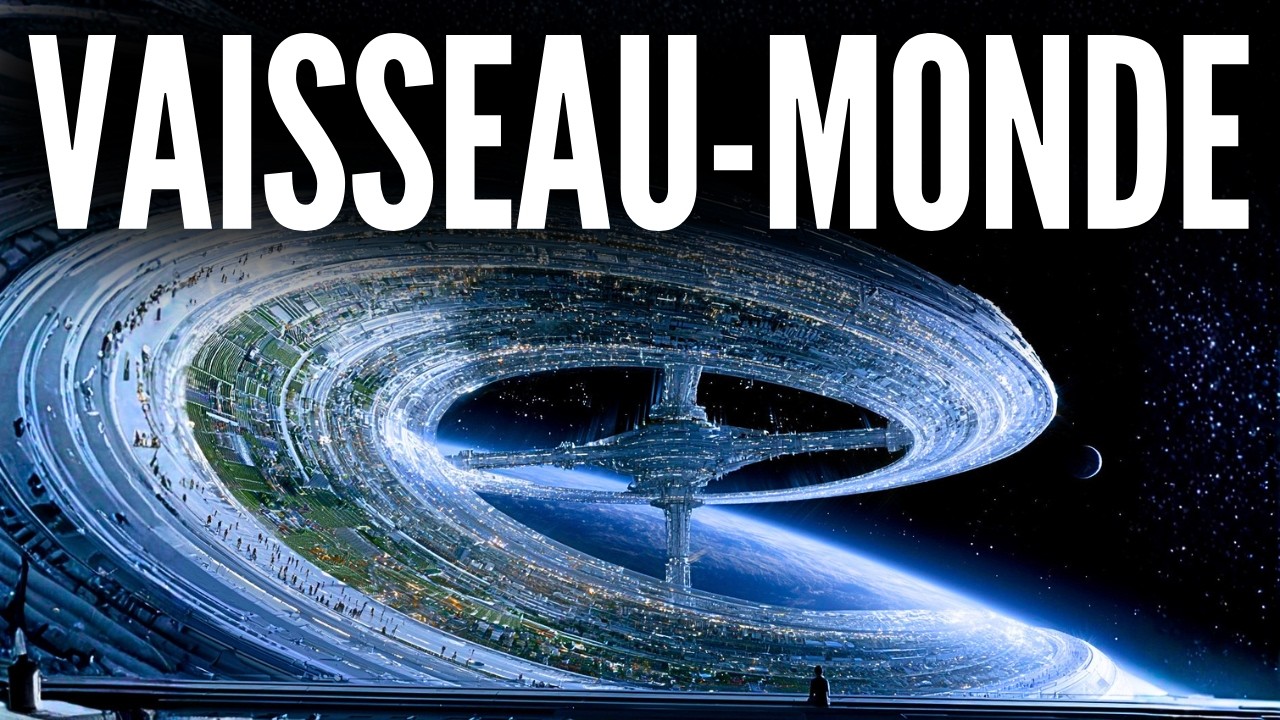
Peut-on CONSTRUIRE un VAISSEAU-MONDE ?
Keywords
artificial gravity
space habitat
rotating spacecraft
Mars colonization
human physiology
Summary
This video explores the feasibility of constructing a world-ship or space habitat with artificial gravity. It begins by highlighting the biological challenges of long-duration spaceflight, such as muscle atrophy, bone density loss, and vision impairment due to microgravity. The presenter then discusses historical and theoretical solutions, including Einstein's equivalence principle, rotating spacecraft, and O'Neill cylinders. The concept of using centrifugal force to simulate gravity is explained, along with engineering challenges like structural integrity and Coriolis effects. The video covers current experiments on the International Space Station and private station initiatives. It also addresses the role of Mars colonization in driving artificial gravity research. The presenter speculates on future technologies like magnetic tracks and warp drives, but emphasizes the difficulty of creating real gravity. Overall, the video provides a broad, accessible overview suitable for general audiences, though it lacks deep technical detail and rigorous citations.
Critical Evaluation
The video presents a coherent narrative on artificial gravity, targeting a general audience with a mix of established science and speculative ideas. The strength lies in its clear explanation of why gravity is essential for human health in space, drawing on well-known physiological effects. The use of historical concepts (Einstein, O'Neill) adds credibility, and the inclusion of current experiments (ISS, private stations) grounds the discussion in ongoing research. However, the video suffers from several weaknesses. First, it lacks specific citations for many claims; for example, the statement that 'muscles melt' without gravity is not quantified or referenced. Second, the technical depth is limited: the discussion of rotating spacecraft glosses over critical engineering constraints like material strength, rotational stability, and the Coriolis effect on human perception. The section on magnetic tracks and warp drives is highly speculative and not clearly distinguished from established physics. The video's reliance on popular science sources (e.g., Christophe Galfard's book) rather than peer-reviewed literature reduces its academic rigor. The description includes a link to a scientific article on stellar engines, but it is not discussed in the video. The comments section (not analyzed in detail) likely contains a mix of enthusiastic and critical reactions, but no specific data is available. For a university-level audience, the video serves as a useful introductory overview but lacks the depth and critical analysis required for academic work. The presenter's tone is engaging, but the absence of counterarguments or alternative perspectives (e.g., the challenges of large-scale construction in space) limits its comprehensiveness. Overall, the video is informative for laypersons but not suitable as a primary source for scientific research.
Key Moments
- Humans are not made for space: physiological challenges of microgravity.
- First solution: accelerate to create gravity via linear acceleration.
- Rotating a spacecraft to generate centrifugal artificial gravity.
- Building worlds in space: O'Neill cylinders and space habitats.
- The return of private stations: current commercial space station projects.
- Why Mars is changing everything: gravity on Mars and its implications.
- The magnetic track: speculative technology for artificial gravity.
Cited Sources
Contribution & Novelties
The video synthesizes existing knowledge on artificial gravity in an accessible format, but does not present original research or novel insights. Its main contribution is in popularizing concepts like O'Neill cylinders and rotating habitats for a French-speaking audience, linking them to current space exploration trends (Mars, private stations). However, it does not advance the scientific discourse beyond what is available in standard textbooks or popular science books.
Radar Profile
The radar profile shows moderate scores across all dimensions, with quantity and quality of information around 6-7, technical level at 5, and reliability at 6. This indicates a balanced but not deeply specialized presentation, suitable for general education but lacking the rigor expected in academic contexts.
Reliability
/10