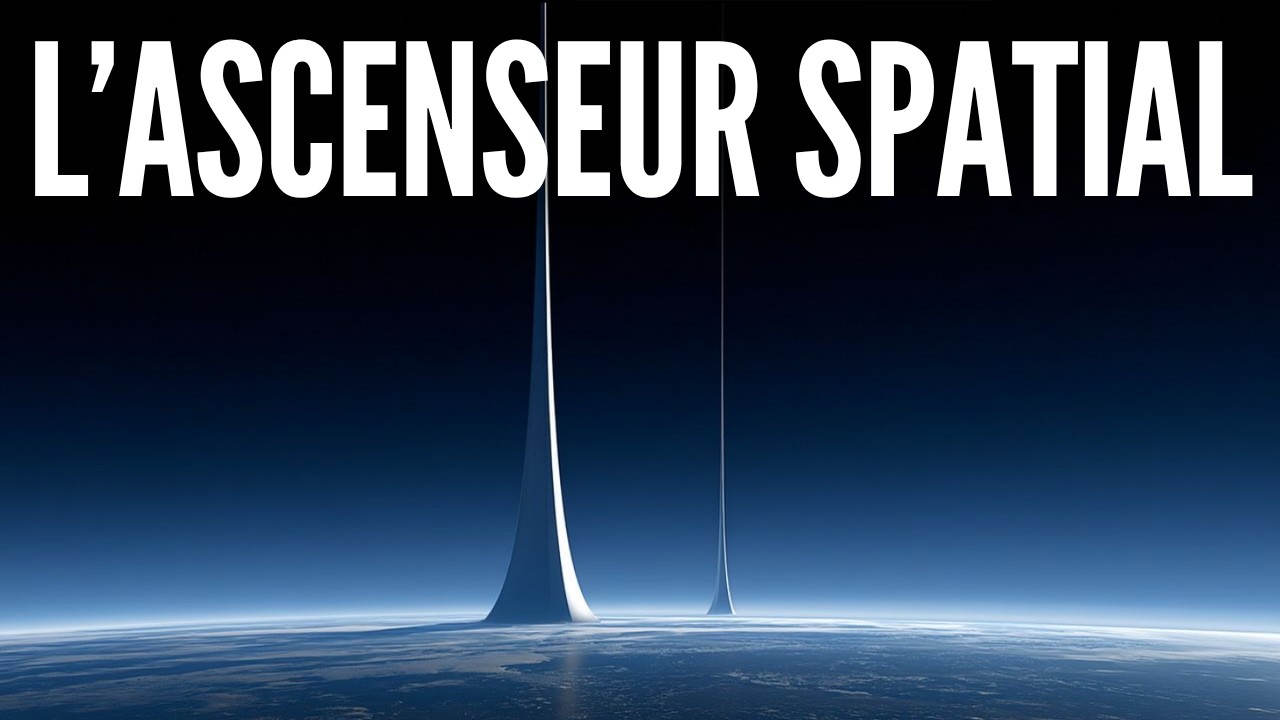
L’IA DÉCOUVRE DÉJÀ des MATÉRIAUX qui changent TOUT (ascenseur spatial compris)
Keywords
space elevator
carbon nanotubes
AI
materials discovery
space debris
Summary
This video explores the concept of a space elevator as a revolutionary alternative to rocket-based space access, emphasizing the critical role of advanced materials and artificial intelligence in making it feasible. It begins by outlining the high cost and physical limitations of current rocket technology, then introduces the space elevator principle: a tether anchored on Earth extending to geostationary orbit, with a counterweight. The video explains why traditional materials like steel are inadequate due to tensile strength requirements, and highlights carbon nanotubes as a promising candidate, though current production methods cannot yet create defect-free macroscopic fibers. It discusses challenges such as space debris collisions, radiation in the Van Allen belts, and the paradox of needing a space elevator to build a space elevator. The latter part focuses on how AI, particularly deep learning, is accelerating materials discovery by predicting properties and synthesizing new compounds, potentially leading to materials stronger than carbon nanotubes. The video concludes by suggesting the Moon as a more practical starting point for elevator construction due to lower gravity and lack of atmosphere, and posits that AI-driven materials innovation could turn the space elevator from science fiction into reality within decades.
Critical Evaluation
The video presents a comprehensive and engaging overview of the space elevator concept, effectively communicating complex engineering and materials science challenges to a broad audience. It successfully integrates recent developments in AI-driven materials discovery, which adds a timely and novel perspective. The argumentation is logically structured, moving from the problem of expensive space access to the proposed solution, then detailing material constraints and potential breakthroughs. However, the scientific rigor is somewhat limited by the lack of explicit citations for many claims; for instance, the specific tensile strength requirements for a space elevator tether are mentioned but not sourced. The video also glosses over some critical issues, such as the feasibility of manufacturing defect-free carbon nanotubes at scale and the economic viability of such a megaproject. The discussion of space debris and Van Allen belt radiation is accurate but could be deepened with quantitative risk assessments. The role of AI in materials discovery is presented optimistically, referencing the Nature article 'Scaling deep learning for materials discovery' but without discussing limitations or reproducibility concerns. The video's strength lies in its ability to synthesize information from multiple disciplines and present a coherent narrative. For a university-level audience, it serves as an excellent introductory resource that stimulates further inquiry, but it should be supplemented with primary literature for rigorous understanding. The comments section (not fully analyzed here) likely contains a mix of enthusiastic support and critical questions about engineering feasibility, which the video partially addresses. Overall, the video is a valuable piece of science communication that balances accessibility with technical depth, earning a high score for its educational value.
Key Moments
- Introduction: Why space is still expensive and the promise of a space elevator.
- What if we built a space elevator? Basic concept introduced.
- The invisible wall of materials: why current materials fail.
- True principle of the space elevator: tether and counterweight.
- A 140,000-kilometer structure: scale and challenges.
- Carbon nanotubes: the miracle material? Properties and limitations.
- Space debris: worst-case scenario and mitigation.
- Danger of Van Allen belts: radiation risks.
- The Moon: best place to start building an elevator.
- AI enters the game: deep learning for materials discovery.
Cited Sources
Contribution & Novelties
The video's original contribution lies in its synthesis of space elevator engineering challenges with recent advances in AI-driven materials discovery. While the space elevator concept is decades old, the video contextualizes it within the current AI revolution, arguing that machine learning can accelerate the identification of novel materials with the necessary tensile strength and lightness. It also proposes the Moon as a more feasible initial construction site, a less common perspective. The integration of these elements provides a fresh, forward-looking narrative that bridges materials science, space engineering, and artificial intelligence.
Radar Profile
The radar profile shows high scores in quantity of information (8) and quality (7), reflecting the video's comprehensive coverage and clear explanations. The technical level (6) is moderate, suitable for a general audience with some scientific background. The overall reliability (7) is good but limited by a lack of detailed citations. This suggests the video is an effective educational tool but should be complemented with primary sources for deeper understanding.
Reliability
/10