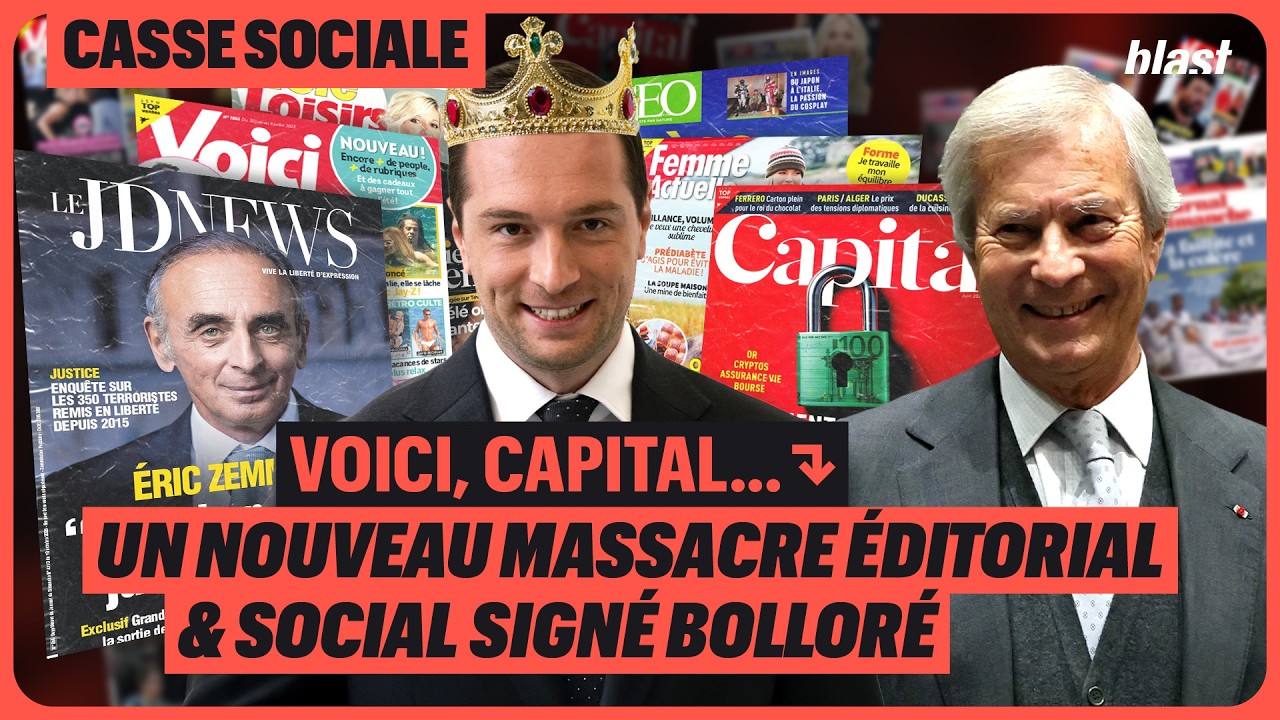
VOICI, CAPITAL ETC : UN NOUVEAU MASSACRE ÉDITORIAL ET SOCIAL SIGNÉ BOLLORÉ
Keywords
Bolloré
Prisma Media
media independence
social dumping
far-right influence
Summary
This video from Blast, a French independent media outlet, investigates the social and editorial consequences of Vincent Bolloré's acquisition of Prisma Media, France's largest magazine publisher. It argues that Bolloré's strategy involves systematic layoffs, restructuring, and editorial alignment to promote far-right ideas, using Prisma as a new piece in his media empire alongside CNews, Europe 1, and Le Journal du Dimanche. The journalist, Hamza Chennaf, presents testimonies from employees and examples of deteriorating working conditions, linking these to broader political influence ahead of the 2027 presidential election. The video critiques the concentration of media ownership and its impact on democratic debate. While it provides a coherent narrative, it lacks direct citations of sources and relies on general allegations. The production values are high, with clear visuals and editing. The video is primarily aimed at a French audience concerned with media independence and social justice.
Critical Evaluation
The video presents a compelling critique of media consolidation under Vincent Bolloré, focusing on Prisma Media. Its strength lies in the clear articulation of a narrative linking corporate restructuring to political influence. The journalist uses specific examples, such as layoffs and editorial changes, to support the claim of a deliberate strategy. However, the video lacks rigorous sourcing: it does not cite specific documents, financial reports, or independent studies. The claims about 'far-right influence' are asserted without concrete evidence of editorial bias in Prisma's publications. The video relies heavily on employee testimonies, which are valuable but not independently verified. From a scientific perspective, the argumentation is more persuasive than empirical. The video does not engage with counterarguments or alternative explanations, such as market pressures or digital transformation. The absence of expert interviews (e.g., media economists or political scientists) weakens its analytical depth. The comments section (not fully analyzed due to limited access) likely reflects polarized views, with supporters praising the critique and detractors dismissing it as partisan. For a university audience, the video serves as a useful case study in media ownership debates but falls short of academic standards due to lack of verifiable data. The emotional tone and use of terms like 'massacre' indicate a partisan stance, which may reduce credibility for neutral observers. The video's value lies in raising awareness and prompting further investigation, but it does not provide a balanced or comprehensive analysis. The production quality is high, with effective use of graphics and pacing. Overall, it is a well-crafted piece of advocacy journalism rather than a scholarly work.
Key Moments
- Introduction: Blast presents itself as independent media, sets up the topic of Bolloré's media strategy.
- Overview of Bolloré's media acquisitions: CNews, Europe 1, Le Journal du Dimanche, and Prisma Media.
- Employee testimonies about deteriorating working conditions at Prisma Media after acquisition.
- Discussion of editorial changes: alleged pressure to align content with conservative views.
- Link to 2027 presidential election: Prisma Media as a tool for political influence.
- Conclusion: call for media independence and social responsibility.
Cited Sources
Contribution & Novelties
The video provides a focused case study on Prisma Media, which is less discussed than Bolloré's other outlets. It synthesizes employee accounts and public information to argue that Prisma is being used for political influence. However, it does not present new data or original research beyond journalistic investigation.
Radar Profile
The radar shows moderate scores across all dimensions, with quantity of information slightly higher than quality and reliability. This indicates a video that presents a coherent narrative but lacks rigorous sourcing and technical depth, typical of advocacy journalism.
Reliability
/10