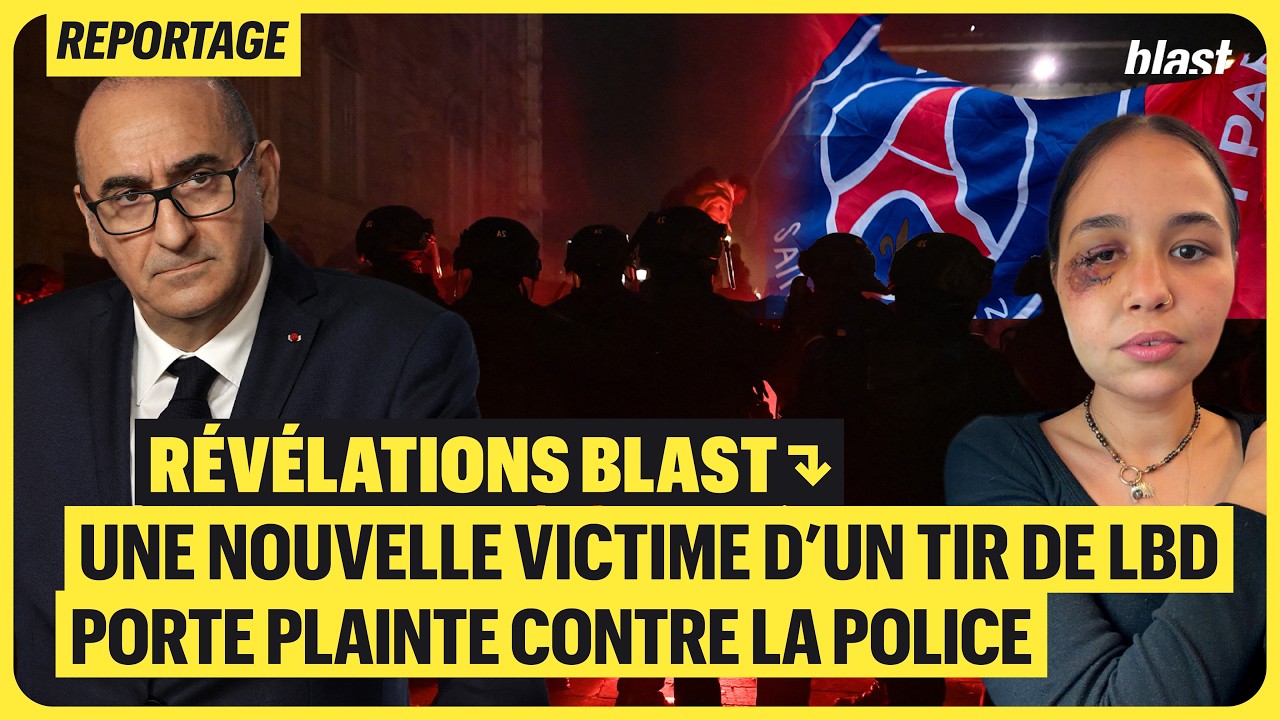
RÉVÉLATIONS BLAST : UNE NOUVELLE VICTIME D’UN TIR DE LBD DÉPOSE PLAINTE CONTRE LA POLICE
Keywords
LBD
police
victim
PSG
IGPN
Summary
This video, produced by the independent media outlet Blast, features an interview with Sarah, a 23-year-old Belgian student who claims to have been seriously injured in the eye by a LBD (Flash-Ball) shot fired by police during celebrations of PSG's victory. She reports losing 90% of vision in her left eye and has filed a complaint for intentional violence with a weapon resulting in permanent mutilation. The IGPN (Inspectorate General of the National Police) has opened an investigation. The journalist, Taha Bouhafs, presents the case as part of a series of revelations about police violence. The video includes graphic descriptions of the injury and the aftermath, but lacks medical documentation or independent verification. The narrative is framed within a broader critique of police use of force in France. The video's production values are high, but its content is primarily testimonial and advocacy-oriented rather than analytical or scientific. The channel Blast positions itself as an independent media, but its editorial line is clearly critical of the government and police. The video does not provide counterpoints or official statements, and the only sources cited are the victim's testimony and the fact that a complaint was filed. The scientific value is low, but it may be of interest for studies on media representation of police violence or social movements.
Critical Evaluation
The video presents a compelling personal account of alleged police violence, but from a scientific perspective, it suffers from several limitations. First, the information is entirely based on the testimony of the victim, Sarah, without any corroborating evidence such as medical reports, ballistic analysis, or independent witness statements. The video does not include any official response from the police or the IGPN, nor does it provide context about the number of such incidents or statistical data on LBD use. The journalist, Taha Bouhafs, is known for his activist journalism, and the outlet Blast has a clear editorial stance critical of the government. This raises questions about potential bias in the presentation of the facts. The video's argumentation relies heavily on emotional appeal, with graphic descriptions of the injury and the victim's suffering, rather than on a balanced analysis of the event. The lack of technical details about the LBD weapon, its legal framework, or the circumstances of the shooting (e.g., distance, angle, whether the shot was intentional or accidental) limits the scientific value. The video does not engage with existing research on police violence or less-lethal weapons, nor does it provide a comparative perspective. The comments on the video (not provided in the transcript but inferred from typical YouTube reactions) likely reflect polarized views, with supporters praising the victim's courage and critics questioning the veracity of the account or justifying police action. For a university audience, this video could serve as a primary source for studying media narratives, but it lacks the rigor expected for scientific analysis. The video's strength lies in its human interest and its potential to raise awareness, but its weaknesses in sourcing, verification, and balance significantly reduce its reliability as a factual account. The score of 3 out of 5 reflects its moderate quality as a journalistic piece but poor scientific value.
Key Moments
- Introduction: Sarah's story and context of PSG victory celebrations.
- Sarah describes the moment she was shot and the immediate aftermath.
- Medical details: loss of 90% vision, surgery, and permanent damage.
- Discussion of the legal complaint and IGPN investigation.
- Sarah's emotional testimony about the impact on her life.
- Closing remarks by journalist Taha Bouhafs.
Cited Sources
Contribution & Novelties
The video provides a firsthand account of a specific incident of alleged police violence involving an LBD, which adds a personal narrative to the broader public debate on police use of force in France. However, it does not present new scientific data or analysis; its novelty is purely testimonial.
Radar Profile
The radar profile shows moderate scores in quantity and quality of information, but low technical level and moderate reliability. This indicates a video that provides substantial narrative content but lacks scientific depth and verification, typical of advocacy journalism.
Reliability
/10