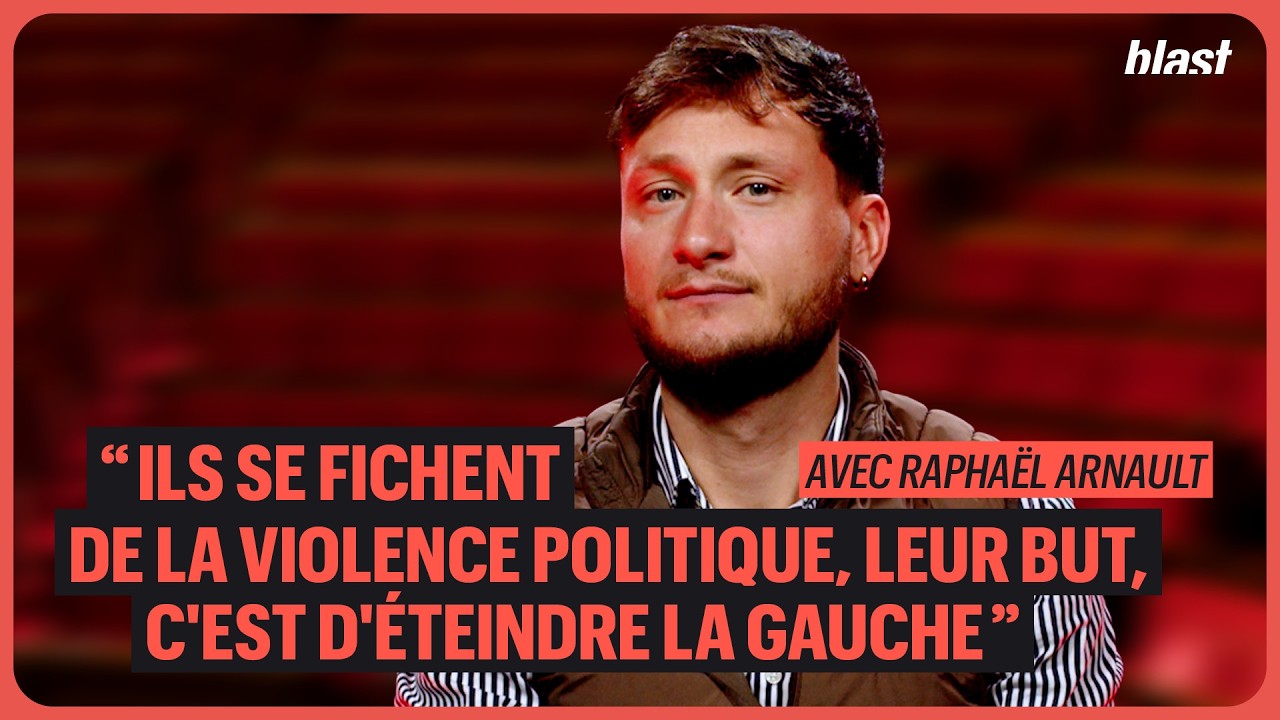
RAPHAËL ARNAULT : "ILS SE FICHENT DE LA VIOLENCE POLITIQUE, LEUR BUT, C’EST D’ÉTEINDRE LA GAUCHE"
Keywords
Raphaël Arnault
Blast
antifascism
political violence
media bias
Summary
This video features an exclusive interview with Raphaël Arnault, a French deputy and co-founder of the Jeune Garde, conducted by journalist Soumaya Benaissa. Arnault discusses a recent fatal altercation in Lyon involving a neo-fascist militant, Quentin Deranque, and the subsequent political and media backlash. He argues that the incident has been instrumentalized by the executive and far-right to attack the left and antifascist movements, accusing them of political violence while ignoring the rise of fascism. Arnault claims there is a coordinated effort to silence leftist voices and invert reality, with the media complicit in this narrative. The interview covers the history of fascism in France, the inaction of public authorities, and the need for antifascist resistance. The video is presented as an exclusive exposé, but it lacks balanced perspectives and relies heavily on Arnault's personal account, making it a partisan opinion piece rather than an objective analysis.
Critical Evaluation
The video is a one-hour interview with Raphaël Arnault, a political figure with a clear leftist and antifascist agenda. The content is highly partisan, presenting a narrative that blames the government, media, and far-right for orchestrating a campaign against the left. The argumentation is emotionally charged and lacks rigorous evidence. Arnault makes several claims about media manipulation and political conspiracies but provides no verifiable sources or data to support them. The interview format allows for uninterrupted monologue, with the journalist asking only supportive questions, which undermines critical scrutiny. The video's description and title frame the content as an exposé, but it functions more as a political rallying cry. The production quality is professional, but the substance is weak from a scientific perspective. The video does not engage with counterarguments or acknowledge the complexity of the events. It relies on anecdotal evidence and personal interpretation. The comments section (not fully analyzed but inferred from typical YouTube patterns) likely contains polarized reactions, with supporters praising the interview and critics dismissing it as propaganda. For a university-level audience, this video has limited value as a source of objective information. It could be used as a case study in media bias or political communication, but not as a reliable reference for facts. The lack of citations, absence of opposing viewpoints, and strong ideological framing significantly reduce its credibility. The video's main contribution is to illustrate how political actors use media platforms to advance their narratives, but it does not provide new empirical insights or balanced analysis.
Key Moments
- Introduction and context of the interview
- Arnault describes the Lyon incident and the death of Quentin Deranque
- Discussion on media and political instrumentalization
- Arnault accuses the executive of collaborating with far-right
- Historical context of fascism in France
- Call for antifascist resistance and conclusion
Cited Sources
Contribution & Novelties
The video offers a first-person account from a prominent leftist activist regarding a specific incident of political violence in France. However, it does not present new empirical data or original research. Its novelty lies in the personal perspective and the framing of the event as part of a broader political conspiracy, but this is not substantiated by evidence. The video adds to the discourse on media bias and political polarization but lacks scientific rigor.
Radar Profile
The radar profile shows low scores in quality, technical level, and reliability, indicating a highly biased and non-rigorous source. The quantity of information is moderate, but the lack of balance and evidence undermines its overall value. The video is more persuasive than informative.
Reliability
/10