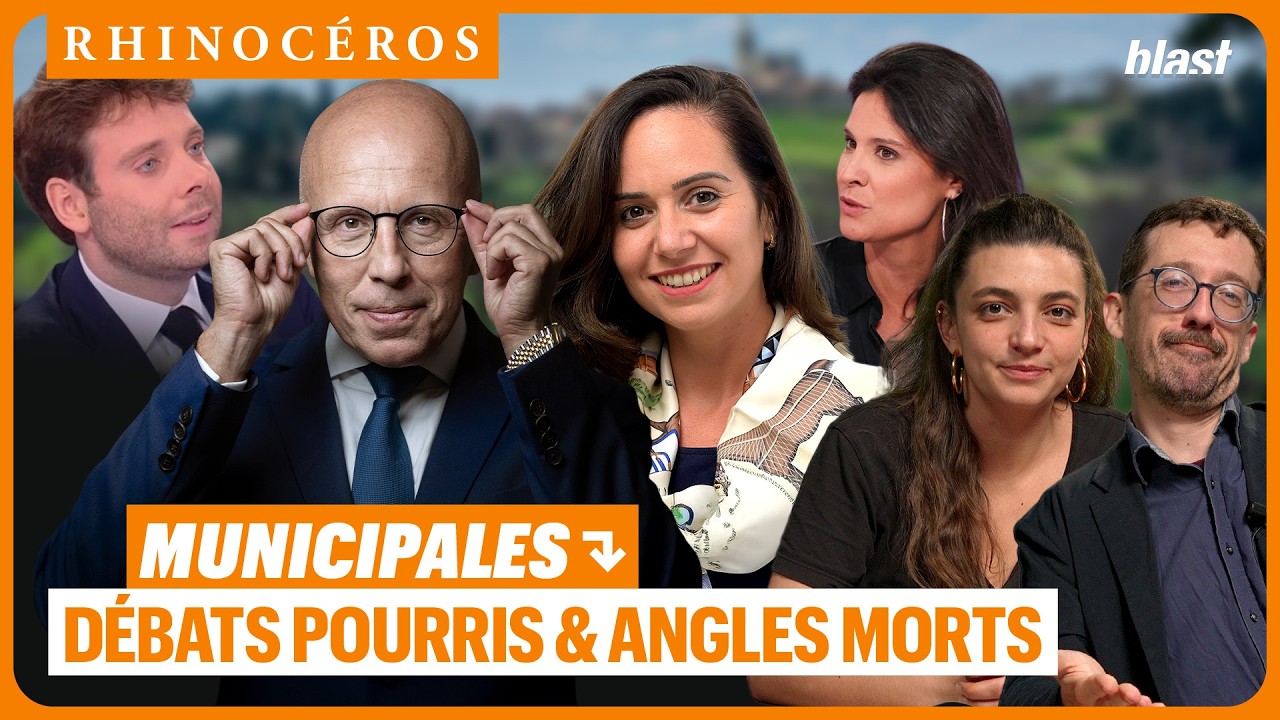
🦏 MUNICIPALES : DÉBATS POURRIS ET ANGLES MORTS
Keywords
municipal elections
media bias
local politics
France
political commentary
Summary
This video from the Blast media channel, part of the Rhinocéros series hosted by Usul and Lumi, critiques the national media's coverage of French municipal elections. The hosts argue that local elections are complex and often neglected by major outlets, which prefer to focus on national political narratives. They discuss how the media tends to oversimplify local issues, emphasizing partisan conflicts rather than substantive policy debates. The video highlights the limited powers of municipal governments and the diversity of local contexts, suggesting that voters often prioritize practical concerns over party labels. The hosts also point out the media's tendency to create artificial drama and ignore important local topics. The analysis is presented in a conversational style, with some references to specific cities and examples. The video does not cite specific sources but relies on the hosts' observations and general knowledge. It is intended for a general audience interested in media criticism and French politics.
Critical Evaluation
The video offers a thoughtful critique of media coverage of French municipal elections, but its value is limited by a lack of empirical evidence and reliance on anecdotal observations. The hosts, Usul and Lumi, present a coherent argument that national media often neglects local elections due to their complexity and lack of national drama. They correctly note that municipal governments have limited powers, focusing on local services like housing and transport, and that voters may not prioritize party affiliation. However, the analysis lacks depth: it does not provide specific examples of biased coverage or data on media framing. The video is essentially an opinion piece, not a rigorous study. The hosts do not cite any sources, which undermines the credibility of their claims. The production quality is high, with clear editing and graphics, but the content remains superficial. The video's strength lies in raising awareness about media blind spots, but it does not offer solutions or new insights. The comments section (not fully analyzed) likely reflects polarized views, with supporters praising the critique and detractors dismissing it as partisan. For a university audience, the video could serve as a starting point for discussion on media bias, but it lacks the scholarly rigor expected in academic contexts. The hosts' tone is informal and engaging, which may appeal to a general audience but detracts from its scientific value. Overall, the video is a decent piece of media criticism but falls short of academic standards.
Key Moments
- Introduction: hosts note they haven't discussed municipal elections before.
- Discussion on complexity of local elections and media's difficulty covering them.
- Explanation of limited powers of municipal governments.
- Critique of media focusing on partisan conflicts rather than local issues.
- Examples of media ignoring important local topics.
- Conclusion: call for better media coverage of local elections.
Cited Sources
Contribution & Novelties
The video provides a critical perspective on media coverage of French municipal elections, highlighting the gap between national media narratives and local realities. While not novel in academic terms, it synthesizes common criticisms in an accessible format.
Radar Profile
The radar profile shows moderate scores across all dimensions, indicating a balanced but unremarkable analysis. The video is strongest in quality of information and weakest in technical level, reflecting its opinion-based nature.
Reliability
/10