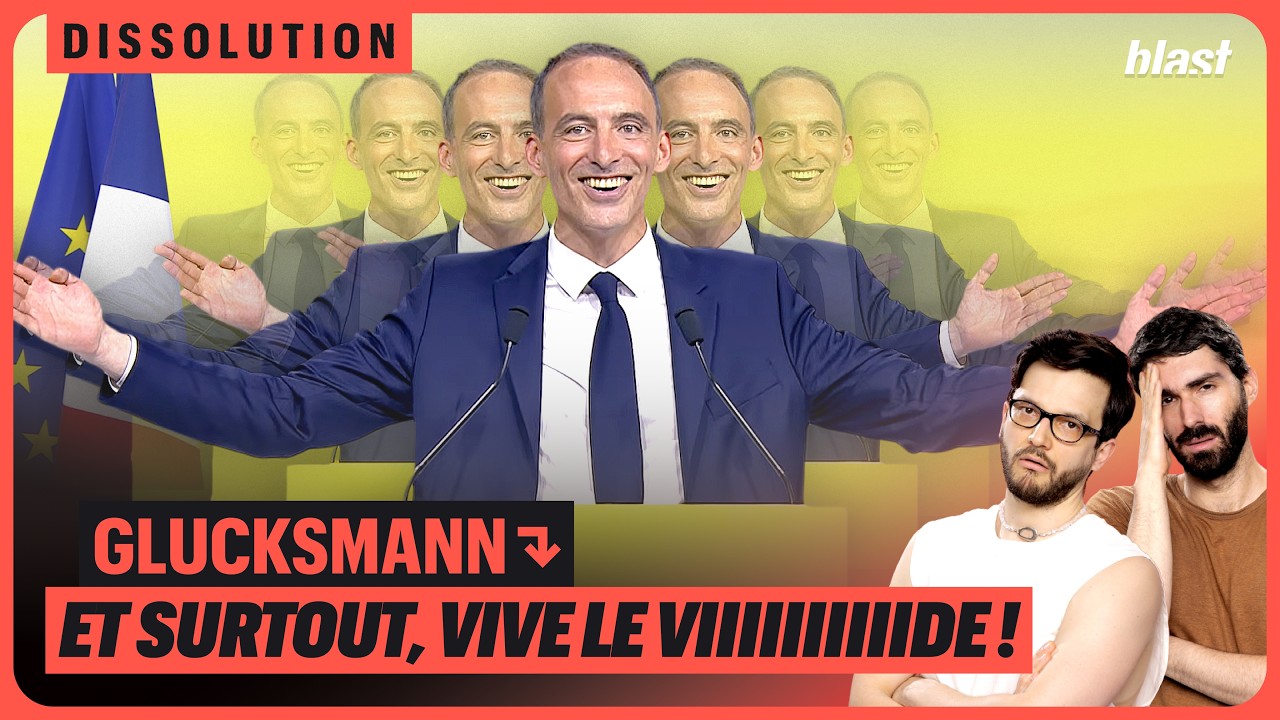
GLUCKSMANN : ET SURTOUT, VIVE LE VIIIIIIIIIIDE !
Keywords
Glucksmann
meeting
Aubervilliers
nationalization
ArcelorMittal
Summary
This video from Blast, a French independent media outlet, critiques Raphaël Glucksmann's unofficial presidential campaign launch at the Docks d'Aubervilliers. The hosts, Camille Chastrusse-Sultra and Victor-Ulysse Sultra-Chastrusse, argue that Glucksmann's speech was ideologically empty and politically vain, accusing him of adopting violent and degrading postures for media attention. The first segment, 'Zoom présidentielle', dissects the event, claiming it lacked substantive policy proposals and was merely a performative display. The second segment, 'Les écuries d’Augias', discusses the potential nationalization of ArcelorMittal, framing it as a necessary step to reclaim industrial sovereignty. The video is heavily opinionated, with no empirical evidence or balanced perspectives. It serves as a polemical commentary rather than an objective analysis. The production quality is high, but the content is partisan and lacks academic rigor. The video targets a politically engaged audience and does not provide new insights beyond standard left-wing critiques of centrist candidates.
Critical Evaluation
The video presents a scathing critique of Raphaël Glucksmann's campaign launch, but its value for academic purposes is limited. The argumentation is primarily rhetorical, relying on ad hominem attacks and sweeping generalizations rather than empirical evidence. For instance, the claim that Glucksmann's speech was 'empty' and 'vain' is not supported by specific examples or transcript excerpts; instead, the hosts rely on subjective interpretation. The segment on ArcelorMittal touches on a relevant policy issue—nationalization—but does not provide a rigorous economic or legal analysis. No sources are cited for the claims about the company's operations or the feasibility of nationalization. The video's tone is confrontational, using terms like 'néant programmatique' and 'postures violentes', which undermines its credibility as an objective analysis. From a scientific standpoint, the video lacks methodological transparency: there is no disclosure of how the hosts selected their evidence, nor any acknowledgment of counterarguments. The comments section (not analyzed due to lack of access) likely reflects polarized reactions, but the video itself does not engage with opposing views. For a university audience, this video might serve as a primary source for studying media bias or political communication, but it cannot be relied upon for factual information. The production values are high, with clear editing and graphics, but the content is more akin to a political editorial than a scholarly work. The hosts' credentials (one is a doctoral student in public law) suggest some expertise, but the video does not leverage this in a rigorous manner. Overall, the video is interesting for understanding partisan discourse in French politics but fails to meet academic standards of objectivity and evidence-based analysis.
Key Moments
Cited Sources
Contribution & Novelties
The video offers no original research or new data. Its contribution is limited to a partisan commentary on a current political event, which may be of interest to those studying media framing or political rhetoric. However, it does not advance the state of knowledge in any academic field.
Radar Profile
The radar profile shows very low scores across all dimensions (quantity, quality, technical level, reliability), indicating that this video is not suitable for academic reference. It is a highly opinionated piece with minimal factual content and no scientific rigor.
Reliability
/10