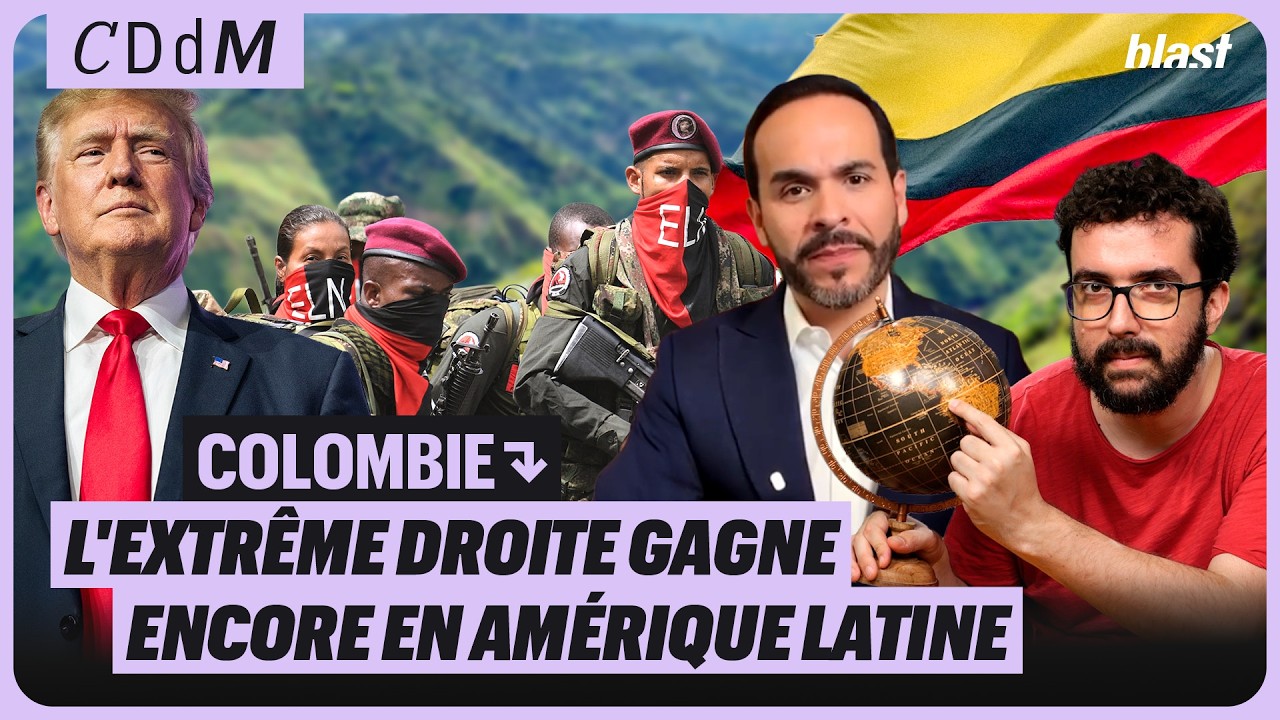
COLOMBIE : L'EXTRÊME DROITE GAGNE ENCORE EN AMÉRIQUE LATINE
Keywords
Colombia
presidential election
far-right
Abelardo de La Espriella
Latin America
Summary
This video from BLAST, a French independent media, analyzes the recent presidential election in Colombia, where far-right candidate Abelardo de La Espriella won with 49.66% of the vote. The commentator, Ostpolitik, frames this victory as part of a broader trend of far-right gains in South America since 2018, citing examples from Brazil, El Salvador, Chile, and Peru. The video discusses the political context in Colombia, the reactions from opposition groups, and briefly touches on the country's international relations. However, the analysis is heavily opinionated and lacks rigorous sourcing, with no references to academic studies or official data. The video also includes a speculative segment about a football match, which undermines its credibility. The production quality is professional, but the content is more suitable for a general audience than for academic purposes.
Critical Evaluation
The video presents a clear narrative: the rise of far-right politics in Latin America, with Colombia as the latest example. The commentator, Ostpolitik, uses a conversational tone and references several countries to support the claim of a 'brown wave' (vague brune). However, the analysis suffers from several weaknesses. First, it lacks empirical rigor. No specific sources are cited for the election results or the characterization of candidates as 'far-right.' The video mentions Bukele, Kast, and Fujimori but does not provide evidence for their ideological classification. Second, the argumentation is one-sided, with no acknowledgment of counterarguments or nuances, such as the diversity of right-wing politics in the region. Third, the inclusion of a football match prediction (Colombia vs. Portugal) is irrelevant and detracts from the seriousness of the topic. Fourth, the video does not engage with academic literature or expert opinions, relying instead on the commentator's own perspective. The production values are high, with clear graphics and editing, but the content is more akin to a political opinion piece than a factual report. For a university-level audience, this video would be of limited value due to its lack of objectivity and scholarly grounding. The comments on the video (not provided) would likely reflect polarized views, but without access, we cannot analyze them. Overall, the video is useful as an example of media framing but not as a reliable source of information.
Key Moments
- Introduction: far-right victories in South America since 2018.
- Mention of Bukele, Kast, and Fujimori as examples.
- Colombian election results: Abelardo de La Espriella wins with 49.66%.
- Reactions from Colombian opposition.
- Analysis of reasons for far-right victory.
- Speculation about Colombia vs. Portugal football match.
Cited Sources
Contribution & Novelties
The video does not provide original research or new insights. It summarizes recent political events in Colombia and Latin America from a specific ideological perspective. Its novelty lies in its framing of the Colombian election as part of a regional trend, but this is a common narrative in political commentary.
Radar Profile
The radar profile shows low scores across all dimensions, reflecting the video's lack of technical depth, poor sourcing, and limited information quality. It is more of a commentary piece than an informative or educational resource.
Reliability
/10