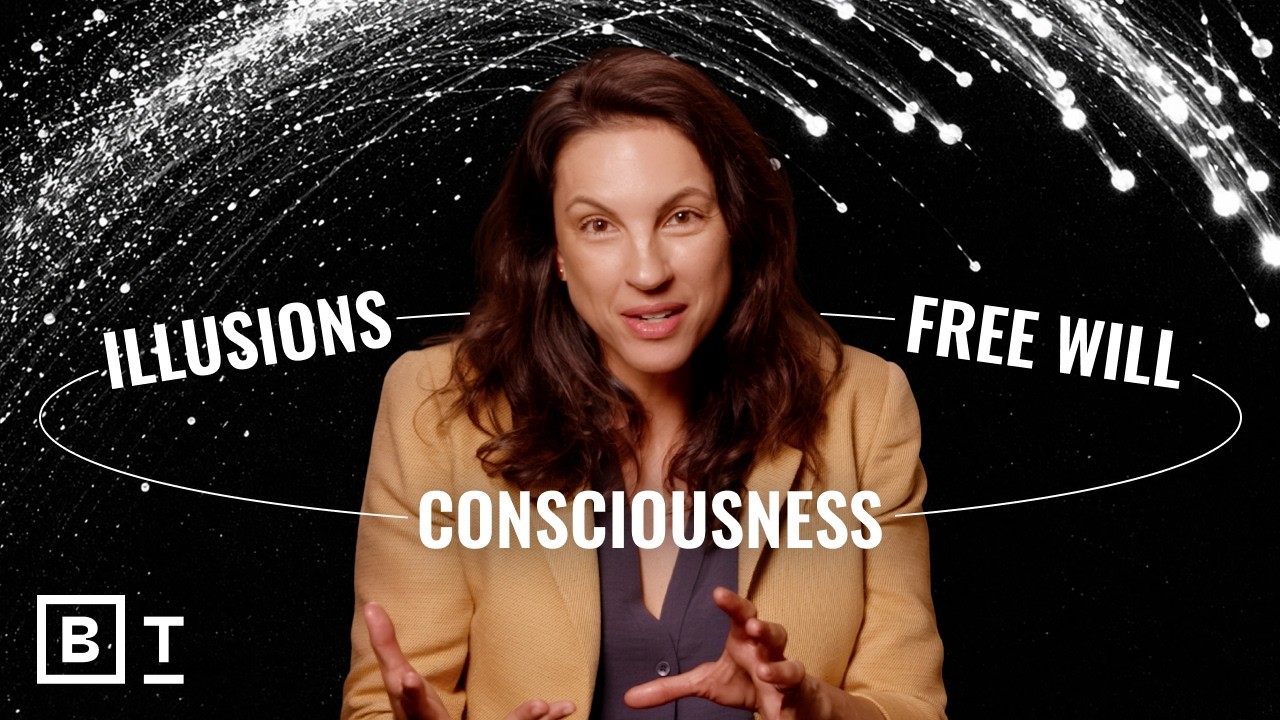
Science’s difficult journey to try to understand consciousness
Keywords
consciousness
hard problem
intuition
self
free will
Summary
Annaka Harris discusses the scientific challenges in understanding consciousness, emphasizing the distinction between consciousness and thought. She explores the hard problem of consciousness, questioning why and how physical processes give rise to subjective experience. Harris argues that intuitions often mislead us, particularly the assumption that consciousness requires complex brains or is necessary for behavior. She considers the possibility that consciousness might be fundamental to reality, akin to space or time. The interview delves into the illusion of self and free will, suggesting that recognizing these illusions can be beneficial. Harris advocates for a more open-minded scientific approach, challenging deeply held assumptions to advance our understanding of consciousness.
Critical Evaluation
The interview provides a thoughtful and accessible overview of key issues in consciousness studies, suitable for a general academic audience. Annaka Harris effectively communicates complex ideas, such as the hard problem and the role of intuition, without oversimplifying. Her arguments are logically structured and grounded in philosophical and neuroscientific discourse. However, the video lacks empirical data or references to specific studies, relying instead on conceptual analysis and thought experiments. This limits its scientific rigor; it is more of a philosophical exploration than a scientific review. Harris's perspective aligns with panpsychism and the idea that consciousness may be fundamental, which is a minority view in neuroscience. The interview does not address counterarguments in depth, such as materialist or functionalist theories. The comments section (not analyzed in detail) likely contains diverse opinions, but the video itself does not engage with criticism. For a university-level audience, the video serves as a good introduction but should be supplemented with primary literature. The production quality is high, and the pacing allows for reflection. Overall, it is a valuable contribution to public understanding of consciousness, but its speculative nature warrants caution.
Key Moments
- Introduction and definition of consciousness
- Explanation of the hard problem of consciousness
- Discussion on whether consciousness could be fundamental
- Definition and role of intuitions
- How to challenge intuitions about consciousness
- What might be revealed if we are wrong about consciousness
- The illusion of self
- Brain processes creating the illusion of self
- Challenging the illusion of free will
Cited Sources
Contribution & Novelties
The video synthesizes existing philosophical and neuroscientific perspectives on consciousness, particularly emphasizing the role of intuition in shaping scientific assumptions. Harris's accessible presentation of the hard problem and the illusion of self offers a clear entry point for those unfamiliar with the topic, but does not present novel research or data.
Radar Profile
The radar profile shows high scores in quality of information and technical level, reflecting the depth of conceptual discussion. However, the quantity of information is moderate due to the interview format, and reliability is slightly lower due to the lack of empirical support. Overall, the video is strong in philosophical analysis but weaker in scientific rigor.
Reliability
/10