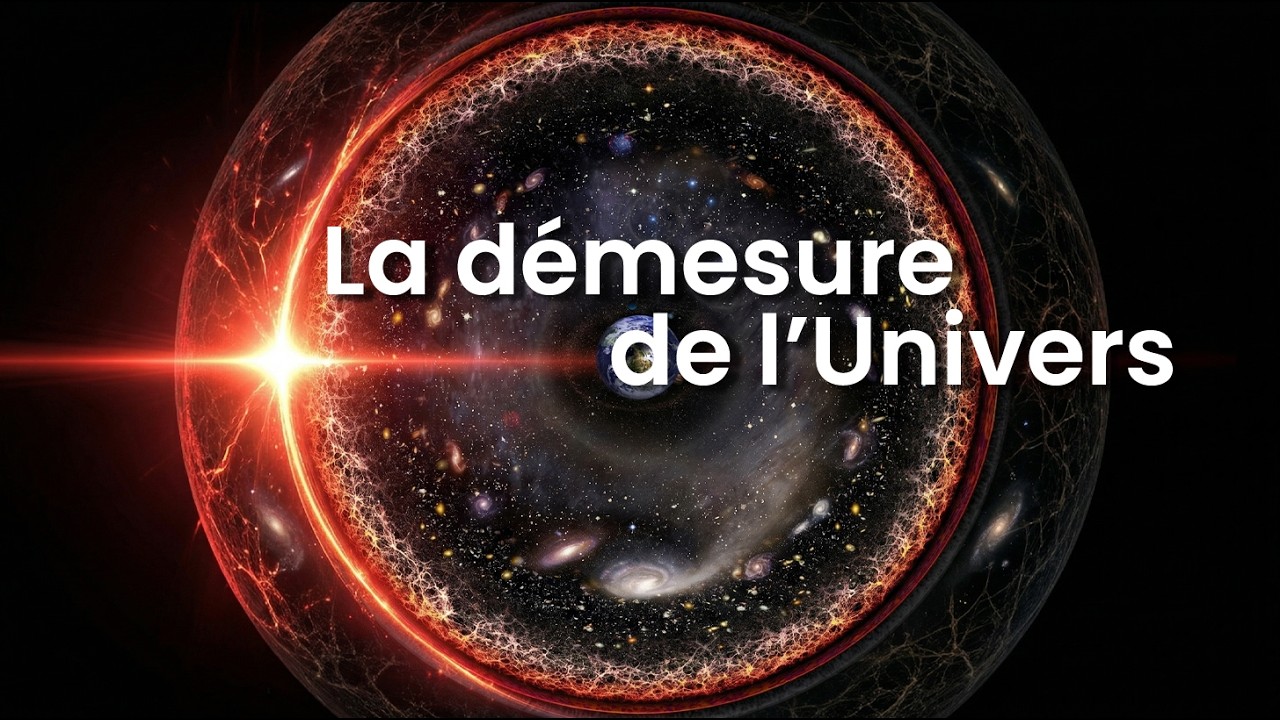
La taille démentielle de l’Univers va vous retourner le cerveau
Keywords
universe
scale
distance
galaxy
observable universe
Summary
This video by Balade Mentale offers a visually compelling journey through the scales of the universe, from Earth-Moon distance to the observable universe. It systematically presents orders of magnitude, using analogies and comparisons to convey the vastness of space. The narrative covers key astronomical distances, sizes of stars, the Voyager probe, the solar system, the Milky Way, and the cosmic web. The video relies on established data from NASA, ESA, and educational platforms, and includes a sponsored segment for Opera browser. While informative and engaging for a general audience, it lacks in-depth mathematical derivations or recent research findings. The presentation is accessible, with clear visuals and chapter markers, making it suitable for introductory cosmology education.
Critical Evaluation
The video effectively communicates the immense scales of the universe through a structured, visual narrative. It begins with familiar distances (Earth-Moon, Earth-Sun) and progressively expands to stellar sizes, the solar system, the Milky Way, and the observable universe. The use of analogies, such as comparing the solar system to a grain of sand, helps viewers grasp abstract concepts. The video cites sources like Khan Academy, Wikipedia, and NASA, lending credibility. However, it does not reference specific peer-reviewed papers or recent measurements (e.g., from Planck or Hubble). The sponsored segment for Opera browser, while clearly marked, may be seen as a distraction. The technical level is moderate; concepts like light dilution and cosmic distances are explained qualitatively without equations. The video's strength lies in its ability to inspire awe and curiosity, but it lacks critical analysis of uncertainties or controversies in cosmology (e.g., the Hubble tension). The comments section (not fully analyzed due to lack of data) likely contains a mix of appreciation and questions about the content. For a university audience, the video serves as a good introductory overview but would need supplementation with primary sources and quantitative exercises. The production quality is high, with engaging visuals and clear narration. Overall, it is a valuable educational tool for non-specialists, but its scientific depth is limited.
Key Moments
Cited Sources
Contribution & Novelties
The video synthesizes well-known astronomical scales into a cohesive, visually engaging narrative. While it does not present new research, its contribution lies in the pedagogical approach: using relatable analogies and a progressive zoom-out structure to make cosmic distances intuitive. It updates classic comparisons with modern data (e.g., Voyager's current distance) and includes interactive tools like the Scale of the Universe app. For a general audience, it effectively bridges the gap between textbook numbers and experiential understanding.
Radar Profile
The radar profile shows high scores in quantity of information and technical level, reflecting the video's comprehensive coverage of cosmic scales. Quality and reliability are moderate due to reliance on secondary sources and lack of peer-reviewed references. The overall shape indicates a solid educational resource with room for deeper scientific rigor.
Reliability
/10