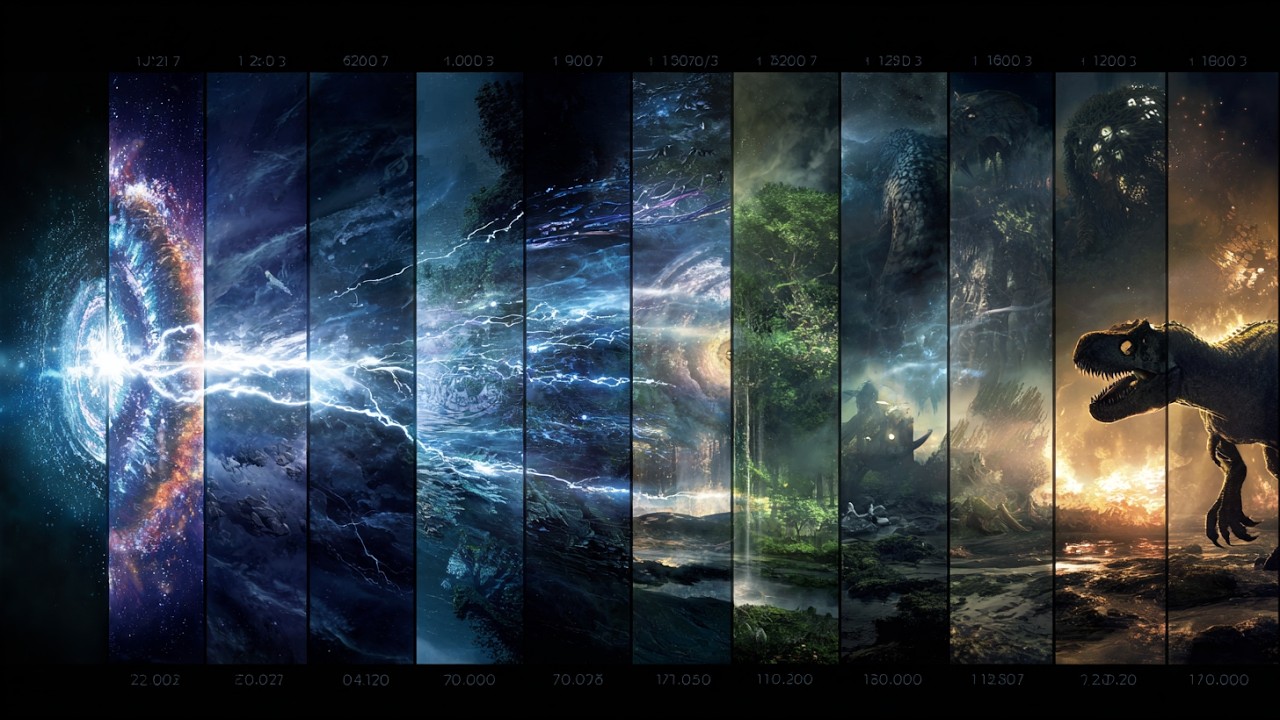
La folle histoire de l’Univers en 365 jours
Keywords
cosmic calendar
universe history
evolution of life
geological time
astronomy documentary
Summary
This documentary presents the entire history of the universe compressed into a single year, starting with the Big Bang on January 1st and ending with the present on December 31st at midnight. It covers major events such as the formation of galaxies, the solar system, Earth, the emergence of life, the evolution of complex organisms, the rise and fall of dinosaurs, and the appearance of humans. The narrative uses the cosmic calendar as a pedagogical tool to illustrate the vast timescales involved. Key milestones include the formation of the Milky Way, the development of photosynthesis, the Cambrian explosion, and the relatively recent emergence of Homo sapiens. The video also speculates on future events, including the eventual death of the Sun and the end of life on Earth. The content is presented in an engaging, accessible manner suitable for a general audience, with visual aids and a clear chronological structure.
Critical Evaluation
The video 'La folle histoire de l’Univers en 365 jours' by Balade Mentale is an ambitious and visually engaging documentary that condenses 13.8 billion years of cosmic and biological history into a 54-minute narrative. The use of the cosmic calendar, popularized by Carl Sagan, is an effective pedagogical tool that helps viewers grasp the immense timescales involved. The content is generally accurate and follows the current scientific consensus on major events such as the Big Bang, stellar nucleosynthesis, planet formation, the origin of life, and evolution. However, the video lacks explicit citations or references to specific scientific studies, which limits its utility for academic purposes. The narrative is linear and deterministic, which may oversimplify complex processes and uncertainties in scientific understanding. For instance, the origin of life is presented as a straightforward progression from simple molecules to cells, while in reality, the exact mechanisms remain debated. The video also makes some speculative leaps, particularly in the final sections about the future of the universe and the possibility of life elsewhere, without clearly distinguishing between established science and hypothesis. The production quality is high, with excellent visuals and a compelling soundtrack, but the technical depth is moderate, making it more suitable for a general audience than for specialists. The comments on YouTube are generally positive, with many viewers praising the clarity and educational value, though some note the lack of depth in certain areas. Overall, the video is a valuable resource for science communication but should be supplemented with more rigorous sources for academic study. The absence of a bibliography or references to primary literature is a significant drawback for a university-level audience.
Key Moments
- Introduction to the cosmic calendar concept.
- January: Darkness and the first stars.
- Formation of the solar system.
- Emergence of life on Earth.
- The Cambrian explosion.
- Dinosaurs and mammals.
- Homo sapiens and the conquest of the world.
- Predicting the future of the universe.
- The death of the Sun and end of life on Earth.
Cited Sources
Contribution & Novelties
The video does not present new scientific findings but rather synthesizes existing knowledge into a coherent narrative using the cosmic calendar framework. Its originality lies in the engaging visual storytelling and the compression of vast timescales into a relatable format. It effectively communicates the relative timing of major events in cosmic and biological history, which can help viewers appreciate the rarity and significance of human existence.
Radar Profile
The radar profile shows high scores in quantity of information and quality of information, reflecting the comprehensive coverage and clear presentation. The moderate technical level indicates accessibility to a broad audience, while the reliability score is good but not excellent due to the lack of explicit sources. Overall, the video is a solid educational resource for general science communication.
Reliability
/10