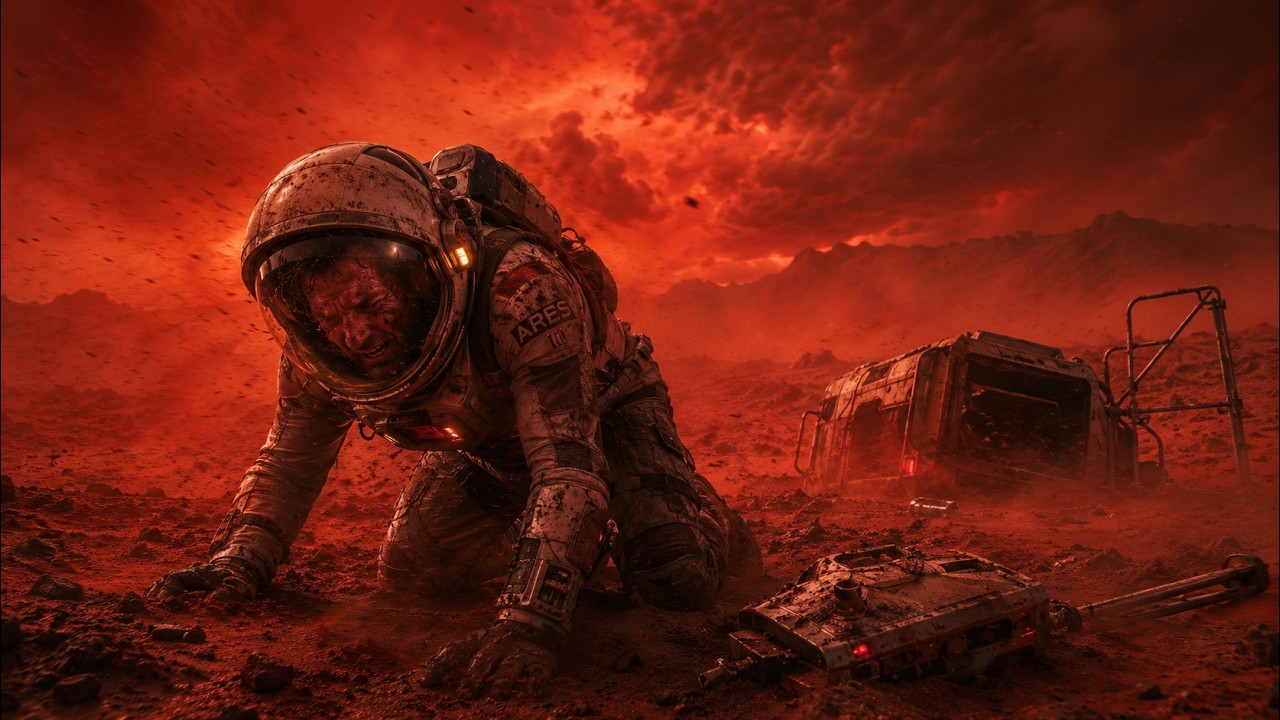
Ce qui attend vraiment les premiers astronautes sur Mars
Keywords
Mars
astronauts
radiation
survival
space travel
Summary
This 38-minute documentary by Balade Mentale critically examines the challenges facing the first astronauts to Mars. It covers the journey's physiological effects, including muscle atrophy and bone loss, the lethal radiation environment, and the difficulty of landing on Mars. The video highlights the toxic and radioactive soil, dust storms, and the psychological strain of isolation. It discusses water recycling, food production, and energy generation as survival necessities. The documentary argues that the return trip is nearly impossible with current technology, questioning the feasibility of the entire endeavor. It presents a sobering view of Mars colonization, emphasizing the immense risks and technical hurdles. The narrative is engaging and well-structured, suitable for a general audience interested in space exploration.
Critical Evaluation
The video provides a comprehensive and sobering analysis of the challenges of sending humans to Mars. It effectively communicates complex scientific and engineering problems in an accessible manner. The strength lies in its holistic approach, covering not just the journey but also the harsh Martian environment, resource limitations, and psychological factors. The argumentation is solid, drawing on known issues such as radiation exposure (e.g., galactic cosmic rays), the thin atmosphere, and the lack of a magnetic field. The video mentions the problem of perchlorates in the soil and the difficulty of producing food and water. However, it lacks explicit citations for many claims, which reduces its scientific rigor. The video does not provide a balanced view by discussing potential solutions or ongoing research, such as in-situ resource utilization or advanced propulsion. The tone is somewhat pessimistic, which may skew the perception of feasibility. The comments section (not fully analyzed) likely reflects a mix of awe and skepticism. For a university audience, the video serves as a good introductory overview but lacks depth in technical details and references. It would benefit from citing specific studies or missions. The production quality is high, with clear visuals and narration. Overall, it is a valuable piece for sparking discussion but should be supplemented with primary sources for academic use.
Key Moments
- The journey to Mars: travel time and propulsion challenges.
- Effects on the body: muscle atrophy, bone loss, and fluid shifts.
- Radiation problem: galactic cosmic rays and solar particle events.
- Landing challenges: thin atmosphere and precision landing.
- Radioactive soil and dust storms: perchlorates and electrostatic dust.
- Water and recycling: extracting water from ice and recycling systems.
- Food challenge: growing crops in Martian soil and limited supplies.
- Energy and survival: solar vs nuclear power and energy storage.
- The impossible return: fuel production and Earth return vehicle.
Cited Sources
Contribution & Novelties
The video synthesizes known challenges of Mars colonization into a compelling narrative, emphasizing the harsh realities often glossed over in popular media. It does not present new research but offers a comprehensive, critical perspective that is valuable for public understanding.
Radar Profile
The radar profile shows high quantity of information and moderate quality, with a balanced technical level. The reliability is decent but limited by lack of citations. The video excels in breadth but lacks depth in some areas.
Reliability
/10