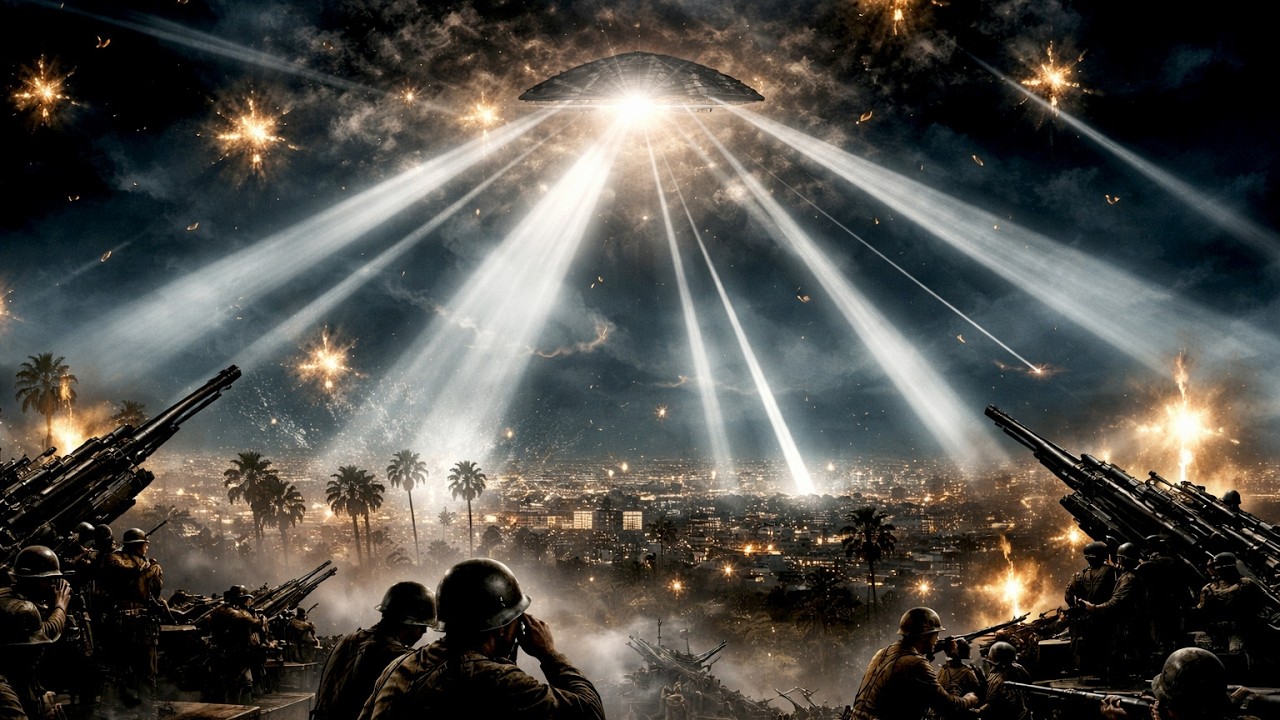
🪐L'OVNI le plus marquant de l'Histoire : la bataille de Los Angeles
Keywords
Battle of Los Angeles
UFO
1942
anti-aircraft
misidentification
Summary
This video by AstronoGeek examines the famous 1942 Battle of Los Angeles, a historical event where US military forces fired thousands of anti-aircraft shells at an unidentified object in the sky. The presenter sets the context of heightened tension after Pearl Harbor and a Japanese submarine attack, then describes the night of February 24-25, 1942, when radar detected an unknown object approaching Los Angeles. Despite extensive anti-aircraft fire, no enemy aircraft were shot down, and the object eventually disappeared. The video presents eyewitness accounts and newspaper reports, but the presenter remains skeptical, suggesting the object was likely a weather balloon or misidentified aircraft. The narrative is engaging but lacks critical analysis of alternative explanations and does not cite primary sources. The video ends with a promotional segment for a sponsor. Overall, it provides a basic overview of the event but lacks scientific rigor and depth.
Critical Evaluation
The video provides a detailed narrative of the Battle of Los Angeles, a well-known historical event often cited in UFO lore. The presenter, AstronoGeek, adopts a skeptical tone, aiming to debunk the extraterrestrial interpretation. However, the analysis suffers from several shortcomings. First, the video relies heavily on anecdotal eyewitness accounts and newspaper articles without critically evaluating their reliability. For instance, the description of a 'huge, pale orange object' is presented without considering potential biases or the influence of wartime hysteria. Second, the video fails to engage with scholarly historical research on the event. No academic sources are cited, and the explanation offered (weather balloon or misidentified aircraft) is simplistic and not supported by evidence. The presenter mentions that radar detected an object, but does not discuss the limitations of radar technology in 1942 or the possibility of radar anomalies. Third, the video includes a lengthy sponsor segment and promotional content, which detracts from its credibility as an educational piece. The comments section, though not analyzed in detail, likely contains a mix of believers and skeptics, but the video does not address common counterarguments. For a university-level audience, the video lacks the rigor expected of historical analysis. It does not provide a balanced evaluation of competing hypotheses, nor does it discuss the sociopolitical context that may have influenced perceptions. The presenter's admission of being a skeptic is not backed by a systematic debunking of the UFO hypothesis. In conclusion, while the video is entertaining and informative for a general audience, it falls short of academic standards due to its lack of source verification, superficial analysis, and promotional content.
Key Moments
- Sponsor introduction and presenter's skeptical stance on UFOs
- Historical context: Pearl Harbor and Japanese submarine attack
- Radar detection and initial alerts on February 24, 1942
- Eyewitness descriptions of the object and anti-aircraft fire
- Military response and fighter jets scrambled
- Aftermath and official explanations
- Presenter's conclusion and skepticism about extraterrestrial origin
Cited Sources
Contribution & Novelties
The video offers a popular retelling of the Battle of Los Angeles with a skeptical perspective, but does not provide new research or original analysis. It synthesizes existing accounts without adding novel insights or evidence.
Radar Profile
The radar profile shows a moderate amount of information (7/10) but low quality (5/10) and technical depth (4/10), indicating a broad but shallow treatment of the topic. The reliability score (4/10) reflects the lack of rigorous source verification and critical analysis.
Reliability
/10