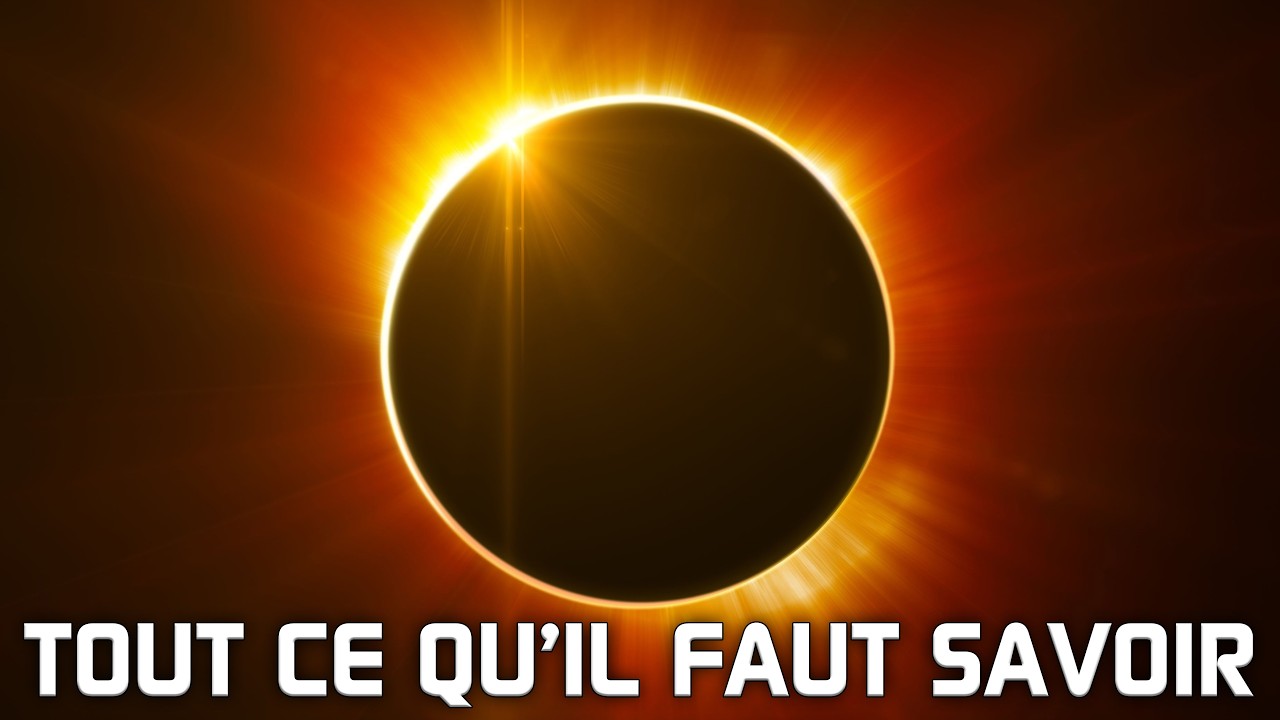
🪐Eclipse du 12 août : toutes les infos
Keywords
solar eclipse
total eclipse
eclipse safety
observation methods
Spain
Summary
This video by AstronoGeek provides a comprehensive guide to the total solar eclipse occurring on August 12, 2026, visible from northern Spain and Greenland. The presenter explains the celestial mechanics behind solar and lunar eclipses, emphasizing that solar eclipses occur when the Moon passes directly between Earth and the Sun, and that they are rare due to the Moon's inclined orbit. The video details the path of totality in Spain, with the total phase starting around 20:25 local time and lasting up to 1 minute 45 seconds at the center. Practical advice includes using interactive maps (theeclipse.app), checking weather forecasts, being mobile to avoid clouds, and understanding Spanish camping laws. Safety is a major focus: never look at the partial phases without proper eye protection (eclipse glasses or solar filters), and never use optical devices without filters. The video reviews various observation methods from pinhole cameras to telescopes, including H-alpha filters for detailed solar views. It also covers equipment like the Solarquest mount and Heliostar telescopes, though these are presented with commercial links. The presenter stresses that the minimum requirement is transportation to the path of totality, and that the experience is unforgettable.
Critical Evaluation
The video serves as an excellent educational resource for the general public, particularly for those planning to observe the 2026 total solar eclipse. The scientific explanation of eclipses is accurate and well-structured, starting from basic orbital mechanics to the specific geometry that makes total solar eclipses possible. The presenter correctly distinguishes between solar and lunar eclipses, and explains why lunar eclipses are more common and visible from larger areas. The safety advice is thorough and critical: the warning against looking at the Sun without proper filters, especially through optical devices, is emphasized repeatedly. This is essential because retinal damage can occur without pain. The video also provides practical tips such as using eclipse glasses with ISO 12312-2 certification, making a pinhole camera, and using solar filters for cameras and telescopes. The discussion of Spanish logistics (camping rules, mobile observation) adds value for travelers. However, the video has a significant commercial component: multiple links to sponsored products (YFood, telescopes, mounts) are embedded, and the presenter explicitly mentions 'conflits d’intérêt' at timestamp 3057s. While this transparency is commendable, it may bias the equipment recommendations. The scientific depth is moderate; the video does not delve into advanced topics like the Baily's beads, diamond ring effect, or coronal structure in detail. The target audience is clearly beginners to intermediate enthusiasts. The transcription shows occasional informal language ('emmerdements') and a conversational tone, which aids engagement but reduces formal academic rigor. The video's structure with chapters is helpful. Overall, the information is reliable and well-presented, but the commercial aspects and lack of deep scientific analysis prevent it from being a top-tier academic resource. For a university audience, it serves as a good introductory overview but would need supplementation with peer-reviewed sources for deeper understanding.
Key Moments
- Explanation of basic eclipse mechanics: Earth, Moon, Sun alignment.
- Lunar eclipse explanation: Earth's shadow on the Moon.
- Solar eclipse explanation: Moon's shadow on Earth.
- Introduction of theeclipse.app interactive map for eclipse path.
- Safety precautions: never look at partial eclipse without protection.
- Eclipse glasses and pinhole camera methods.
- Astrosolar filter and photography tips.
- Conflict of interest disclosure regarding sponsored equipment.
- Solarquest mount and Heliostar telescopes overview.
- Conclusion: encouragement to travel and witness the eclipse.
Cited Sources
Contribution & Novelties
This video provides a timely and practical guide for the 2026 total solar eclipse, combining basic astronomy education with specific logistical advice for Spain. It stands out by addressing both safety and equipment options across a wide budget range, from free methods (pinhole camera) to high-end telescopes. The integration of an interactive map and real-time weather considerations adds practical value not always found in academic resources.
Radar Profile
The radar profile shows high scores in quantity of information and fiabilite, reflecting the video's comprehensive coverage and accurate science. The moderate technical level indicates accessibility for a general audience, while the quality of information is slightly lower due to commercial bias. Overall, the video is a reliable introductory resource.
Reliability
/10