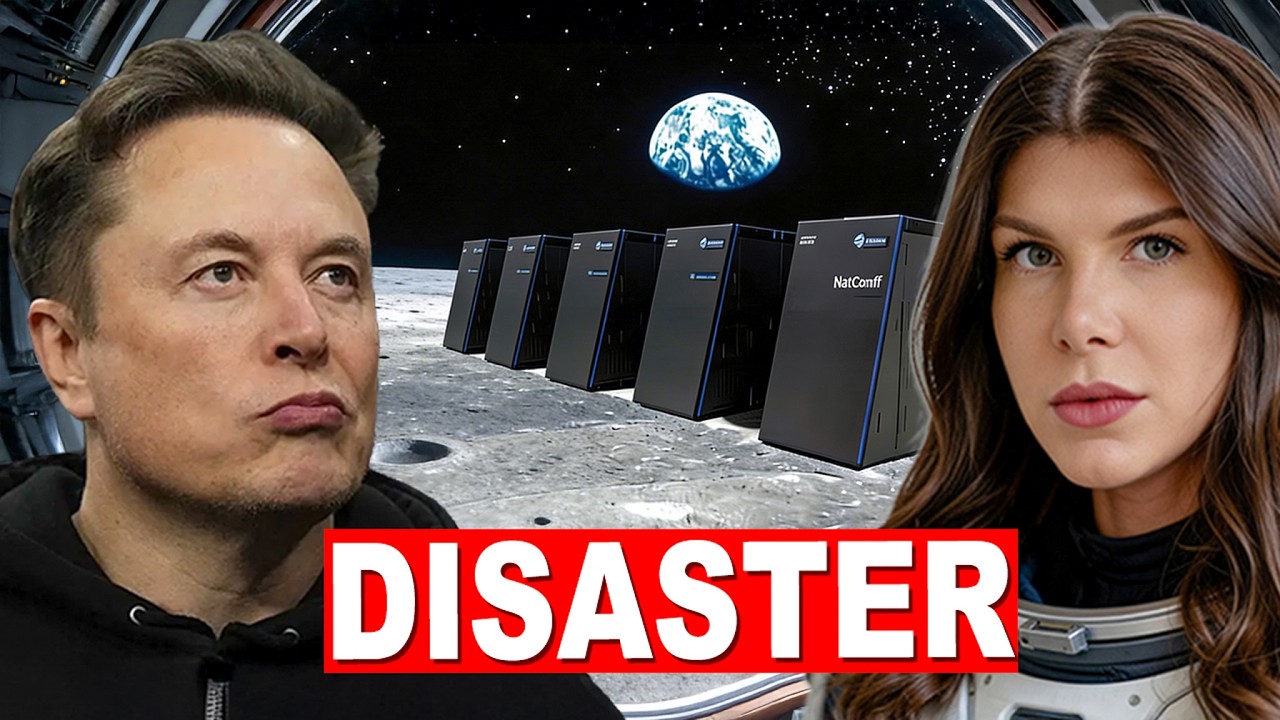
The Killer Behind Data Centers In Space
Keywords
space data centers
radiative cooling
orbital computing
Starcloud
lunar data centers
Summary
This video explores the feasibility of deploying AI data centers in space, motivated by terrestrial constraints on power, water, and land. The author, an experienced chip designer, systematically examines two scenarios: low Earth orbit (LEO) and lunar surface. Key challenges include radiation hardening of GPUs, massive solar arrays for power (e.g., 350x350 m for 40 MW), and especially thermal management in vacuum, where radiative cooling requires huge radiator panels (120,000 m² for 40 MW). Data transmission back to Earth via laser links faces atmospheric interference, limiting bandwidth. The video references Starcloud's successful launch of an NVIDIA Hopper GPU into space as proof of concept. Economic analysis suggests launch costs of $200-400 million for radiators alone, even with Starship. The author concludes that while technically plausible, orbital data centers are economically and logistically daunting, and lunar data centers face even greater challenges. The presentation is balanced, highlighting both potential and pitfalls.
Critical Evaluation
The video provides a comprehensive and technically grounded analysis of a speculative but timely topic. The author's background in microchip design lends credibility to the discussion of radiation effects and thermal constraints. The argumentation is logically structured: starting from the terrestrial drivers (energy, cooling, land scarcity), then moving to orbital requirements (power, cooling, data links), and finally to lunar considerations. The use of specific numbers (e.g., 40 MW, 120,000 m² radiators) adds concreteness, though these are estimates and not from published engineering studies. The video cites Starcloud's mission as a real-world data point, which strengthens the plausibility. However, the analysis lacks citations of peer-reviewed literature or official industry reports; it relies on the author's calculations and general knowledge. The sponsorship by IEEE Spectrum, a reputable publication, partially mitigates this, but the content remains an expert opinion rather than a systematic review. The video does not address counterarguments in depth, such as alternative cooling methods (e.g., heat pipes, phase-change materials) or advances in laser communication (e.g., adaptive optics). The discussion of lunar data centers is brief and less rigorous. Overall, the video is informative and thought-provoking for a university audience, but its conclusions should be treated as speculative. The comments section (not analyzed here) likely includes both enthusiastic and skeptical reactions, reflecting the divisive nature of the topic. For a master-level audience, the video serves as a good case study in applying physics and engineering principles to futuristic concepts, but it should be supplemented with primary sources.
Key Moments
Cited Sources
Contribution & Novelties
The video synthesizes recent developments (e.g., Starcloud's GPU launch) with fundamental physics to evaluate the feasibility of space-based data centers. It provides a clear, quantitative comparison of terrestrial vs. orbital constraints, particularly highlighting the often-overlooked challenge of radiative cooling at scale. The discussion of bandwidth limitations due to atmospheric interference adds a practical dimension often missing in popular coverage.
Radar Profile
The radar profile shows high scores in quantity and technical level, reflecting the video's detailed engineering analysis. The quality and reliability scores are moderate due to the lack of peer-reviewed sources and reliance on expert opinion. This indicates a well-informed but not rigorously scientific presentation, suitable for educational purposes but not as a definitive reference.
Reliability
/10