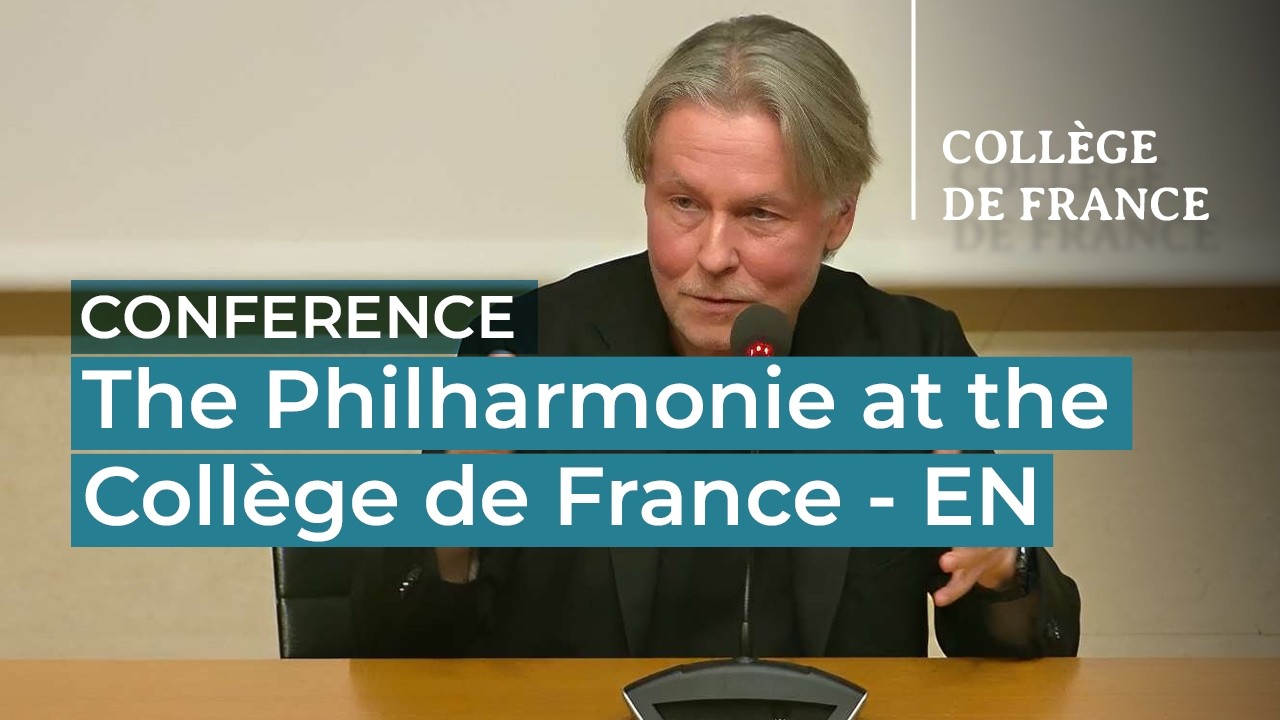
Music! The Philharmonie at the Collège de France (6) - 2025-2026
Keywords
Summary
180 words
Critical Evaluation
The video provides a valuable and insightful discussion on the future of symphony concerts, featuring one of the most respected figures in classical music. Esa-Pekka Salonen’s perspective is informed by decades of experience as both a conductor and composer, and his reflections on the role of music institutions in society are thoughtful and nuanced. The conversation is well-moderated by Christian Thompson, who guides the discussion effectively, touching on key topics such as music education, institutional challenges, and the evolution of concert formats. Salonen’s anecdotes about his early career and his comparison between the Philharmonie and the Walt Disney Concert Hall offer concrete examples of how arts complexes can drive civic regeneration. The discussion is grounded in personal experience rather than empirical data, which is appropriate for an expert opinion format. However, the lack of specific references or data may limit its scientific rigor. The video also includes a brief film of Salonen conducting, which adds visual interest but does not contribute significantly to the intellectual content. Overall, the video is a high-quality contribution to the discourse on classical music’s future, though it remains subjective and lacks broader evidence. The title accurately reflects the content, and the production quality is professional. The main weakness is the absence of concrete data or citations to support some of the claims, such as the assertion that the Philharmonie has the youngest audience in Europe. Nevertheless, the video offers a compelling and articulate vision for the future of orchestral music, making it a valuable resource for those interested in the topic.
256 words
Title / Content Match
The title accurately reflects the content: a lecture series event at the Collège de France featuring a conversation about the future of symphony concerts.
Quality & Reliability
8/10
The video features a high-level conversation with Esa-Pekka Salonen, a renowned conductor and composer, moderated by Christian Thompson. The content is based on personal experience and expertise, with no formal citations, but the institutional backing of the Collège de France and Philharmonie de Paris adds credibility. The discussion is insightful and well-articulated, though it remains subjective and lacks empirical data.
Key Moments
Markers derived by PSI from the transcript: the creator did not define chapters.
- Introduction by William Marx, chair of compared philosophy at Collège de France.
- Olivier Mantéi, managing director of the Cité de la Musique, introduces the event and Esa-Pekka Salonen.
- Christian Thompson begins the interview, asking Salonen about his decision to come to Paris.
- Salonen discusses his early career in Finland and the 'Ears Open' group.
- Discussion on music education in Finland and the importance of arts education.
- Salonen reflects on the health of classical music and the challenges facing institutions.
- Short film of Salonen conducting Bruckner's Fourth Symphony with the Orchestre de Paris.
- Continued discussion on the future of concert forms and the role of the Philharmonie.
- Salonen talks about his dual role as creator and guardian of legacy.
- Closing remarks and introduction of the Page Blanche Quartet concert.
Cited Sources
- Collège de France — Institutional website of the Collège de France, hosting the lecture series.
- Fondation du Collège de France — Support page for the Collège de France.
- Collège de France on Threads — Social media profile of the Collège de France.
- Collège de France on Bluesky — Social media profile of the Collège de France.
- Collège de France on LinkedIn — Social media profile of the Collège de France.
Concurring Sources
- Philharmonie de Paris — The institution discussed in the video, supporting its role in civic renewal.
- Esa-Pekka Salonen — Biographical information confirming his career and roles.
Contribution & Novelties
The video offers a unique perspective on the future of symphony concerts from a leading conductor and composer, emphasizing the importance of music education and the social role of cultural institutions. Salonen’s insights into the evolution of concert formats and the need for innovation are valuable for practitioners and policymakers.
Pour aller plus loin :
- Esa-Pekka Salonen — Background on the conductor and composer.
- Philharmonie de Paris — Official website of the Philharmonie, the institution discussed.
- Walt Disney Concert Hall — Example of civic regeneration through an arts complex, mentioned by Salonen.
92 words
Radar Profile
The radar profile shows high scores in quality of information and reliability, reflecting the expertise of the speaker and the institutional context. The quantity of information is moderate, as the discussion is focused but not exhaustive. The technical level is moderate, accessible to a general audience interested in classical music.