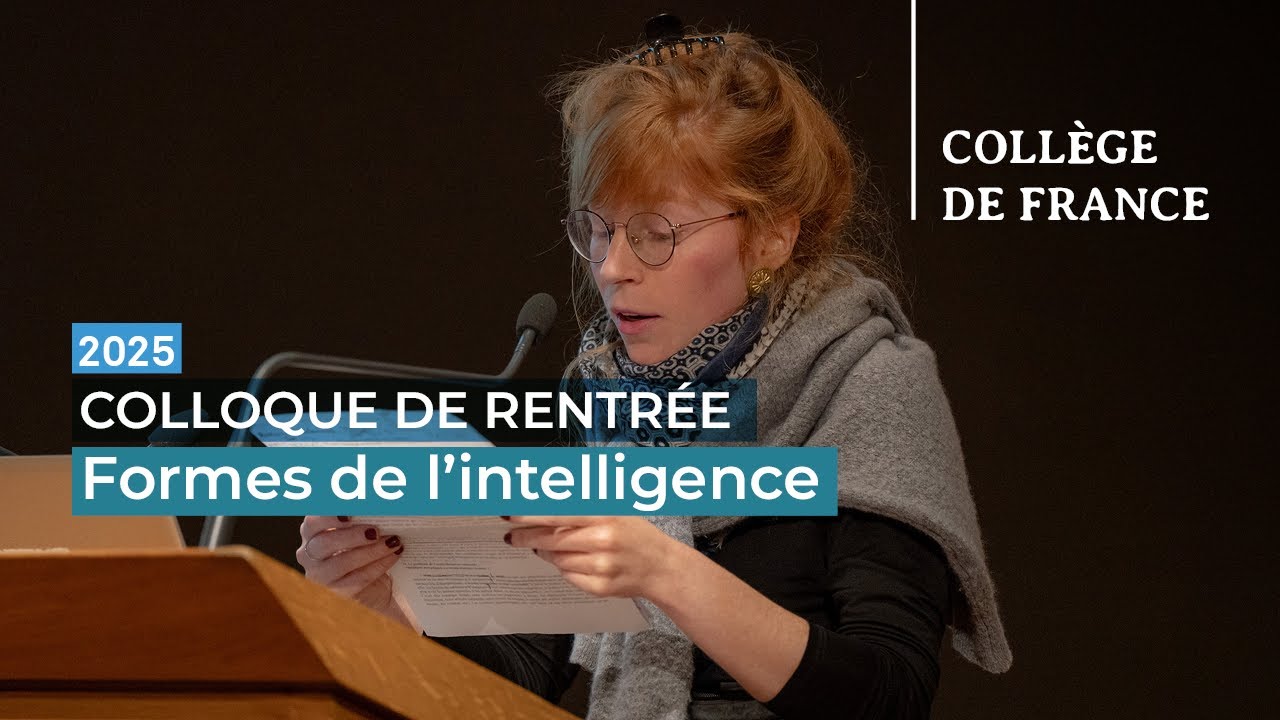
L'IA, entre technologie intellectuelle et déraison computationnelle
Keywords
Summary
135 words
Critical Evaluation
The lecture offers a well-argued philosophical perspective on AI, grounded in a rich tradition of thought from figures like Leroi-Gourhan, Goody, and Canguilhem. Alombert effectively challenges the dominant narrative of AI as a replacement for human intelligence, instead framing it as a technology that co-evolves with human cognition. Her argument that AI can lead to a ‘computational unreason’ is compelling, particularly in the context of generative AI’s rapid adoption. The talk is rigorous in its use of historical and philosophical references, though it lacks empirical evidence and relies on theoretical frameworks. The speaker’s expertise is evident, and she provides a balanced view by acknowledging the potential benefits of AI when designed with human flourishing in mind. The title accurately reflects the content, and the talk is well-structured, moving from a general thesis to specific problems and potential solutions. However, the lecture is primarily an opinion piece, and its claims about the effects of AI on cognition are not backed by empirical studies. The audience’s reception, as indicated by the comments, is largely positive, with many appreciating the depth of the analysis. Overall, the talk is a valuable contribution to the philosophical discourse on AI, but it would benefit from more concrete examples and data to support its claims.
208 words
Title / Content Match
The title accurately reflects the content, which explores AI as an intellectual technology and the risks of computational unreason.
Quality & Reliability
8/10
The speaker is a philosopher with relevant publications, and the talk is grounded in established philosophical and anthropological references. However, it is an opinion-based lecture without empirical data or systematic review.
Key Moments
Markers derived by PSI from the transcript: the creator did not define chapters.
- Introduction by the chair, presenting Anne Alombert and her work.
- Alombert outlines her thesis: intelligence is always already artificial, and can be deformed by technical milieus.
- Discussion of the Dartmouth conference and the two AI paradigms: symbolic and connectionist.
- Critique of anthropomorphism in AI, referencing Weizenbaum and the marketing of chatbots.
- Introduction of the alternative vision of AI as augmentation, citing Bush and Engelbart.
- Exploration of the co-evolution of brain and tools, referencing Leroi-Gourhan and Changeux.
- Comparison between alphabetic writing and algorithmic writing, and their effects on thought.
- Discussion of the three problems: cognitive dependency, cultural homogenization, and political manipulation.
- Proposal for hermeneutic and contributive technologies to support human intelligence.
- Conclusion and final remarks on the need for a critical approach to AI.
Cited Sources
- Collège de France — Official website of the institution hosting the lecture.
- Colloque Formes de l'intelligence — Page of the conference where this lecture took place.
- Fondation du Collège de France — Donation page, not directly related to content but part of description.
Concurring Sources
- Collège de France — Institutional source supporting the lecture's context.
External References
Contribution & Novelties
The lecture offers a novel philosophical framework for understanding AI as an intellectual technology, drawing on historical parallels with writing. It challenges the prevailing anthropomorphic view and proposes a critical approach to AI development.
Pour aller plus loin :
- Technologie intellectuelle — Concept central to the talk, referring to tools that shape cognition.
- Gilbert Simondon — Philosopher whose ideas on technical objects inform the analysis.
- Joseph Weizenbaum — Computer scientist who warned against anthropomorphizing machines.
- Leroi-Gourhan — Paleoanthropologist whose work on exteriorization of memory is cited.
86 words
Radar Profile
The profile shows high scores in information quantity and quality, reflecting the depth of philosophical content. The technical level is moderate, indicating accessibility to a general audience. Overall reliability is high due to the speaker's expertise and institutional backing.
💬 Sur les 0 commentaires analysés, aucune tendance n'est disponible.