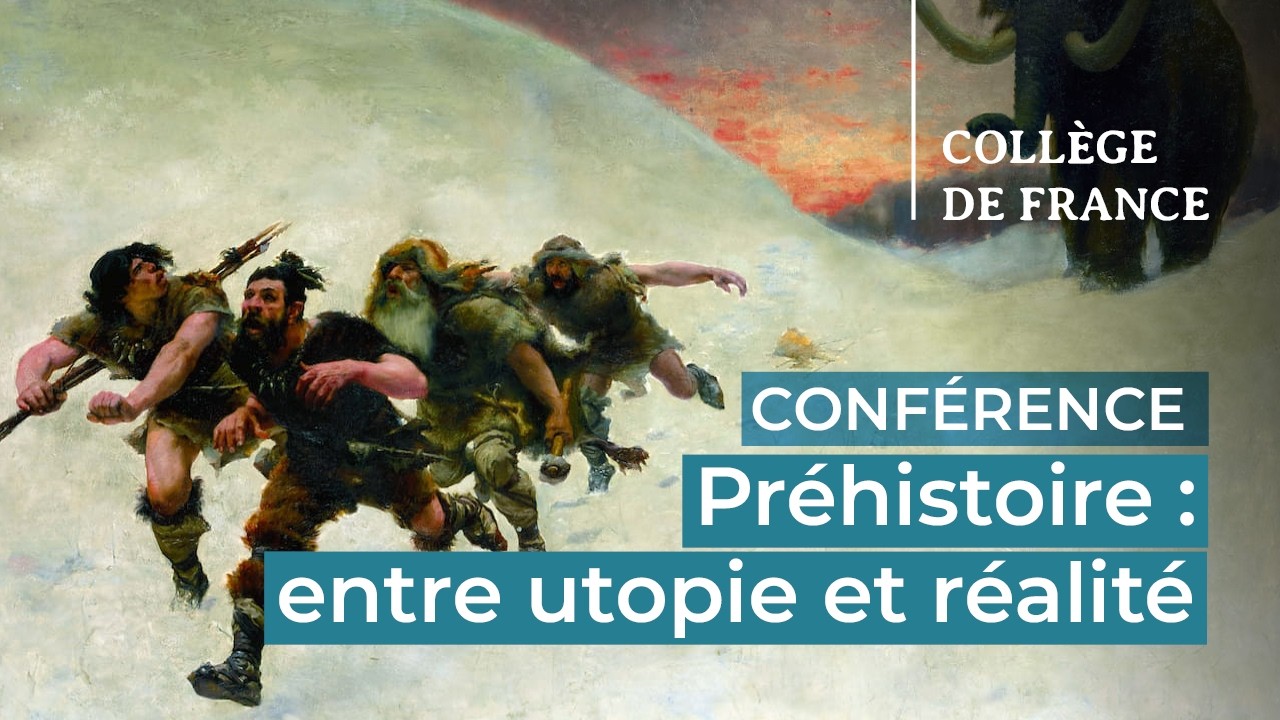
Préhistoire : entre utopie et réalité (1) - 2026
Keywords
Summary
179 words
Critical Evaluation
The lecture provides a rich and insightful overview of the history of prehistory as a scientific discipline, while also exploring its cultural and imaginative dimensions. Hublin’s expertise is evident in his nuanced discussion of how scientific knowledge and popular representations have influenced each other. He effectively uses personal anecdotes to illustrate the emotional appeal of the subject, making the content accessible without oversimplifying. The argumentation is solid, grounded in historical facts and references to specific archaeological discoveries and figures. The lecture is well-structured, moving from the exhibition’s concept to the historical context of the field’s emergence. Hublin acknowledges the limitations of early research and the influence of contemporary ideologies, such as the biblical narrative, on scientific interpretation. The sources cited are primarily the exhibition itself and the associated lecture series, which are appropriate for this introductory talk. The title accurately reflects the content, which focuses on the interplay between utopian visions and scientific reality in prehistory. Overall, the lecture is of high quality, offering both educational value and critical reflection on the discipline’s development.
174 words
Title / Content Match
The title accurately reflects the content, which introduces the exhibition's theme and explores the tension between scientific knowledge and cultural representations of prehistory.
Quality & Reliability
9/10
Lecture by a renowned paleoanthropologist (Professor at Collège de France), based on established scientific knowledge and historical facts, with references to specific archaeological objects and figures. The content is well-structured and nuanced, acknowledging the interplay between science and imagination.
Key Moments
Markers derived by PSI from the transcript: the creator did not define chapters.
- Introduction: Hublin welcomes the audience and explains the purpose of the lecture as an introduction to the exhibition and lecture series.
- Hublin shares a personal anecdote about receiving a book on prehistory as a school prize, sparking his interest in the field.
- Discussion of the exhibition's unique features, including original artifacts and artworks borrowed from museums.
- Overview of the exhibition's thematic structure, following a historical progression from the 19th century to modern debates.
- Introduction of Jacques Boucher de Perthes and his role in the discovery of ancient stone tools, challenging biblical chronology.
- Discussion of the influence of Cuvier's catastrophic theory and the biblical flood narrative on early interpretations of prehistory.
- Hublin explains how prehistory is a young science, leaving much room for imagination and cultural projections.
- Exploration of the theme of women in prehistoric societies and how artists have imagined their roles.
- Discussion of the perception of prehistoric life as either a paradise lost or a hell to be escaped.
- Conclusion: Hublin encourages the audience to visit the exhibition and attend the upcoming lectures.
Cited Sources
- Exhibition program: Préhistoire : entre utopie et réalité — Official page for the exhibition and associated conferences.
- Interviews with Jean-Jacques Hublin — Playlist of interviews with the speaker.
Concurring Sources
- Collège de France official website — Institutional source confirming the speaker's affiliation and the event.
External References
Contribution & Novelties
This lecture offers a unique perspective on the history of prehistory, emphasizing the interplay between scientific discovery and cultural imagination. It highlights the role of amateur scholars and the influence of contemporary ideologies on scientific interpretation. The exhibition itself is presented as a novel approach to presenting prehistory, combining original artifacts with artworks to illustrate these dynamics.
Pour aller plus loin :
- Boucher de Perthes — Key figure in the early history of prehistory.
- Paleolithic art — Context for the artistic representations discussed.
- History of paleoanthropology — Overview of the discipline’s development.
92 words
Radar Profile
The radar profile shows high scores in information quality and reliability, reflecting the speaker's expertise and the well-founded content. The quantity of information is also substantial, though the technical level is moderate, making it accessible to a broad audience.