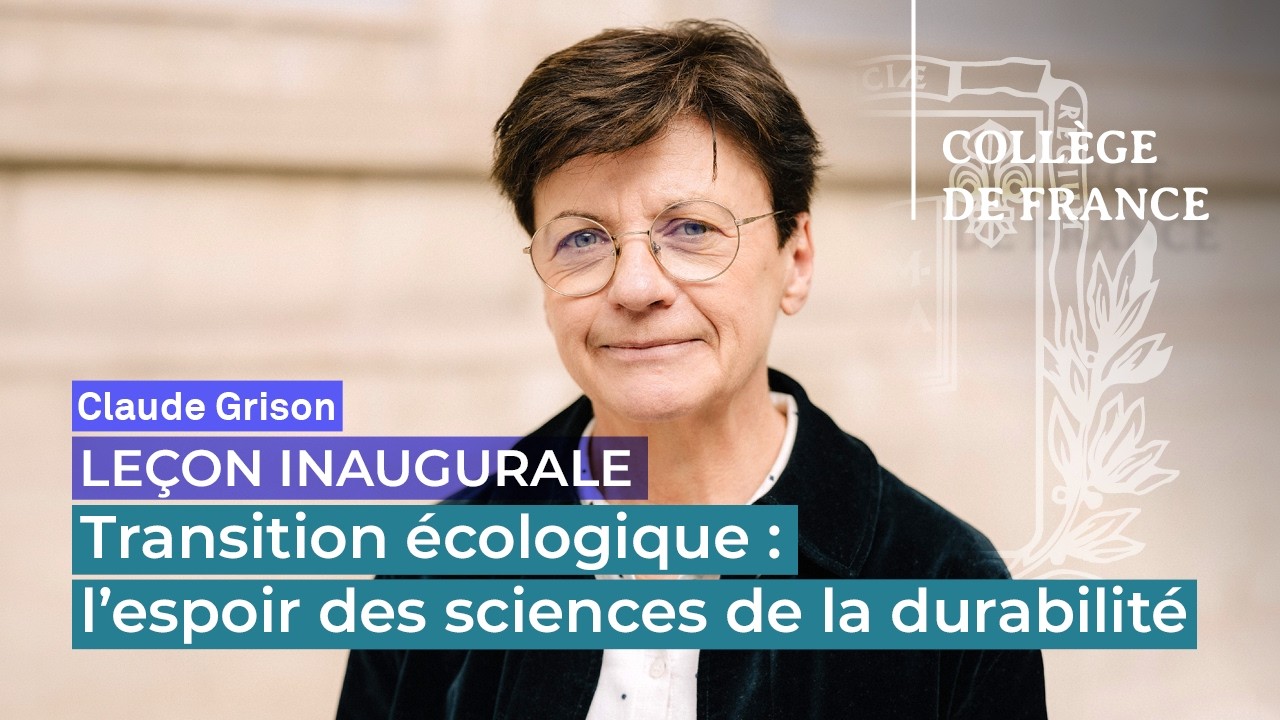
Transition écologique : l’espoir des sciences de la durabilité - Claude Grison (2026)
Keywords
Summary
164 words
Critical Evaluation
The lecture by Claude Grison is a masterful synthesis of scientific rigor and passionate advocacy for sustainability. As a leading expert in bio-inspired chemistry and ecological innovation, Grison brings a unique perspective that bridges chemistry and ecology, challenging the traditional separation of these disciplines. The content is highly informative, covering a wide range of topics from the diagnosis of biodiversity loss to concrete solutions like phytoremediation and ecocatalysis. The argumentation is solid, grounded in scientific evidence and international reports such as IPBES and COP15. Grison effectively communicates complex scientific concepts to a broad audience without oversimplifying, maintaining a high level of technical accuracy. The inclusion of real-world applications, such as the creation of companies like Stratos Bioinspired, demonstrates the practical impact of her research. The lecture also addresses the socio-economic dimensions of sustainability, emphasizing the need for inclusive and equitable solutions. The sources cited are credible, including the Collège de France, CNRS, and international bodies. The title accurately reflects the content, and the lecture lives up to its promise of offering hope through science. The only minor critique is that the lecture could have delved deeper into the policy and governance aspects of implementing these solutions, but given the time constraints, it provides a comprehensive overview. Overall, this is an excellent lecture that inspires and educates, deserving a top rating.
220 words
Title / Content Match
The title accurately reflects the content, focusing on sustainability sciences and ecological transition, with a strong emphasis on hope and solutions.
Quality & Reliability
9/10
The lecture is delivered by a renowned CNRS researcher and professor at the Collège de France, with extensive publications and patents. The content is based on established scientific concepts (phytoremediation, ecocatalysis) and references to international reports (IPBES, COP15). The presentation is rigorous and well-structured, with clear explanations of complex topics.
Key Moments
Markers derived by PSI from the transcript: the creator did not define chapters.
- Introduction by the administrator of the Collège de France, presenting Claude Grison and her achievements.
- Grison begins her lecture, thanking the institution and introducing the theme of sustainability sciences.
- She quotes Jacques Chirac's 2002 speech, highlighting the urgency of environmental action.
- Discussion of the five key drivers of biodiversity loss identified at COP15, including land-use change and climate change.
- Introduction of phytotechnologies: phytoremediation and phytosorption as nature-based solutions.
- Explanation of the concept of ecocatalysis, a novel approach combining ecology and chemistry.
- Examples of applications: using plants to extract metals from polluted soils and using them as catalysts in green chemistry.
- Discussion of invasive species management and the valorization of biomass.
- Emphasis on the need for interdisciplinary research and breaking down barriers between disciplines.
- Conclusion: call for collective action and hope, highlighting the role of scientists in building a sustainable future.
Cited Sources
- Collège de France - Claude Grison, Avenir Commun Durable — Official page for the chair held by Claude Grison, providing context for her lecture.
- Collège de France - Article on breaking down artificial barriers between scientific disciplines — Article related to the theme of interdisciplinary research mentioned in the lecture.
Concurring Sources
- IPBES Global Assessment Report on Biodiversity and Ecosystem Services — The report provides evidence on biodiversity loss, supporting the lecture's claims.
- COP15 Biodiversity Conference — The conference where the five key drivers of biodiversity loss were identified, as mentioned in the lecture.
External References
Contribution & Novelties
The lecture introduces the concept of ecocatalysis, a novel approach that integrates ecology and chemistry to address environmental pollution and biodiversity loss. It provides a comprehensive overview of phytotechnologies and their applications in restoring degraded ecosystems. The lecture emphasizes the importance of nature-based solutions and interdisciplinary research, offering a hopeful perspective on the role of science in sustainability.
Pour aller plus loin :
- Phytoremediation - Wikipedia — Provides background on the use of plants for environmental cleanup.
- Ecocatalysis - CNRS — Official CNRS page on ecocatalysis, detailing the concept and its applications.
- IPBES Global Assessment Report — The IPBES report on biodiversity and ecosystem services, referenced in the lecture.
- Nature-based Solutions - IUCN — Overview of nature-based solutions, a key theme in the lecture.
124 words
Radar Profile
The radar profile shows high scores across all dimensions, indicating a well-rounded and reliable lecture. The strong scores in information quantity and quality reflect the depth and accuracy of the content, while the high technical level and global reliability underscore the scientific rigor and credibility of the speaker.