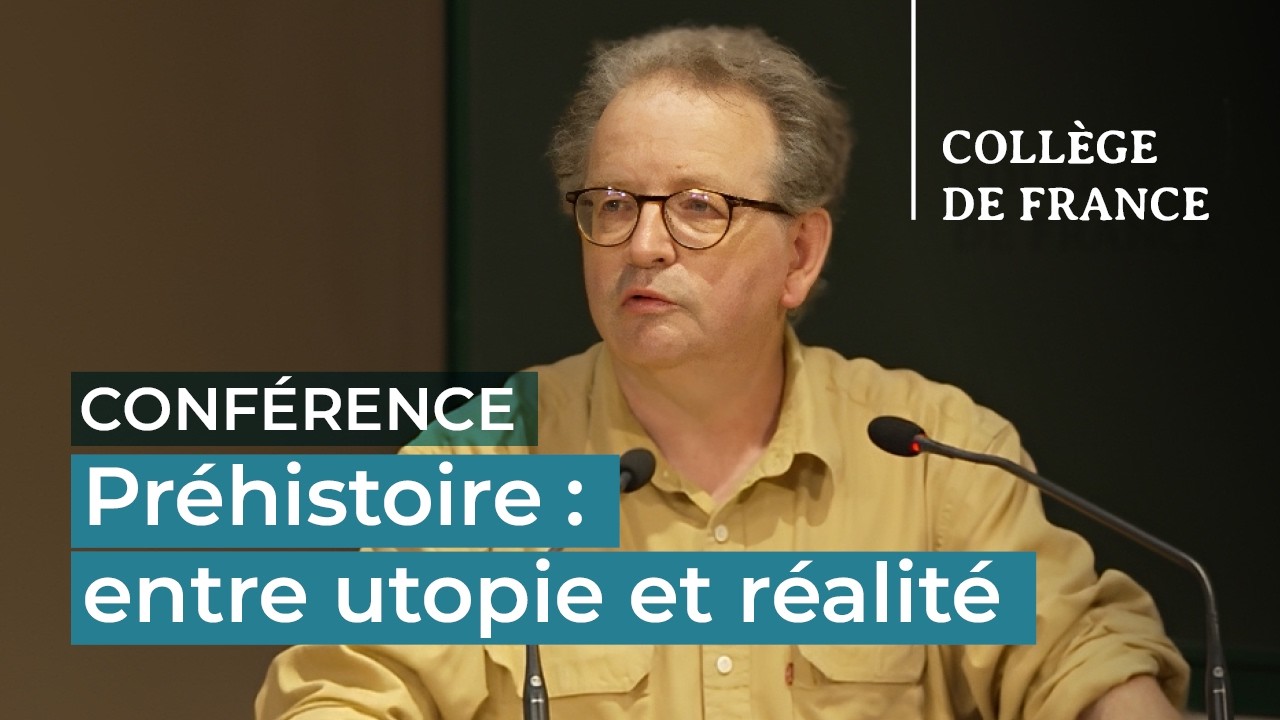
Préhistoire : entre utopie et réalité (3) - 2026
Keywords
Summary
178 words
Critical Evaluation
The lecture provides a comprehensive and well-documented overview of the historical representations of Neanderthals, effectively demonstrating how scientific and popular imagery has been influenced by cultural and ideological contexts. Depaepe’s expertise is evident in his detailed knowledge of 19th-century scientific debates and his ability to connect them to broader societal attitudes. The argumentation is solid, as he systematically traces the evolution of Neanderthal imagery from the discovery in 1856 to the present, highlighting key turning points such as the initial rejection of Neanderthals as a distinct species, the influence of Darwin’s theory of evolution, and the racialist theories that pervaded the period. He also effectively uses primary sources, including illustrations from books and scientific publications, to support his claims. However, the lecture is primarily an expert opinion rather than a peer-reviewed study, and some assertions, such as the specific influence of certain artists or the exact number of representations, are not rigorously quantified. Additionally, while Depaepe critiques the racialist underpinnings of early representations, he could have delved deeper into the contemporary implications of these stereotypes. The lecture is well-structured and engaging, with a clear narrative that keeps the audience’s attention. The title accurately reflects the content, and the lecture successfully fulfills its aim of questioning our current perceptions of Neanderthals. Overall, it is a valuable contribution to the public understanding of prehistory and the history of science.
227 words
Title / Content Match
The title accurately reflects the content, which critically examines representations of Neanderthals in the context of the exhibition 'Prehistory: Between Utopia and Reality'.
Quality & Reliability
8/10
The lecture is delivered by a recognized expert (Pascal Depaepe, Inrap regional director) and is hosted by the Collège de France, a prestigious academic institution. The content is well-structured, historically grounded, and references numerous primary sources and scholarly debates. However, it is an opinion/expert lecture rather than a peer-reviewed study, and some claims rely on historical context rather than direct evidence.
Key Moments
Markers derived by PSI from the transcript: the creator did not define chapters.
- Introduction by Jean-Jacques Hublin, presenting the speaker and the topic.
- Depaepe begins his lecture, noting the high number of online references to Neanderthals compared to Lucy.
- Discussion of early representations of 'savages' in medieval art, setting the stage for Neanderthal imagery.
- Context of 19th-century learned societies and early popular science books on prehistory.
- Discovery of Neanderthal in 1856 and initial scientific debates, including theories denying its distinct species status.
- Influence of Darwin's 'Origin of Species' and the racialist theories of the time, with examples from Gobineau and others.
- Examination of early scientific illustrations of Neanderthals, often depicting them as ape-like and primitive.
- Discussion of the role of artists and scientists in shaping Neanderthal imagery, and the persistence of stereotypes.
- Comparison of Neanderthal representations with those of other 'others' in the 19th century, including racial caricatures.
- Depaepe questions our current perceptions of Neanderthals and the 'other' in prehistory, concluding the lecture.
Cited Sources
- Collège de France - Conférences Préhistoire : entre utopie et réalité — Official page for the conference series, providing context for the lecture.
- Entretiens avec Jean-Jacques Hublin (playlist) — Playlist of interviews with Jean-Jacques Hublin, related to the exhibition and prehistory.
- Collège de France - Official Website — Institutional website of the Collège de France, hosting resources and information.
Concurring Sources
- Collège de France - Conférences Préhistoire : entre utopie et réalité — The lecture is part of this series, and the page confirms the event's details.
External References
Contribution & Novelties
This lecture offers a critical historical analysis of Neanderthal representations, highlighting how scientific and popular imagery has been shaped by cultural biases. It provides a nuanced perspective on the interplay between science and society, and challenges current perceptions of Neanderthals.
Pour aller plus loin :
- Neanderthal 1 (Wikipedia) — The original fossil specimen discovered in 1856, central to the lecture’s topic.
- History of anthropology (Wikipedia) — Provides context on the development of anthropological thought in the 19th century.
- Scientific racism (Wikipedia) — Relevant to the racialist theories discussed in the lecture.
91 words
Radar Profile
The radar profile shows high scores in information quantity, quality, and reliability, with a moderate technical level. This indicates a well-researched and informative lecture that is accessible to a general audience while maintaining scientific rigor.