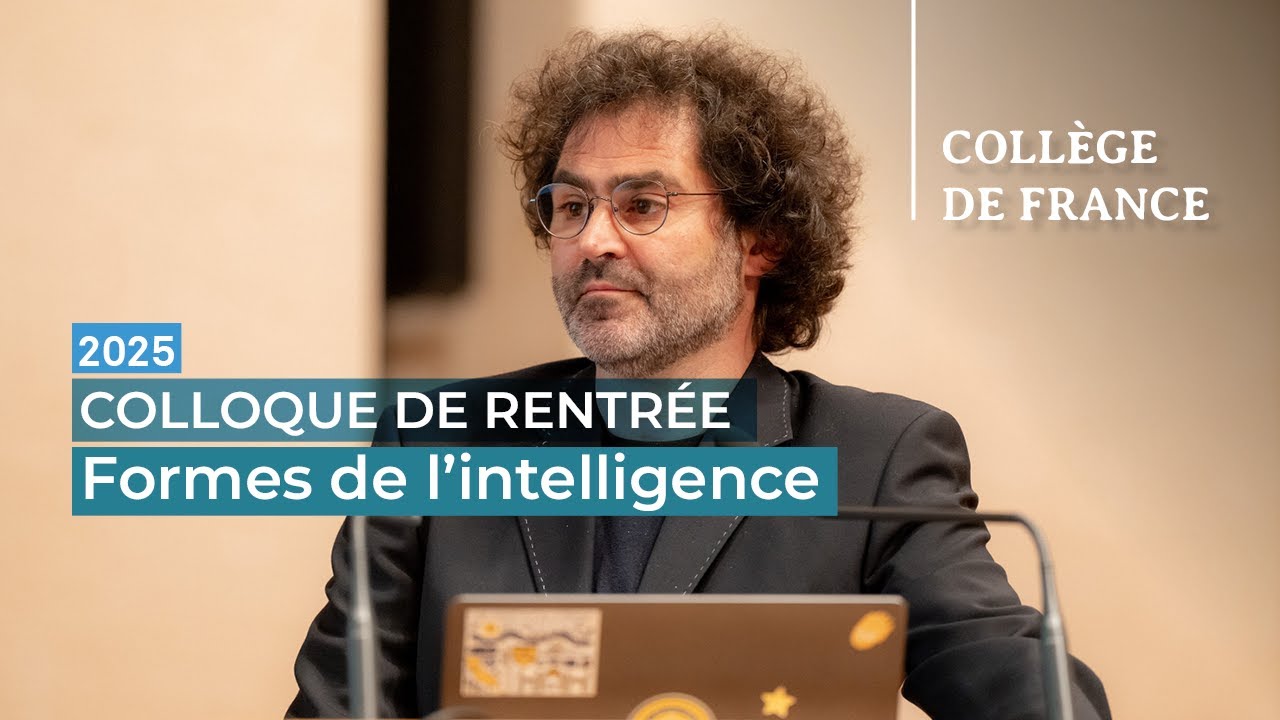
Formalisation mathématique et apprentissage machine dans la création musicale - C.-E. Cella
Keywords
Summary
177 words
Critical Evaluation
The lecture offers a thoughtful and nuanced perspective on the intersection of AI and music creation. Cella demonstrates a deep understanding of both musical theory and computational methods, drawing on concrete examples from Bach and Ligeti to illustrate the evolution from symbolic to signal-based composition. His use of philosophical categories (mimesis and katharsis) provides a useful framework for discussing the potential of AI to go beyond mere imitation. The argument is well-structured, moving from definitions of creativity to a provocative thought experiment about the finite combinatorial space of digital audio, which challenges deterministic views of creativity. However, the lecture is primarily an opinion piece rather than a rigorous scientific presentation; while he references established theories (Boden, Rhodes, Turing), he does not provide detailed evidence or empirical data to support his claims. The philosophical definitions are acknowledged as imprecise, which is acceptable given the context. The discussion of his own work on orchestration is intriguing but lacks technical depth, leaving the audience wanting more specifics. The adéquation between title and content is strong, as the lecture indeed addresses mathematical formalization and machine learning in music creation. Overall, the lecture is intellectually stimulating and offers valuable insights, but it would benefit from more concrete examples and a clearer articulation of the technical challenges and solutions.
213 words
Title / Content Match
The title accurately reflects the content, which discusses the intersection of mathematical formalization and machine learning in music creation.
Quality & Reliability
8/10
The speaker is an associate professor at UC Berkeley with a hybrid background in music composition and computational creativity. The lecture is part of a prestigious academic event (Collège de France colloquium). The content is well-structured, references established theories (Margaret Boden, Alan Turing, Margaret Boden's 4Ps), and includes concrete musical examples. However, it is an opinion/expert talk rather than a peer-reviewed presentation, and some philosophical simplifications are acknowledged.
Key Moments
Markers derived by PSI from the transcript: the creator did not define chapters.
- Introduction: positioning of AI in artistic creation, use of mimesis and katharsis.
- Example of Bach fugue: multi-scale relational complexity, geometric transformations.
- Example of Ligeti's Atmosphères: shift from symbol to signal, focus on texture and density.
- Two spaces in music: symbolic space of quantities and analytical space of qualities.
- Discussion on creativity: theories of Boden and Rhodes, 4Ps.
- Ada Lovelace vs Turing on machine creativity; machines can be creative through errors.
- Examples from DALL-E: combining concepts, questioning if this is creative.
- Thought experiment: finite combinatorial space of digital audio, questioning creativity.
- Introduction to orchestration as a combinatorial problem.
- Definition of mimesis and katharsis, and their relevance to AI.
- Examples from Cella's work: computational orchestration and co-composition.
- Conclusion: co-evolution of humans and machines, shared structures.
Cited Sources
- Colloque de rentrée 2025 : Formes de l’intelligence : IA, connaissance, déduction, apprentissage — Official page of the colloquium where this lecture took place.
- Collège de France — Institution hosting the lecture.
- Bluesky profile of Collège de France — Social media presence of the institution.
- LinkedIn of Collège de France — Social media presence of the institution.
- Fondation du Collège de France — Donation page, not directly related to content.
- Threads of Collège de France — Social media presence of the institution.
Concurring Sources
- Margaret Boden, The Creative Mind: Myths and Mechanisms — Boden's book is a foundational work on computational creativity, aligning with the lecture's discussion.
- Mel Rhodes, An Analysis of Creativity — Rhodes' 4Ps model is referenced in the lecture.
Dissenting Sources
- Ada Lovelace's notes — Lovelace argued that computers cannot be creative, a view that the lecture challenges.
Contribution & Novelties
The lecture offers a novel perspective on AI in music creation by framing it through the philosophical lens of mimesis and katharsis, arguing that machine learning can move beyond imitation to enable transformative, cathartic experiences. It also presents a thought experiment that challenges deterministic views of creativity by highlighting the finite combinatorial space of digital audio. The speaker’s own work on computational orchestration and human-machine co-composition provides concrete examples of how mathematical models can structure aesthetic processes.
Pour aller plus loin :
- Margaret Boden’s creativity types — Overview of computational creativity, including Boden’s framework.
- Mel Rhodes’ 4Ps of creativity — Explanation of the 4Ps model.
- Ada Lovelace’s notes on the Analytical Engine — Historical context on Lovelace’s views on machine creativity.
- Alan Turing’s Computing Machinery and Intelligence — Turing’s seminal paper discussing machine intelligence.
- DALL-E — Information on the text-to-image model mentioned in the lecture.
145 words
Radar Profile
The radar profile shows high scores in quality of information and reliability, reflecting the speaker's expertise and the academic context. The quantity of information is moderate, as the lecture is more conceptual than data-heavy. The technical level is high but accessible, indicating a balance between depth and clarity.
💬 No comments were provided for analysis.