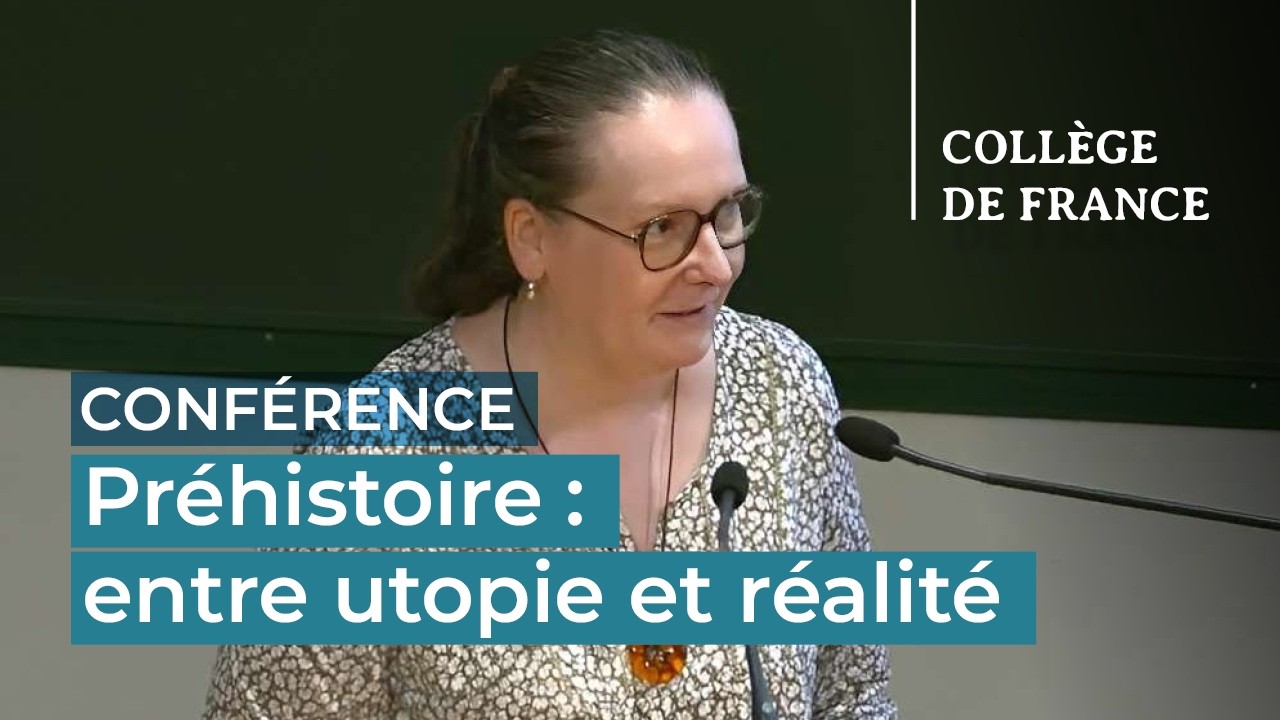
Préhistoire : entre utopie et réalité (4) - 2026
Keywords
Summary
170 words
Critical Evaluation
The lecture provides a rich and well-documented overview of the intersection between prehistoric archaeology and popular culture. Catherine Schwab demonstrates deep expertise, drawing on her curatorial experience and knowledge of museum collections. She effectively uses specific examples, such as the evolution of illustrations in Louis Figuier’s book, to illustrate how early scientific visualizations were influenced by classical aesthetics and later by ethnographic data. The argument is coherent and well-structured, moving from the birth of the discipline to contemporary media. However, the lecture is primarily descriptive rather than analytical; it does not deeply engage with theoretical debates about the social construction of prehistoric narratives. The sources cited are mostly historical works and popular media, with limited reference to recent scholarship. The speaker’s authority is evident, but the talk is aimed at a general audience, which may limit its depth. The title accurately reflects the content, and the lecture successfully highlights the tension between scientific knowledge and fictional representations. Overall, it is a valuable contribution to public understanding of the history of prehistory, though it could benefit from more critical analysis of the ideological underpinnings of these representations.
186 words
Title / Content Match
The title accurately reflects the content, which explores the gap between scientific knowledge and popular representations of prehistory.
Quality & Reliability
8/10
The speaker is a senior curator at the National Archaeological Museum, with deep expertise in prehistoric art and material culture. The lecture is grounded in historical sources and museum objects, though it is a popular science talk rather than a peer-reviewed presentation.
Key Moments
Markers derived by PSI from the transcript: the creator did not define chapters.
- Introduction by Jean-Jacques Hublin, presenting Catherine Schwab and her role in the exhibition.
- Schwab discusses her collection of prehistoric figurines and the stereotypical image of the caveman.
- Overview of the three major works of prehistoric fiction: La Guerre du feu, the film, and Rahan.
- Analysis of the club as a symbol of prehistoric man and its persistence in popular culture.
- Examination of early visualizations in Louis Figuier's book and the influence of classical art.
- Discussion of the role of ethnography and colonial explorations in shaping prehistoric imagery.
- Exploration of prehistoric themes in comics, films, and other media throughout the 20th century.
- Reflection on the enduring gap between scientific knowledge and popular fiction.
Cited Sources
- Conference program: Préhistoire : entre utopie et réalité — Official program of the lecture series, providing context for the exhibition and related events.
- Interviews with Jean-Jacques Hublin — Playlist of interviews with Jean-Jacques Hublin, complementing the lecture series.
- Collège de France official website — Institutional website of the Collège de France, hosting lectures and resources.
Concurring Sources
- Collège de France official website — Institutional source confirming the lecture series and the speaker's affiliation.
External References
Contribution & Novelties
This lecture offers a unique perspective on the history of popular representations of prehistory, drawing on the speaker’s curatorial expertise and the exhibition’s context. It highlights the persistence of stereotypes and the influence of historical and cultural factors on scientific visualization.
Pour aller plus loin :
- History of archaeology — Provides background on the development of prehistoric archaeology.
- La Guerre du feu (novel) — Details on the novel and its adaptations.
- Rahan (comics) — Information on the comic series and its cultural impact.
83 words
Radar Profile
The radar profile shows high scores in information quantity, quality, and reliability, reflecting the speaker's expertise and the lecture's solid content. The technical level is moderate, suitable for a general audience, which is consistent with the nature of the talk.