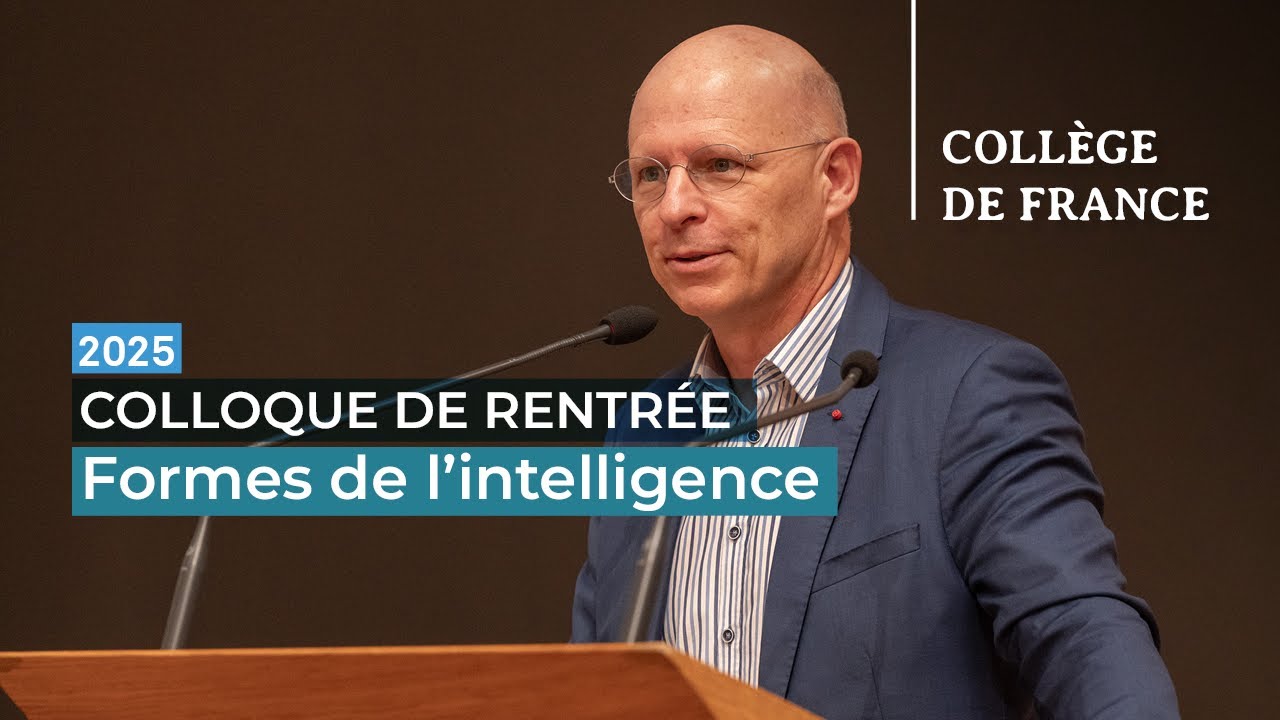
Comment le cerveau humain se compare-t-il aux intelligences artificielles actuelles ? - S. Dehaene
Keywords
Summary
151 words
Critical Evaluation
The presentation is a masterful synthesis of current research at the intersection of neuroscience and AI. Dehaene’s argument is logically structured, moving from evidence of convergence between artificial and biological neural networks to a critical analysis of their differences. He provides concrete examples from his own laboratory, such as the ’letter box’ area for reading, and references key studies like those of Bertrand Thirion and Christophe Pallier. The scientific rigor is high, as he carefully distinguishes between what is well-established and what remains speculative. He acknowledges the impressive predictive power of deep learning models for brain activity, but also highlights their limitations, such as the need for massive data and their fragility in certain tasks. The talk is balanced, avoiding both hype and dismissal of AI. The sources cited are credible, primarily from peer-reviewed literature and the speaker’s own research. The title accurately reflects the content, and the talk delivers on its promise to compare human and artificial intelligence. The only minor weakness is that some concepts are presented quickly, but this is appropriate for a general audience. Overall, this is an excellent, informative, and thought-provoking presentation.
187 words
Title / Content Match
The title accurately reflects the content, which systematically compares human brain functions with current AI capabilities.
Quality & Reliability
9/10
Presentation by a leading cognitive neuroscientist at a prestigious institution, based on peer-reviewed research and direct laboratory work. The content is rigorous, well-structured, and supported by references to specific studies.
Key Moments
Markers derived by PSI from the transcript: the creator did not define chapters.
- Introduction: Dehaene sets the stage, expressing his admiration for the human brain and outlining the talk's structure.
- Neural inspiration: He explains how AI is inspired by synaptic plasticity and distributed processing in the brain.
- Hierarchical vision: He shows how deep networks develop features similar to the visual cortex, citing Hubel and Wiesel.
- Reading and the 'letter box': He discusses his research on how neural networks model reading acquisition and the visual word form area.
- Language models: He presents evidence that large language models develop linguistic representations that align with brain activity, referencing the 'Petit Prince' project.
- Critical comparison: He argues that the human brain is not a blank slate, but is structured from birth, with specialized circuits.
- Human advantages: He highlights human abilities in learning from few examples, abstract representation, and robustness.
- Challenges for AI: He points out remaining limitations of AI, such as reasoning and causal understanding, and suggests future directions.
Cited Sources
- Collège de France - Forms of Intelligence symposium — Official page for the symposium where this talk was given.
- Collège de France — Institutional website of the Collège de France.
Concurring Sources
- Thirion et al., 2014 — Studies showing correspondence between deep network layers and brain areas.
- Pallier et al., 2023 — Research on the 'Petit Prince' project and brain-language alignment.
External References
Contribution & Novelties
This talk provides a comprehensive and up-to-date overview of the relationship between human brain and AI, emphasizing both the inspirations and the remaining gaps. It synthesizes recent research from the speaker’s laboratory and others, offering a balanced perspective.
Pour aller plus loin :
- Neural correlates of consciousness — Relevant to understanding what AI lacks compared to human cognition.
- Deep learning — Background on the neural networks discussed.
- Visual word form area — Directly related to the ’letter box’ concept mentioned.
- Large language model — Context for the language models discussed.
90 words
Radar Profile
The radar profile shows high scores in quantity and quality of information, with a slightly lower but still strong technical level. This indicates a dense, well-supported presentation that is accessible to a broad audience while maintaining scientific depth.