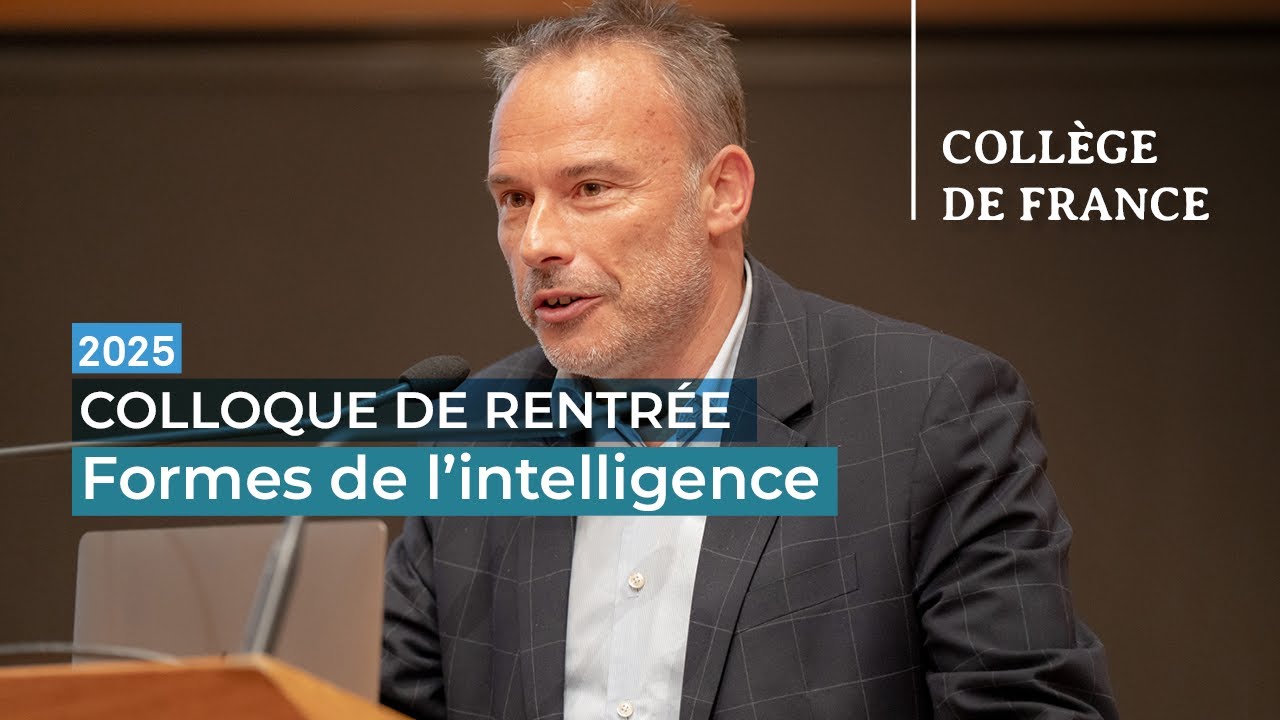
Comment l’IA transforme le droit et la justice - Benoît Frydman
Keywords
Summary
110 words
Critical Evaluation
The lecture provides a sophisticated historical and theoretical analysis of AI’s impact on law. Frydman demonstrates deep knowledge of legal philosophy and history, connecting contemporary AI applications to long-standing ambitions of formalizing law. He effectively argues that AI in law is not a radical break but a continuation of projects like Leibniz’s. The argumentation is solid, though it remains at a conceptual level without empirical case studies. The sources are not explicitly cited, but references to Grotius, Leibniz, and Coase are clear. The title is accurate. The lecture is well-structured and intellectually stimulating, though it may be dense for non-specialists. The lack of concrete examples of AI failures could be seen as a weakness. Overall, it is a high-quality academic contribution.
121 words
Title / Content Match
The title accurately reflects the content, which focuses on the transformation of law and justice by AI.
Quality & Reliability
8/10
High-quality academic lecture by a law professor at a prestigious institution, with historical grounding and references to Leibniz, Grotius, and Coase. However, no formal citations or peer-reviewed sources are provided in the video itself.
Key Moments
Markers derived by PSI from the transcript: the creator did not define chapters.
- Introduction: AI landing in legal practice, risks of algorithmic governance.
- Historical models of legal intelligence: interpretation vs. formalization.
- Grotius and the geometric model of law.
- Leibniz's dream of a calculable law.
- Economic analysis of law and Coase theorem.
- AI in law: expert systems and predictive justice.
- Risks: lack of control, threats to rights, opacity.
- Need for safeguards and technological countermeasures.
Cited Sources
- Collège de France - Colloque de rentrée 2025 — Official page of the conference where this lecture was given.
- Collège de France — Institution's official website.
- Bluesky profile — Social media profile of the institution.
- LinkedIn page — LinkedIn page of the institution.
- Threads profile — Social media profile of the institution.
Concurring Sources
- Stanford Encyclopedia of Philosophy - Leibniz's Philosophy of Law — Supports the historical claims about Leibniz's legal formalism.
Dissenting Sources
- No discordant sources found — No sources contradicting the lecture's main arguments were identified.
External References
Contribution & Novelties
The lecture offers a historical perspective on AI in law, linking contemporary developments to Leibniz’s project and the economic analysis of law. It emphasizes the continuity of formalization attempts and the political implications.
Pour aller plus loin :
- Leibniz and the calculable law — Stanford Encyclopedia of Philosophy entry on Leibniz’s legal philosophy.
- Coase theorem — Overview of the Coase theorem and its applications.
- Predictive justice — Concept of using AI to predict court decisions.
75 words
Radar Profile
The radar profile shows high scores in information quantity, quality, and reliability, with a slightly lower technical level, reflecting the lecture's strong academic foundation but moderate technical depth.