Keynote Lecture: Nancy Kanwisher - CCN 2025
Keywords
Summary
198 words
Critical Evaluation
Value of the Information & Strength of the Argument
The talk provides valuable insights into the neural basis of intuitive physics, presenting a compelling case for the existence of dedicated brain regions that perform physical reasoning. The argumentation is solid, built on a series of well-designed fMRI experiments that systematically rule out alternative explanations, such as overlap with the multiple demand system or low-level visual confounds. The speaker carefully distinguishes between correlation and causation, acknowledging that causal evidence is still forthcoming. The use of multiple complementary methods (localizers, MVPA, decoding) strengthens the conclusions. The discussion of AI models’ limitations adds a valuable comparative perspective, highlighting the uniqueness of human physical reasoning.
Scientific Rigor, Source Quality, Title Accuracy
The talk demonstrates high scientific rigor, with clear descriptions of experimental methods and results. The speaker references specific studies and collaborators, and the work is grounded in a strong theoretical framework. The title accurately reflects the content, focusing on intuitive physical reasoning. The talk does not overstate findings, and the speaker explicitly notes where evidence is incomplete. The sources cited are primarily the speaker’s own published work and that of colleagues, which is appropriate for a keynote. The talk is well-structured and accessible to a scientific audience.
204 words
Title / Content Match
The title accurately reflects the content: a keynote lecture by Nancy Kanwisher at CCN 2025, focusing on intuitive physical reasoning in the human brain.
Quality & Reliability
9/10
The talk is delivered by a leading expert in cognitive neuroscience, with a strong track record of peer-reviewed publications. The content is based on empirical studies, including fMRI experiments and computational modeling, and is presented with appropriate scientific caution. The speaker acknowledges limitations and ongoing debates, enhancing credibility.
Key Moments
Markers derived by PSI from the transcript: the creator did not define chapters.
- Introduction of Nancy Kanwisher by Iris, highlighting her contributions.
- Kanwisher begins her talk, acknowledging collaborators and setting the agenda.
- Discussion of visual recognition progress and the need to study physical reasoning.
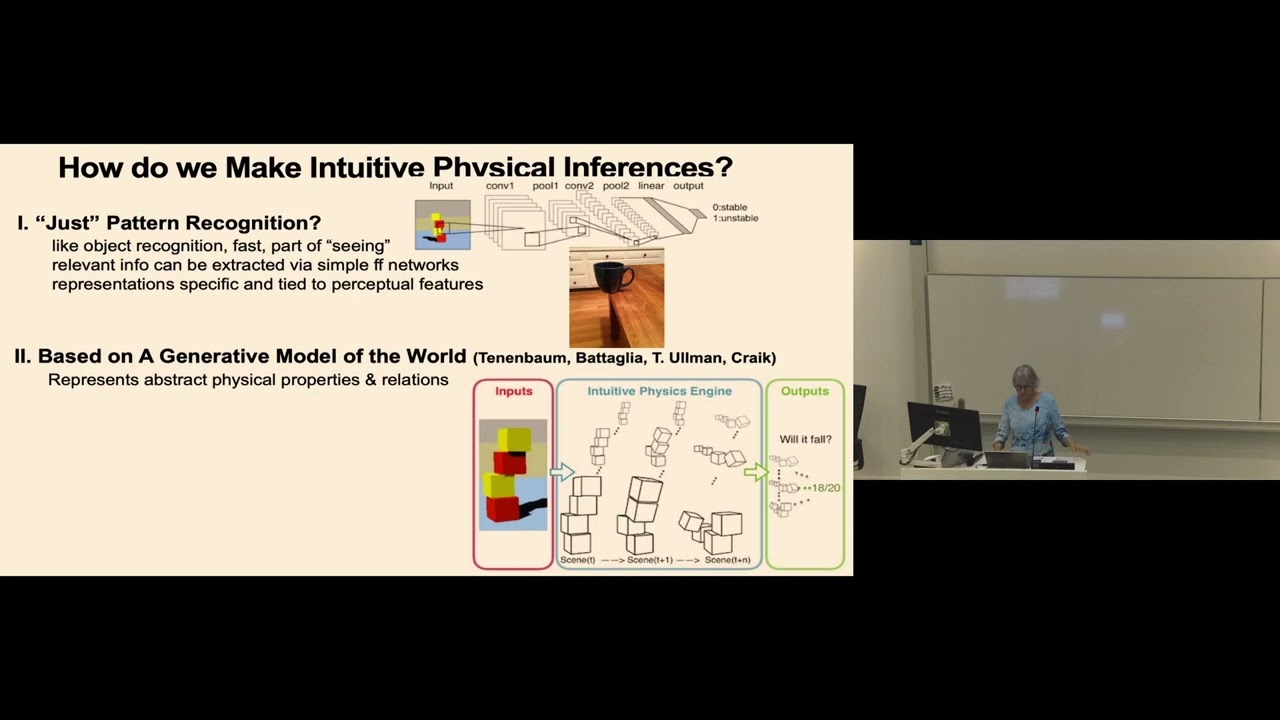
- Introduction of two computational frameworks: pattern recognition vs. generative model.
- Presentation of early fMRI findings identifying brain regions engaged in physical inference.
- Comparison with the multiple demand system, showing minimal overlap.
- Decoding of mass information from the physics network using MVPA.
- Decoding of contact relationships and prediction of collisions.
- Testing of video-trained neural networks and vision-language models on similar tasks, showing poor performance.
- Discussion of ongoing patient studies to establish causal role.
Cited Sources
- Fischer, J., Mikhael, J. G., Tenenbaum, J. B., & Kanwisher, N. (2016). Functional neuroanatomy of intuitive physical inference. — Early work identifying brain regions engaged in physical inference.
- Schwettmann, S., Tenenbaum, J. B., & Kanwisher, N. (2019). Invariant representations of mass in the human brain. — Decoding mass information from the physics network.
- Schultheis, M., et al. (2024). Intuitive physics understanding in vision-language models. — Reference to a recent paper on vision-language models' performance on intuitive physics benchmarks.
Concurring Sources
- Tenenbaum, J. B., et al. (2011). How to grow a mind: Statistics, structure, and abstraction. — Theoretical framework for generative models in cognition.
- Baillargeon, R. (2004). Infants' physical world. — Early developmental evidence for intuitive physics.
Dissenting Sources
- Davis, T., & Poldrack, R. A. (2013). Measuring neural representations with fMRI: Practices and pitfalls. — Potential methodological concerns about fMRI decoding and its interpretation.
Contribution & Novelties
This talk synthesizes a decade of research on intuitive physics in the brain, providing a comprehensive overview of the evidence for a dedicated neural system. The novelty lies in the systematic combination of fMRI decoding, computational modeling, and comparisons with AI models, offering a multi-faceted perspective. The talk also highlights ongoing efforts to establish causal roles, which is a critical next step.
Pour aller plus loin :
- Intuitive physics — Overview of the field.
- Multiple demand system — Related concept discussed in the talk.
- Generative model — Theoretical framework underlying the physics engine hypothesis.
94 words
Radar Profile
The radar profile shows high scores across all dimensions, with particularly strong performance in quality of information and reliability. The talk is technically detailed but accessible, and the speaker's expertise is evident. The only slightly lower score is in technical level, which is still high, reflecting the advanced nature of the content.
💬 Sur les 0 commentaires analysés, aucune tendance n'a pu être identifiée.