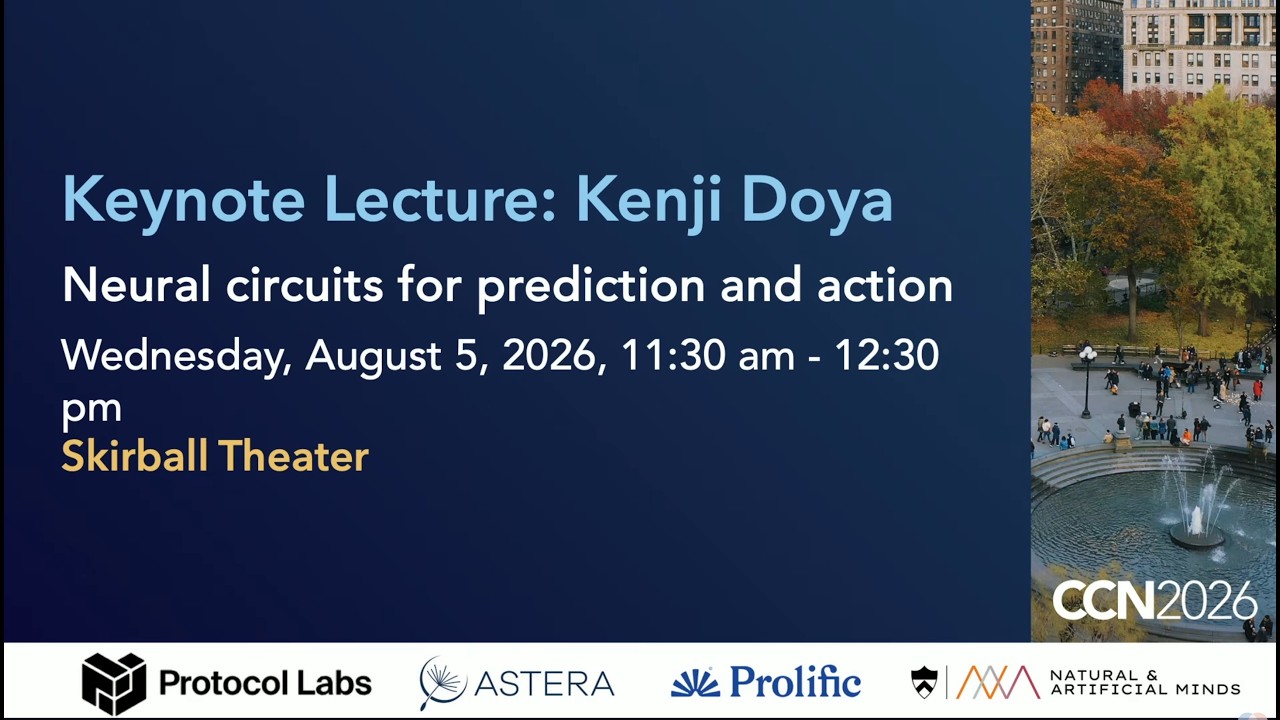
CCN 2026 | Keynote: Kenji Doya
Keywords
Summary
217 words
Critical Evaluation
Value of the Information & Strength of the Argument
The talk provides valuable insights into the neural mechanisms of reinforcement learning and mental simulation, synthesizing decades of research. Doya’s argumentation is solid, grounded in both theoretical frameworks and experimental evidence from his own lab. He clearly explains the logic behind each hypothesis and presents data that either supports or refines it. For instance, he shows that serotonin’s effect is not simply on temporal discounting but is context-dependent, highlighting the complexity of neuromodulation. The integration of robotics, machine learning, and neurobiology is compelling, demonstrating the bidirectional benefits of these fields.
Scientific Rigor, Source Quality, Title Accuracy
The talk demonstrates high scientific rigor, with references to key studies (e.g., Schultz et al. on dopamine, and his own publications). However, as a keynote, it does not provide a full literature review, and some claims are presented as hypotheses without exhaustive citation. The title accurately reflects the content, though the talk is broader than ‘prediction and action’, covering also learning and mental simulation. The speaker’s authority is unquestionable, given his extensive publication record and awards.
181 words
Title / Content Match
The title 'Neural circuits for prediction and action' accurately reflects the main theme, though the talk covers broader topics including reinforcement learning and mental simulation.
Quality & Reliability
8/10
The talk is given by a leading expert in computational neuroscience, with a strong publication record and honors. The content is based on established research and his own experimental work, but it is a keynote presentation, not a peer-reviewed article, so some claims are presented as hypotheses.
Key Moments
Markers derived by PSI from the transcript: the creator did not define chapters.
- Introduction of Kenji Doya by session chair
- Doya introduces his lab and research themes
- Overview of reinforcement learning concepts
- Robot learning to stand up as example of delayed reward
- Basal ganglia and dopamine in reinforcement learning
- Experimental evidence from rat choice task and calcium imaging
- Serotonin and temporal discounting: optogenetics experiments
- Model-free vs model-based reinforcement learning
- Mental simulation and brain circuits: fMRI grid navigation
- Neural decoding in mouse parietal cortex during virtual navigation
Cited Sources
- Okinawa Institute of Science and Technology — Doya's affiliation and lab
- Neural Networks (journal) — Doya served as Co-Editor in Chief
Concurring Sources
- Schultz, W., Dayan, P., & Montague, P. R. (1997). A neural substrate of prediction and reward. — Foundational study on dopamine and reward prediction error.
- Doya, K. (2008). Modulators of decision making. — Doya's own work on neuromodulators and reinforcement learning parameters.
Contribution & Novelties
The talk synthesizes Doya’s extensive research on reinforcement learning and mental simulation, offering a comprehensive framework linking computational models to neural circuits. It highlights novel findings on serotonin’s role in temporal discounting and the neural basis of mental simulation. The integration of robotics and neurobiology provides a unique perspective.
Pour aller plus loin :
- Reinforcement learning — Foundational concept.
- Basal ganglia — Key brain region discussed.
- Dopamine — Neuromodulator central to reward prediction error.
- Serotonin — Neuromodulator implicated in temporal discounting.
- Temporal difference learning — Algorithm underlying dopamine responses.
89 words
Radar Profile
The radar profile shows high scores across all dimensions, indicating a well-rounded and reliable presentation. The talk is rich in information, technically sound, and based on credible sources, with a strong alignment between title and content.