Keynote Lecture: Yasuo Kuniyoshi - CCN 2025
Keywords
Summary
185 words
Critical Evaluation
Value of the Information & Strength of the Argument
The talk provides a valuable perspective on the limitations of current AI and proposes a novel framework centered on embodiment. The argumentation is strong in its use of concrete examples from robotics, such as the passive dynamic walker and the humanoid robot learning to stand up, which effectively illustrate the theoretical points. The concept of ’necks’ as sparse important states emerging from embodiment is insightful and well-supported by motion capture data. The introduction of super-embodiment and physical reservoir computing broadens the scope and connects to existing computational theories. However, the argumentation is somewhat one-sided, as it does not deeply engage with alternative approaches or potential criticisms. The claims about emotion, aesthetics, and moral are presented more as a roadmap than a fully developed argument, leaving gaps in the logical progression.
Scientific Rigor, Source Quality, Title Accuracy
The talk demonstrates scientific rigor through references to published papers and experimental demonstrations from the speaker’s lab. The sources cited are relevant and credible, including work on physical reservoir computing and complex systems. The title accurately reflects the content, which is a keynote lecture on embodiment and super-embodiment. The talk is well-structured, following a clear outline of key concepts. However, as a keynote, it is more of an expert opinion than a peer-reviewed study, and some claims are made without detailed evidence. The lack of external validation for some of the more speculative ideas, such as the link to consciousness, slightly reduces the overall rigor.
250 words
Title / Content Match
The title accurately reflects the content, which focuses on embodiment and super-embodiment as a constructive approach to open-ended and human-aligned intelligence.
Quality & Reliability
8/10
The talk is a keynote by a leading researcher in cognitive robotics, presenting a coherent theoretical framework supported by experimental demonstrations from his lab and references to published papers. However, it is largely an opinion piece with limited external validation and some claims are presented without detailed evidence.
Key Moments
Markers derived by PSI from the transcript: the creator did not define chapters.
- Introduction of the problem: AI failures on out-of-distribution inputs, adversarial attacks, and alignment issues.
- Definition of embodiment as stable constraints orthogonal to interactions, with examples.
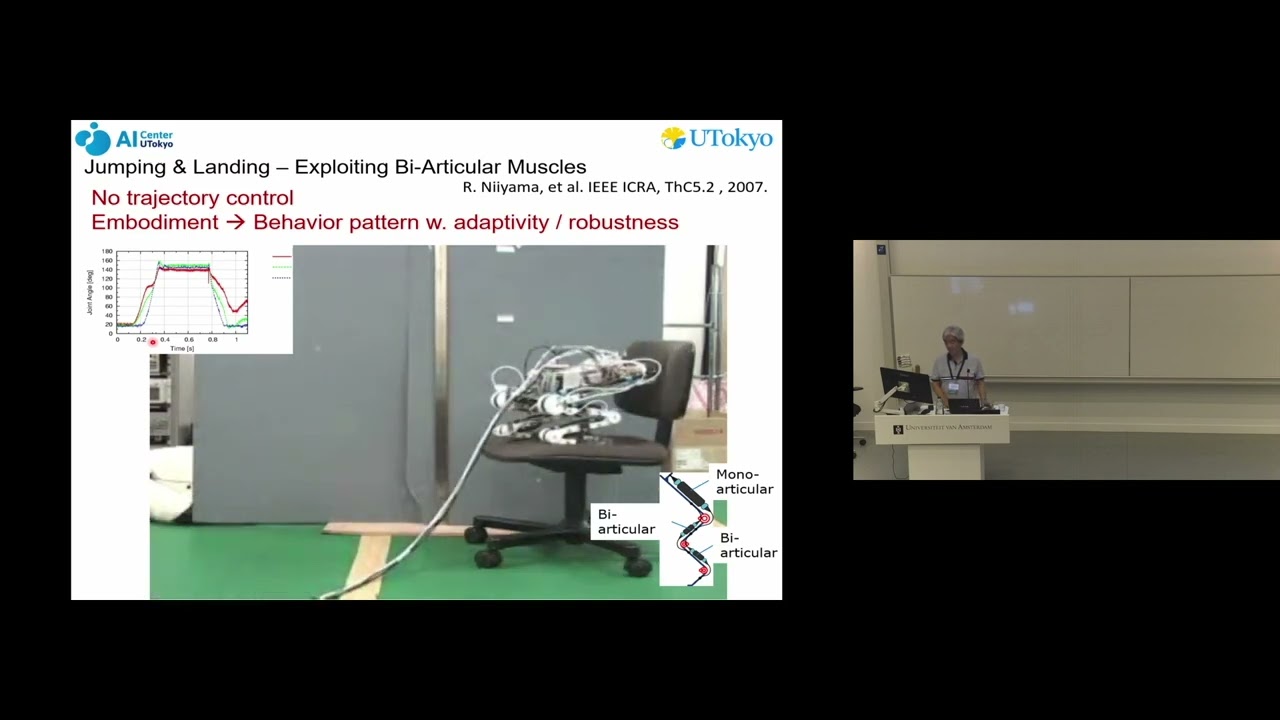
- Demonstration of passive dynamic walker and jumping robot, illustrating emergent behavior from body structure.
- Analysis of humanoid robot learning to stand up, introducing the concept of 'necks' as sparse important states.
- Introduction of super-embodiment and physical reservoir computing, with octopus robot example.
- Discussion of emergence through chaotic maps and neural oscillators, leading to adaptive behaviors.
- Conclusion: embodiment as basis for open-ended intelligence and human alignment, with future directions.
Cited Sources
- From Embodiment to Super-Embodiment: A Constructive Approach to Open-Ended and Human Aligned Intelligence/Moral — The speaker's own paper presenting the framework discussed in the talk.
- Physical reservoir computing — Referenced in the context of the octopus robot and generalization of embodiment.
- Passive dynamic walking — Referenced as a classic example of embodiment.
Concurring Sources
- Embodied Cognition (Stanford Encyclopedia of Philosophy) — Supports the idea that cognition is deeply rooted in the body's interactions with the world.
- Physical reservoir computing in soft robotics — Provides evidence for the computational power of physical bodies, aligning with the talk's claims.
Dissenting Sources
- On the Dangers of Stochastic Parrots: Can Language Models Be Too Big? — This paper critiques the limitations of large language models, which contrasts with the optimistic view of AI progress but aligns with the talk's critique of current AI.
Contribution & Novelties
The talk offers a novel perspective on AI alignment by grounding it in embodiment, arguing that physical constraints can provide a foundation for open-ended intelligence and human-like moral reasoning. It introduces the concept of ‘super-embodiment’ to generalize embodiment beyond the physical body, and demonstrates how emergent behaviors can arise from simple coupled dynamics. The idea of ’necks’ as sparse important states is a fresh contribution to understanding skill acquisition and communication.
Pour aller plus loin :
- Embodied cognition — Relevant to the philosophical underpinnings of the talk.
- Reservoir computing — Directly related to the physical reservoir computing concept.
- Passive dynamics — Further reading on passive dynamic walking.
- Free energy principle — A related theoretical framework for understanding adaptive behavior.
119 words
Radar Profile
The radar profile shows high scores in quantity and quality of information, reflecting the depth and relevance of the content. The technical level is moderately high, indicating a specialized audience. The global reliability is slightly lower due to the opinion-based nature of the talk, but still solid.
💬 No comments were provided for analysis.