Keynote Lecture: Anna Schapiro - CCN 2025
Keywords
Summary
125 words
Critical Evaluation
Value of the Information & Strength of the Argument
The talk provides substantial value by integrating computational modeling with empirical data to propose a novel mechanistic account of hippocampal function. The argumentation is solid, building on established theory (CLS) and addressing key questions with testable predictions. The speaker clearly explains the logic and evidence, making a compelling case for the role of the monosynaptic pathway in gradual learning. The presentation is well-structured, with clear transitions between ideas and appropriate use of examples.
Scientific Rigor, Source Quality, Title Accuracy
The scientific rigor is high, as the talk is based on peer-reviewed research and established theories. The speaker cites relevant literature and presents original data. The title accurately reflects the content, focusing on learning representations of specifics and generalities over time. The talk is appropriate for a specialized audience, and the speaker does not overstate conclusions, acknowledging limitations and open questions.
149 words
Title / Content Match
The title accurately reflects the content, which focuses on learning representations of specifics and generalities over time.
Quality & Reliability
8/10
The talk presents original research from a leading lab, grounded in established theory (CLS) and supported by computational models and empirical data. The speaker is a recognized expert, and the content is consistent with current scientific understanding. However, as a conference keynote, it may not undergo the same peer-review scrutiny as a journal article.
Key Moments
Markers derived by PSI from the transcript: the creator did not define chapters.
- Introduction and overview of the question: how do we learn across timescales?
- Complementary learning systems theory and the role of hippocampus in rapid learning and replay.
- Proposal that hippocampus is not homogeneous, with distinct pathways for different learning functions.
- Computational model SEAHORSE and its two pathways (trisynaptic and monosynaptic).
- Evidence for statistical learning in hippocampus and necessity of hippocampus for this learning.
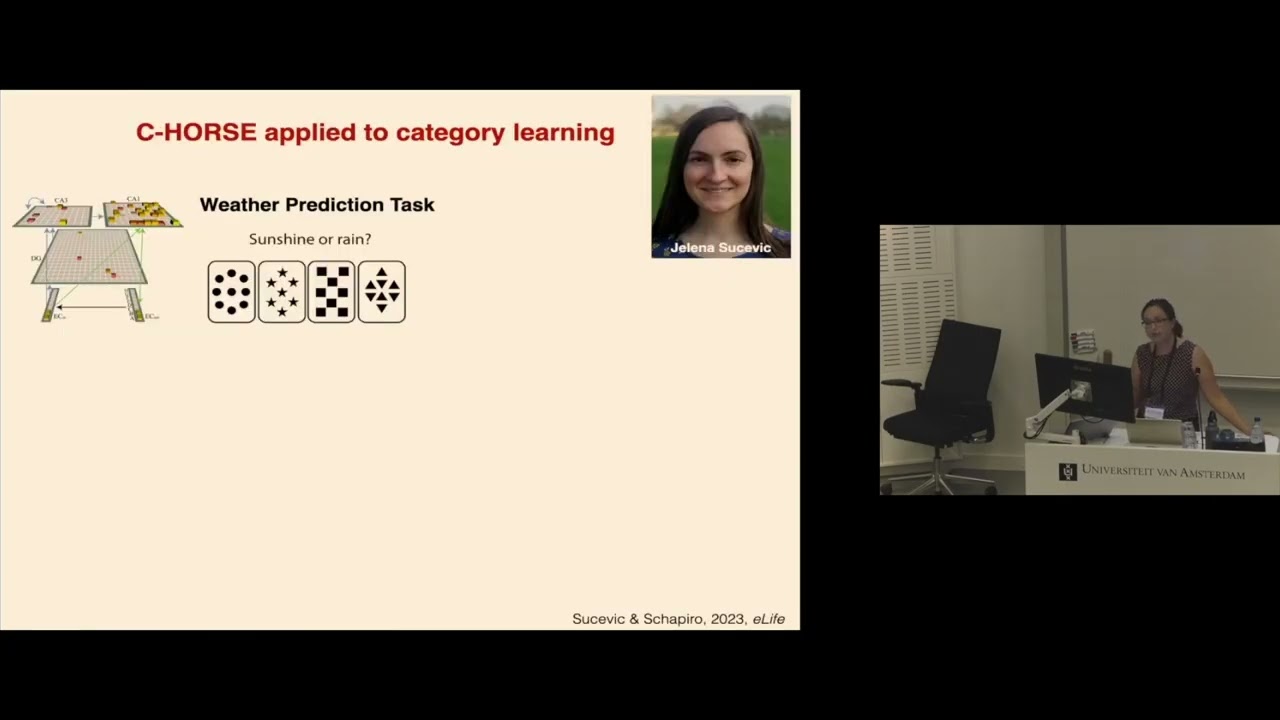
- Application of model to category learning tasks, showing trade-off between pathways.
- New project on mixture of experts with prefrontal cortex for adaptive use of representations.
- Associative inference task and predictions for different learning strategies.
- Behavioral results showing interleaved learning leads to overlapping representations and false alarms.
- Discussion of implications and future directions.
Cited Sources
- Complementary learning systems theory — Referenced as foundational theory for the talk.
- SEAHORSE model — Computational model of hippocampus developed by the lab.
- REMERGE model — Alternative model for associative inference.
Concurring Sources
- Complementary learning systems theory — The talk builds on this theory and extends it.
- Hippocampal subfields — The talk discusses distinct roles of CA1, CA3, and dentate gyrus.
Dissenting Sources
- Alternative models of hippocampal function — Other models may emphasize different mechanisms for inference and learning.
Contribution & Novelties
The talk offers a novel perspective on hippocampal function by proposing that the monosynaptic pathway supports gradual, overlapping representations for statistical and category learning, complementing the classic pattern-separated trisynaptic pathway. This extends the complementary learning systems framework and provides a mechanistic account of how the brain balances rapid and slow learning. The integration of computational modeling with empirical data strengthens the claims and opens new avenues for research.
Pour aller plus loin :
- Complementary learning systems — Overview of the theory.
- Hippocampus — General information on hippocampal anatomy and function.
- Statistical learning — Concept of learning statistical regularities.
98 words
Radar Profile
The radar profile shows high scores in information quantity and quality, with a moderate technical level. This indicates a content-rich talk that is accessible to a specialized audience but may require some background knowledge. The overall reliability is high, reflecting the speaker's expertise and the empirical grounding of the work.