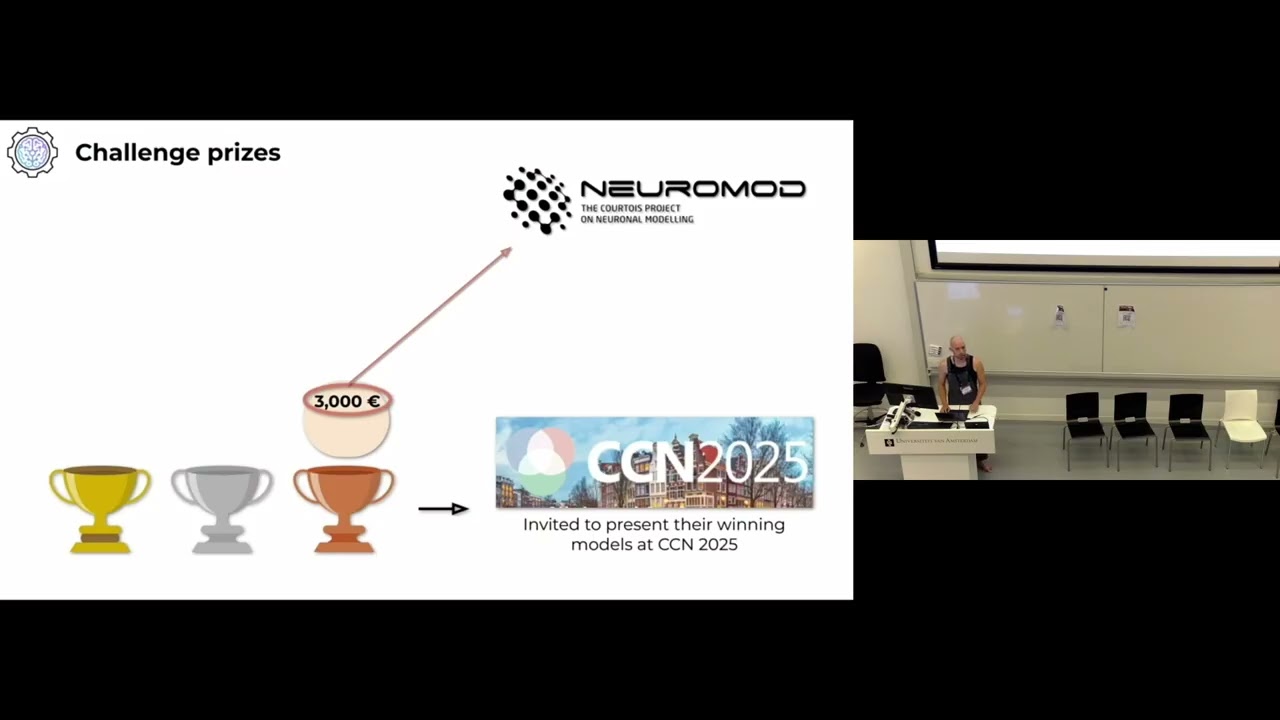
Algonauts Project: 2025 Challenge - CCN 2025
Keywords
Summary
171 words
Critical Evaluation
Value of the Information & Strength of the Argument
The video provides valuable insights into the design and outcomes of a large-scale neuroscience challenge. The organizers clearly articulate the challenge’s motivation, methodology, and results, including quantitative metrics and comparisons. The winning teams present their technical approaches in detail, including model architectures, feature extraction, and ablation studies, which adds depth to the discussion. The argumentation is solid, grounded in empirical results and comparisons to baselines. However, the presentations are concise and may not fully explore limitations or alternative interpretations. The panel discussion offers perspectives on future directions, but it is brief and lacks deep critical analysis. Overall, the content is informative and well-structured, but it is primarily a report of results rather than a critical evaluation of methods.
Scientific Rigor, Source Quality, Title Accuracy
The scientific rigor is high: the challenge uses a well-established dataset (Neuromod) and a clear evaluation metric (Pearson correlation). The organizers emphasize out-of-distribution generalization, which is a robust test of model validity. The sources cited include the Neuromod dataset and the Algonauts Project website, but specific references are not provided in the video. The title accurately reflects the content, as it is a workshop on the Algonauts Project 2025 Challenge. The presentation is consistent with the title and provides a comprehensive overview. No comments were provided for analysis.
221 words
Title / Content Match
The title accurately reflects the content, which is a workshop on the Algonauts Project 2025 Challenge.
Quality & Reliability
8/10
Presentation by challenge organizers and winners, with detailed methodology and results, but lacking peer review and external verification.
Key Moments
Markers derived by PSI from the transcript: the creator did not define chapters.
- Introduction to the Algonauts Project 2025 Challenge by Al Gayford
- Explanation of challenge design and data (Neuromod dataset)
- Presentation of challenge results and winners
- Third place team SDA presents their multimodal recurrent ensemble approach
- Second place team Stfandi presents their model
- First place team NCG presents their model
- Panel discussion on future challenges and large-scale neural datasets
Cited Sources
- Algonauts Project website — Mentioned as the platform for the challenge and related initiatives.
- Neuromod dataset — Used as the basis for the challenge data.
- Kodbench — Platform hosting the challenge and post-challenge benchmarks.
Concurring Sources
- Algonauts Project website — Official source for challenge information and results.
- Neuromod dataset — Dataset used in the challenge, providing fMRI data.
Contribution & Novelties
The video presents the Algonauts Project 2025 Challenge, which advances the field by promoting multimodal encoding models and emphasizing out-of-distribution generalization. It introduces a new benchmark for multimodal brain encoding and highlights the importance of robustness in brain models. The challenge also fosters open science by requiring code and reports. The presentations from winning teams offer novel approaches, such as multimodal recurrent ensembles and curriculum learning strategies.
Pour aller plus loin :
- Encoding models in neuroscience — Provides background on encoding models and their use in neuroscience.
- Neuromod dataset — The dataset used in the challenge, offering extensive fMRI recordings.
- Algonauts Project — Official website with challenge details and resources.
110 words
Radar Profile
The radar profile shows high scores in information quantity, quality, and technical level, with slightly lower reliability. This indicates a technically rich and informative presentation, but with some limitations in external verification.