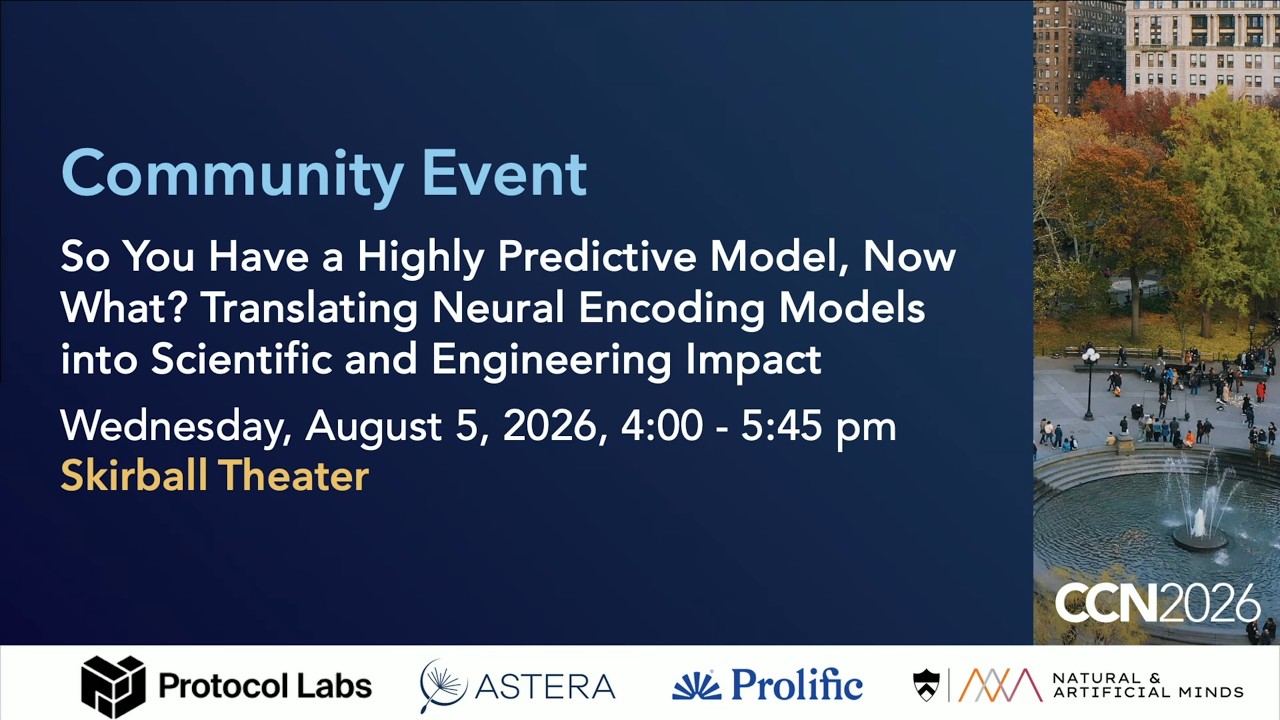
CCN 2026 | Community Event: So You Have a Highly Predictive Model, Now What?
Keywords
Summary
186 words
Critical Evaluation
Value of the Information & Strength of the Argument
The value of the information is high, as it provides concrete examples of how encoding models can be used beyond prediction, such as in stimulus optimization, mechanistic interpretation, and closed-loop engineering. The argumentation is solid, with speakers presenting specific methodologies and results, though some talks are brief and lack detailed evidence. The panel discussion likely adds depth, but the transcript focuses on the talks.
Scientific Rigor, Source Quality, Title Accuracy
The scientific rigor is generally high, with speakers from reputable institutions and references to established methods like ridge regression and sparse autoencoders. The quality of sources is not explicitly detailed, but the event is associated with the CCN conference, which lends credibility. The title accurately reflects the content, focusing on the application of predictive models. No comments were provided, so no analysis of public reception is included.
146 words
Title / Content Match
The title accurately reflects the content, which focuses on the application and interpretation of predictive neural encoding models.
Quality & Reliability
8/10
The event features expert speakers from leading institutions, presenting concrete examples and methodological frameworks. The content is grounded in established research and includes references to ongoing work, but as a community event, it primarily offers expert perspectives rather than peer-reviewed findings.
Key Moments
Markers derived by PSI from the transcript: the creator did not define chapters.
- Introduction by Maggie Henderson: overview of encoding models and the event's purpose.
- Greta Tuckute's talk: using encoding models to identify optimal language stimuli and interpret language network responses.
- Nicholas Lesica's talk: closed-loop hearing aid design using neural encoding models.
- Alex Williams's talk: mechanistic interpretability of neurally predictive models.
- Iris Groen's talk: leveraging encoding models for scientific insight in scene perception.
- Thomas Naselaris's talk: concept dose responses in human visual cortex.
- Johannes Mehrer's talk: model-guided visual prostheses and dyslexia-friendly fonts.
- Panel discussion moderated by Janelle Feather on infrastructure and cultural norms.
Cited Sources
- CCN 2026 Community Event on Highly Predictive Models — Official event page with details on speakers and topics.
Concurring Sources
- CCN 2026 Community Event on Highly Predictive Models — Official event page, consistent with the video content.
Contribution & Novelties
The event provides a comprehensive overview of current approaches to using predictive encoding models for scientific discovery and translational applications. It highlights novel methods such as using encoding models for closed-loop stimulus optimization and mechanistic interpretability. The discussion on infrastructure and cultural norms offers a forward-looking perspective on the field’s development.
Pour aller plus loin :
- Encoding models in neuroscience — Overview of encoding models and their applications.
- Sparse autoencoders — Explanation of sparse autoencoders used for interpretability.
- Brain-Score — Platform for benchmarking models against brain responses.
87 words
Radar Profile
The radar profile shows high scores in information quantity and quality, with moderate technical level and high reliability, indicating a well-rounded and credible presentation.