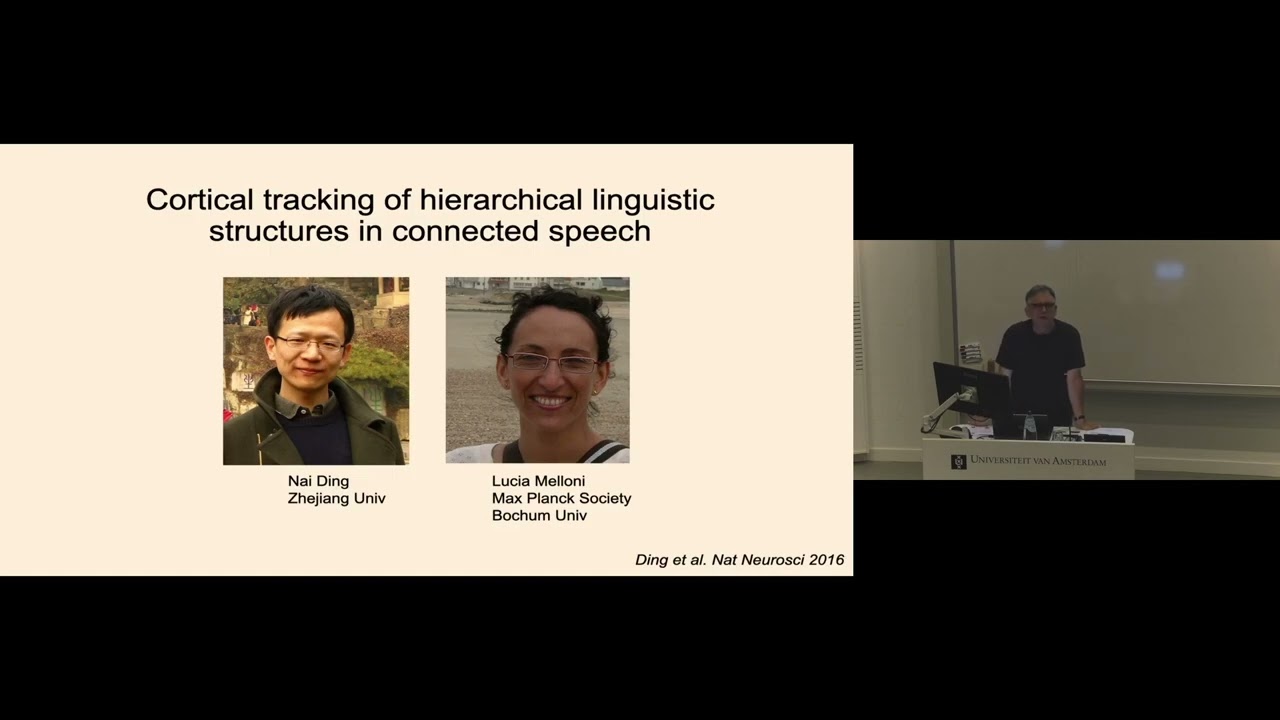
Keynote Lecture: David Poeppel - CCN 2025
Keywords
Summary
174 words
Critical Evaluation
Value of the Information & Strength of the Argument
The lecture provides valuable insights into the neural mechanisms of speech processing, synthesizing decades of research. Poeppel’s argumentation is strong, building from well-established findings (e.g., 4-5 Hz modulation) to novel experimental results. He effectively uses examples and analogies to make complex concepts accessible. However, some claims, such as the universality of 4-5 Hz, are presented as facts without extensive caveats, and the new experiment is preliminary and not yet peer-reviewed.
Scientific Rigor, Source Quality, Title Accuracy
Poeppel demonstrates scientific rigor by referencing specific studies and researchers, such as Florencia Assane, Ding Nai, and Laura Williams. He acknowledges the mechanistic debates in the field and the need for further research. The title accurately reflects the content, focusing on rhythms and algorithms in the brain. The talk is well-structured, but the lack of explicit citations for some claims may reduce its rigor for a general audience.
153 words
Title / Content Match
The title accurately reflects the content: a keynote lecture by David Poeppel at CCN 2025, focusing on rhythms and algorithms in the brain.
Quality & Reliability
8/10
The lecture is given by a leading expert in auditory neuroscience and language, with a strong track record of peer-reviewed research. The content is grounded in established findings (e.g., 4-5 Hz modulation rate, cortical tracking) and presents new experimental data. However, as a keynote, it includes personal opinions and interpretations that are not all peer-reviewed.
Key Moments
Markers derived by PSI from the transcript: the creator did not define chapters.
- Introduction and acknowledgments
- Discussion of speech envelope and 4-5 Hz modulation rate
- Presentation of MEG experiment on hierarchical tracking
- ECoG results showing selective tracking of phrasal and sentential information
- Introduction of 'constituent' as elementary particle
- Critique of predictive coding and discussion of multi-level prediction
- New experiment on constituent constraint prediction
Cited Sources
- Modulation spectra of speech — Poeppel cites work by Florencia Assane on modulation spectra across languages.
- Cortical tracking of speech envelope — He references studies by Ding Nai and others showing auditory cortex tracks the speech envelope.
- Hierarchical tracking of linguistic structures — He discusses his own 2016 study with Ding Nai and Lucia Maloney on tracking phrases and sentences.
- Predictive coding in language — He mentions Goldstein et al. 2022 in Nature Neuroscience on next-word prediction.
Concurring Sources
- The human brain and autoregressive deep language models share three fundamental computational principles — Goldstein et al. 2022, cited by Poeppel, supports the idea of next-word prediction in the brain.
Dissenting Sources
- A critical review of predictive coding in language — Poeppel mentions a review by Ruskin and Monte Nurand that questions the importance of prediction, providing a counterpoint.
Contribution & Novelties
This keynote synthesizes existing research and introduces a new experiment on constituent constraint prediction, which is not yet published. It offers a novel perspective on the parts list of the mind and brain, emphasizing the importance of constituents and hierarchical tracking. The talk also critiques the dominant predictive coding framework, suggesting that prediction operates at multiple levels.
Pour aller plus loin :
- Neural entrainment to speech — Overview of neural entrainment, relevant to cortical tracking of speech.
- Predictive coding — Background on predictive coding theory.
- Constituent (linguistics) — Definition of constituents in linguistics, central to the talk.
97 words
Radar Profile
The radar profile shows high scores in information quantity, quality, and reliability, with a slightly lower technical level, reflecting the accessible yet rigorous nature of the keynote. The balance suggests a talk that is both informative and credible.