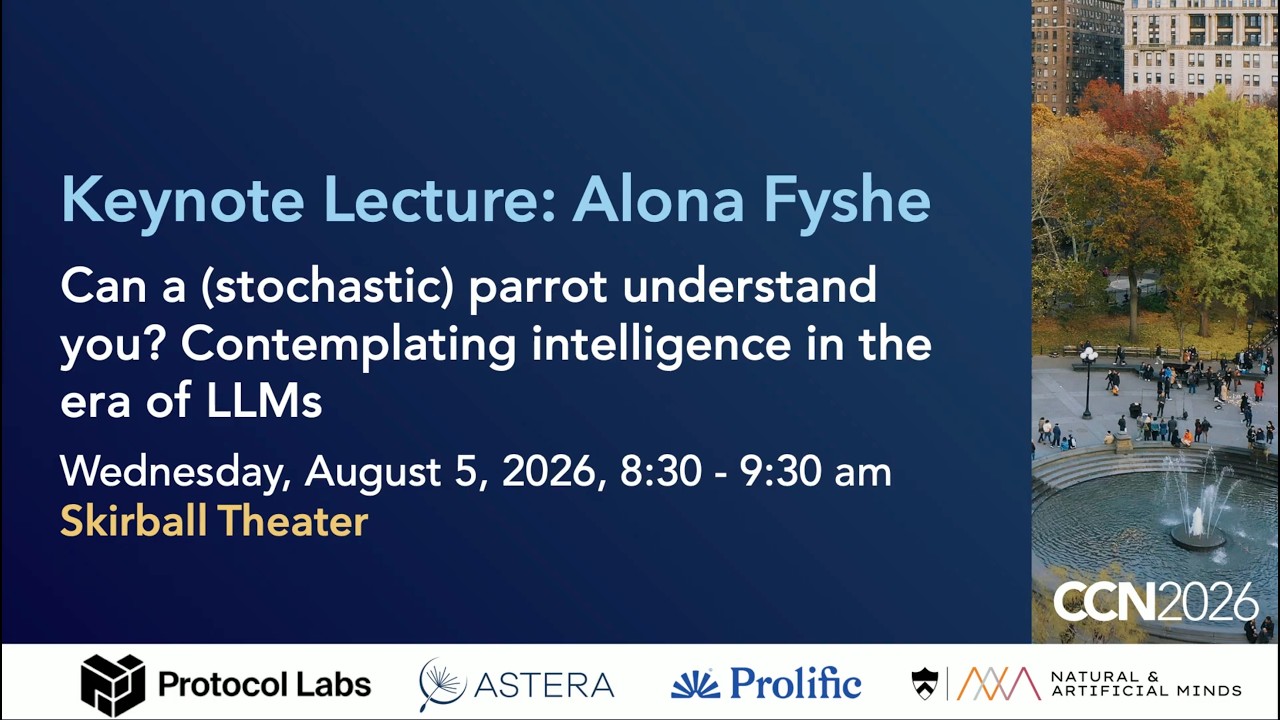
CCN 2026 | Keynote: Alona Fyshe
Keywords
Summary
197 words
Critical Evaluation
Value of the Information & Strength of the Argument
The talk provides a valuable perspective on the intelligence debate, using a compelling analogy from biology (stigmergy in wasps) to argue that simple mechanisms can yield complex behavior. The argumentation is well-structured, starting with a logical framework (Boolean implication) and then providing empirical examples from her lab. However, the analogy to wasps is not directly tested on LLMs, and the evidence for emergent complexity in LLMs is anecdotal. The talk is thought-provoking but does not provide definitive proof, leaving the question open.
Scientific Rigor, Source Quality, Title Accuracy
The talk references the influential paper by Bender et al. (2021) on stochastic parrots, which is a solid scientific source. The speaker’s own research is presented, but without detailed methodology or peer-review context. The title is appropriate and accurately reflects the content. The talk is a keynote, so it is not a formal scientific article, but it is grounded in established concepts and the speaker’s expertise. No comments were provided, so no analysis of public reception is possible.
175 words
Title / Content Match
The title accurately reflects the content, which critically examines the notion of intelligence in LLMs, referencing the 'stochastic parrot' metaphor.
Quality & Reliability
8/10
The talk is given by a recognized expert in computational neuroscience and AI, with a solid academic background. It references a well-known paper (Bender et al., 2021) and presents arguments based on established concepts like stigmergy. However, it is a keynote presentation, not a peer-reviewed study, and some claims are anecdotal or based on personal experience.
Key Moments
Markers derived by PSI from the transcript: the creator did not define chapters.
- Introduction and welcome by session chair.
- Alona Fyshe begins her talk, referencing her 2017 tutorial.
- Discussion of the 'moving goalposts' of intelligence.
- Introduction of the 'stochastic parrot' concept from Bender et al.
- Explanation of LLM training and the argument that it is too simple.
- Analogy with wasp nest construction and stigmergy.
- Application of stigmergy to LLM reasoning traces.
- Presentation of lab's work on paraphrasing to improve LLM classification.
- Discussion of goals and world models in LLMs.
- Conclusion and final thoughts on intelligence testing.
Cited Sources
- On the Dangers of Stochastic Parrots: Can Language Models Be Too Big? — Referenced as the source of the 'stochastic parrot' concept.
Concurring Sources
- Emergent Abilities of Large Language Models — Supports the idea that LLMs can exhibit complex behaviors not explicitly trained for.
Dissenting Sources
- On the Dangers of Stochastic Parrots — The paper argues that LLMs cannot understand meaning, which is the position the speaker challenges.
Contribution & Novelties
The talk offers a novel perspective by using the biological concept of stigmergy to argue that LLMs can exhibit complex behavior despite simple training objectives. It also presents original research from the speaker’s lab on using paraphrasing to improve LLM performance, which is a practical contribution. The talk encourages a re-evaluation of what constitutes intelligence and suggests that current tests may be inadequate.
Pour aller plus loin :
- Stigmergy — The concept of indirect coordination through the environment, central to the wasp analogy.
- Emergent abilities in large language models — A paper discussing emergent behaviors in LLMs, relevant to the argument about complexity.
- World model — The concept of internal representations of the world, discussed in the context of LLMs.
120 words
Radar Profile
The radar profile shows high scores in quality and reliability, reflecting the speaker's expertise and use of established concepts. The quantity of information is moderate, as the talk is a keynote rather than a comprehensive review. The technical level is moderate, accessible to a broad audience. Overall, the talk is well-balanced, with strengths in argumentation and relevance.