Contributed Talks: “Neural mechanisms of learning and memory: from synapses to systems” - CCN 2025
Keywords
Summary
215 words
Critical Evaluation
Value of the Information & Strength of the Argument
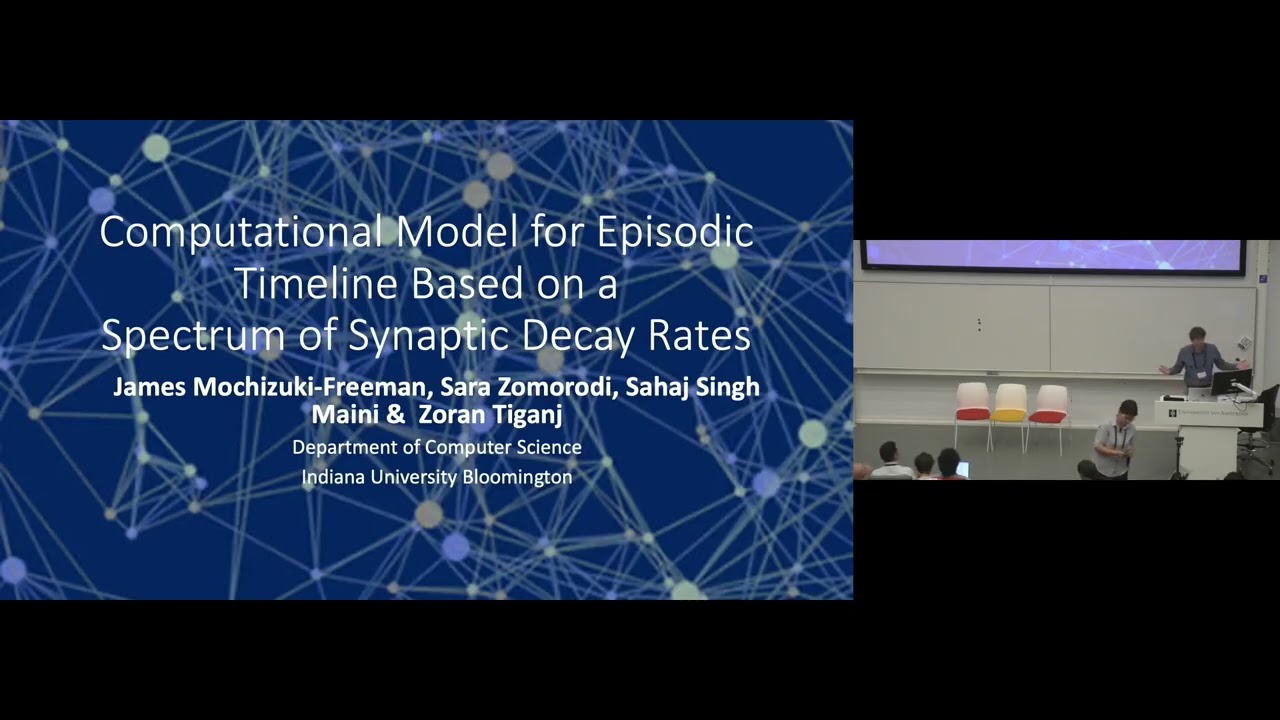
The value of the information is high, as the talks present novel computational models and experimental paradigms that advance understanding of learning and memory. The argumentation is solid, with each speaker providing clear hypotheses, methods, and results. For instance, Huang Ham’s talk uses a computational model to benchmark optimal strategies and compares them with human data, showing adaptive division of labor. Zoran Tiganj’s model offers a novel perspective on synaptic weight representation, with potential implications for episodic memory. Kate Nussenbaum’s work systematically characterizes counterfactual learning, providing a new task and model to measure individual differences. The presentations are well-structured and supported by data, though some talks are brief and lack extensive detail.
Scientific Rigor, Source Quality, Title Accuracy
The scientific rigor is generally high, with presentations based on peer-reviewed research or work in progress at a reputable conference. The speakers cite relevant literature and provide links to abstracts and posters. The title accurately reflects the content, as it is a session on neural mechanisms of learning and memory. The sources cited are primarily the speakers’ own work and conference materials, which are appropriate. The video does not include external references beyond the conference context, but the presentations themselves are grounded in established research. The adequacy between title and content is strong.
220 words
Title / Content Match
The title accurately reflects the content: a session of contributed talks on neural mechanisms of learning and memory, covering topics from synaptic to systems level.
Quality & Reliability
8/10
The video presents peer-reviewed research from a reputable conference (CCN 2025), with clear methodology and results. The talks are given by researchers from recognized institutions. However, the video is a recording of a session, and the content is not independently verified here.
Key Moments
Markers derived by PSI from the transcript: the creator did not define chapters.
- Introduction to the session and first talk by Huang Ham on collaborative encoding of visual working memory.
- Huang Ham explains the spatial working memory task and the computational model for optimal division of labor.
- Huang Ham presents results showing adaptive division of labor, even when benefit is minimal.
- Zoran Tiganj begins his talk on computational model for episodic timelines based on synaptic decay rates.
- Tiganj explains the vector representation of synaptic weights and the timeline encoding.
- Tiganj illustrates the model with a video example and discusses implications for episodic memory.
- Kate Nussenbaum presents her work on strategic counterfactual learning.
- Nussenbaum describes the battle cards game and the model fitting results showing upward counterfactual learning.
- John C Bowler presents on abstraction learning in recurrent networks.
- Mingze Li Leukos presents on reward-prediction-error-guided attention and learning curves.
Cited Sources
- Abstract for Huang Ham's talk — Referenced in the talk as a link to the abstract.
- Poster C70 — Mentioned by Huang Ham for bonus results.
- Poster C73 — Mentioned by Zoran Tiganj for more details.
Concurring Sources
- CCN 2025 Conference Website — Official conference page confirming the session and speakers.
Contribution & Novelties
The video presents several novel contributions: a computational model for collaborative working memory that predicts adaptive division of labor, a model for episodic timelines using synaptic decay spectra, and a task to measure strategic counterfactual learning. These advance the field by providing testable models and paradigms.
Pour aller plus loin :
- Working memory — Foundational concept for the first talk.
- Episodic memory — Relevant to the second talk.
- Counterfactual thinking — Directly related to the third talk.
- Synaptic plasticity — Underlying mechanism for the models.
85 words
Radar Profile
The radar profile shows high scores across all dimensions, indicating a well-rounded and reliable scientific content. The video excels in information quantity and quality, with a strong technical level and high reliability.