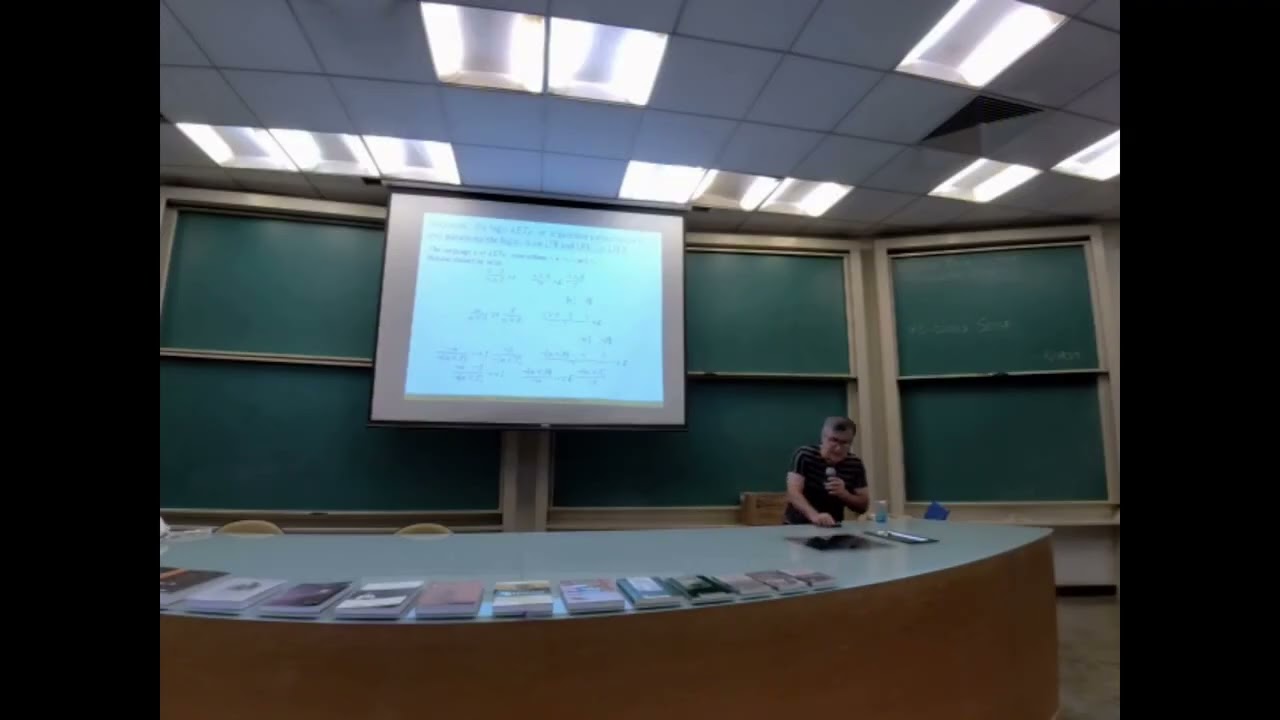
SPLogIC2023 - Paraconsistent Probability and Uncertainty - Walter Carnielli Master Class 8
Keywords
Summary
159 words
Critical Evaluation
Value of the Information & Strength of the Argument
The talk provides a valuable contribution by presenting a novel probabilistic semantics for paraconsistent logic, which is relevant for AI and philosophy. The argumentation is solid, building on established work in paraconsistent logic and probability theory. Carnielli clearly explains the motivation and the formal framework, and he provides intuitive examples to illustrate the concepts. However, some parts of the presentation are informal and the examples are not fully rigorous, which may leave some questions open. The discussion of confirmation theory and its limitations is interesting but not fully developed.
Scientific Rigor, Source Quality, Title Accuracy
The talk demonstrates scientific rigor by referencing several peer-reviewed papers, including works by Belnap, Carnielli, Rodrigues, and others. The sources are relevant and support the claims made. The title accurately reflects the content, focusing on paraconsistent probability and uncertainty. The talk is well-structured and the speaker is an authority in the field. However, the presentation is informal and some technical details are glossed over, which may reduce the overall rigor. The talk does not include a formal proof of the main theorems, but it provides references for further reading.
193 words
Title / Content Match
The title accurately reflects the content: the talk focuses on paraconsistent probability and uncertainty, and how a computer (and philosopher) should reason about evidence.
Quality & Reliability
8/10
The talk is given by a leading expert in logic, Walter Carnielli, and presents a formal framework (LETF) with probabilistic semantics. The content is rigorous, building on published work, and includes references to peer-reviewed articles. However, the presentation is informal and some parts are not fully formalized, and the examples are illustrative rather than empirical.
Key Moments
Markers derived by PSI from the transcript: the creator did not define chapters.
- Introduction: Carnielli introduces the topic and mentions the connection to Belnap's paper 'How a computer should think'.
- Discussion of the law of explosion and the distinction between consistency and contradiction.
- Introduction of LETF and its semantics, including the operators for consistency and inconsistency.
- Presentation of the probabilistic semantics for LETF, with measures of evidence.
- Example of an imprecise survey and how LETF can evaluate evidence from social media.
- Discussion of confirmation theory and its limitations, with examples from physics.
- Conclusion and mention of the forthcoming book and open positions.
Cited Sources
- Paraconsistent probabilities: consistency, contradictions and Bayes’ theorem — Referenced as a basis for the probabilistic approach.
- An epistemic approach to paraconsistency: a logic of evidence and truth — Referenced as a key paper on LETF.
- Measuring evidence: a probabilistic approach to an extension of Belnap–Dunn logic — Referenced for the probabilistic semantics of LETF.
- Kripke-style models for Logics of Evidence and Truth — Referenced for the Kripke-style models.
Concurring Sources
- An epistemic approach to paraconsistency: a logic of evidence and truth — Supports the framework of LETF.
- Measuring evidence: a probabilistic approach to an extension of Belnap–Dunn logic — Supports the probabilistic semantics.
Dissenting Sources
- Classical probability theory — Classical probability theory assumes consistency and may not handle contradictory evidence, which is a limitation that LETF aims to address.
Contribution & Novelties
The talk presents a novel probabilistic semantics for LETF, a paraconsistent and paracomplete logic, which allows for the quantification of evidence. This is an original contribution that extends previous work on LETF and provides a formal framework for reasoning with contradictory and incomplete evidence. The talk also discusses applications to AI and philosophy, and highlights the limitations of classical probability in handling inconsistent evidence.
Pour aller plus loin :
- Paraconsistent logic — Overview of paraconsistent logic.
- First-degree entailment — Related to Belnap-Dunn logic.
- Bayes’ theorem — Relevant to the probabilistic aspects.
91 words
Radar Profile
The radar profile shows high scores in all dimensions, indicating a well-rounded and rigorous presentation. The talk is technically advanced, provides substantial information, and is reliable due to the expertise of the speaker and the references provided.
💬 No comments were provided for analysis.