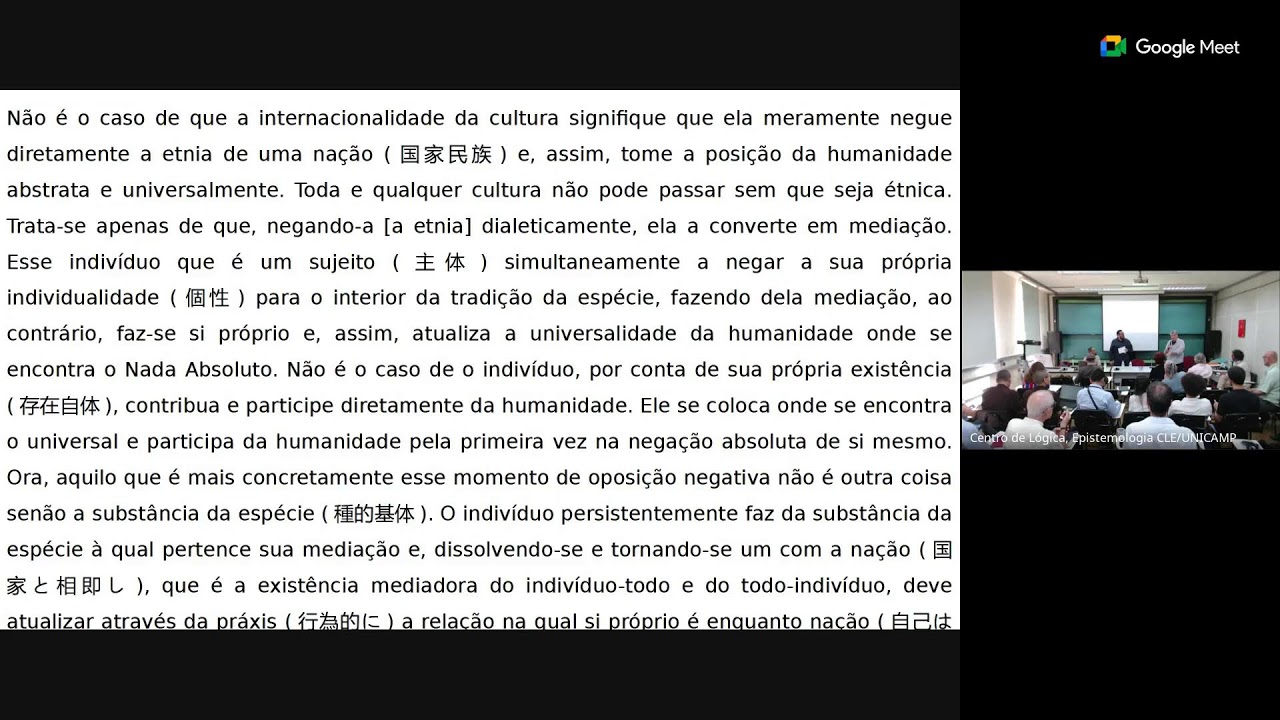
XI COLÓQUIO INTERNACIONAL DE FILOSOFIA ORIENTAL DA UNICAMP – Manhã 17/09 ´- pt2
Keywords
Summary
184 words
Critical Evaluation
Value of the Information & Strength of the Argument
The lecture provides a valuable and rigorous analysis of Tanabe’s logic of species, a complex and often misunderstood aspect of Kyoto School philosophy. The speaker demonstrates a deep understanding of the primary texts and offers a clear, step-by-step exposition of the dialectical structure. He carefully distinguishes Tanabe’s position from Hegel’s, emphasizing the role of absolute negation and the material substrate. The argumentation is solid, grounded in textual evidence, and the speaker acknowledges the difficulty of the material. The discussion that follows adds further value by engaging with the interpretation and raising critical points.
Scientific Rigor, Source Quality, Title Accuracy
The lecture is based on primary sources: Tanabe’s ‘The Logic of the Species’ (1937) and ‘The Logic of the State Being’ (1939). The speaker cites these texts and provides his own translations. The presentation is scholarly and well-referenced, though no external sources are cited. The title accurately reflects the content, as it is a segment of a colloquium on Oriental philosophy. The speaker’s expertise is evident, and the lecture maintains a high level of academic rigor.
184 words
Title / Content Match
The title accurately describes the content: a segment of the XI International Colloquium on Oriental Philosophy at UNICAMP, featuring a lecture on Tanabe's philosophy.
Quality & Reliability
8/10
The presentation is a scholarly lecture by a philosophy professor, based on primary texts of Tanabe Hajime. The argumentation is rigorous and well-structured, with careful textual analysis. However, the video is a recording of a conference presentation, and the speaker himself acknowledges the complexity and potential for confusion. The sources are primarily the original texts of Tanabe, which are cited, but no external verification is provided.
Key Moments
Markers derived by PSI from the transcript: the creator did not define chapters.
- Introduction and presentation of the speaker by the chair.
- Speaker begins his lecture on Tanabe's philosophy, explaining his motivation.
- Explanation of the concept of 'absolute mediation' and 'absolute nothing'.
- Discussion of the species as the substrate of the absolute, and its relation to matter and spirit.
- Introduction of the individual and the triad of individual, species, and genus.
- Explanation of the individual's contradiction and the role of praxis in achieving autonomy.
- Discussion of the role of culture and politics in the logic of species.
- Conclusion of the lecture and beginning of the discussion.
- Discussion with a colleague about the interpretation of Tanabe's philosophy.
Cited Sources
- The Logic of the Species (1937) — Primary text by Tanabe Hajime, discussed in the lecture.
- The Logic of the State Being (1939) — Primary text by Tanabe Hajime, discussed in the lecture.
Concurring Sources
- Stanford Encyclopedia of Philosophy: Tanabe Hajime — Provides scholarly overview of Tanabe's philosophy, consistent with the lecture's interpretation.
Dissenting Sources
- Alternative interpretations of Tanabe's philosophy — Some scholars emphasize the metanoetics as the core of Tanabe's thought, whereas the lecture argues for the centrality of the logic of species.
Contribution & Novelties
The lecture offers a clear and systematic exposition of Tanabe’s logic of species, emphasizing its dialectical structure and its implications for understanding culture and politics. It contributes to the field by providing a rigorous analysis of a complex philosophical system, making it accessible to a broader audience.
Pour aller plus loin :
- Kyoto School — Overview of the philosophical movement to which Tanabe belonged.
- Tanabe Hajime — Stanford Encyclopedia of Philosophy entry on Tanabe.
- Absolute Nothingness — Concept central to Tanabe’s philosophy.
82 words
Radar Profile
The radar profile shows high scores in all dimensions, indicating a lecture that is rich in information, technically rigorous, and highly reliable. The balance between quantity and quality is notable, with a slight emphasis on technical depth.