Javier Gómez-Serrano — Modern Mathematics in the Age of AI
Keywords
Summary
133 words
Critical Evaluation
Value of the Information & Strength of the Argument
The talk provides valuable insights into the practical applications of AI in mathematics, backed by concrete examples and results. The speaker’s argumentation is solid, as he shares both successes and challenges, and acknowledges the limitations of current methods. He effectively demonstrates the power of machine learning in discovering new mathematical structures and accelerating research, while also cautioning about the rapid pace of change and the need for rigorous verification.
78 words
Title / Content Match
The title accurately reflects the content: the speaker discusses the intersection of modern mathematics and AI, sharing his experiences and insights.
Quality & Reliability
8/10
The speaker is an established mathematician with direct experience in applying machine learning to PDEs. He presents concrete results, acknowledges limitations, and references specific works and events. However, the talk is a personal perspective and not peer-reviewed, and some claims are anecdotal.
Key Moments
Markers derived by PSI from the transcript: the creator did not define chapters.
- Introduction: speaker's background and the stages of grief in the math community regarding AI.
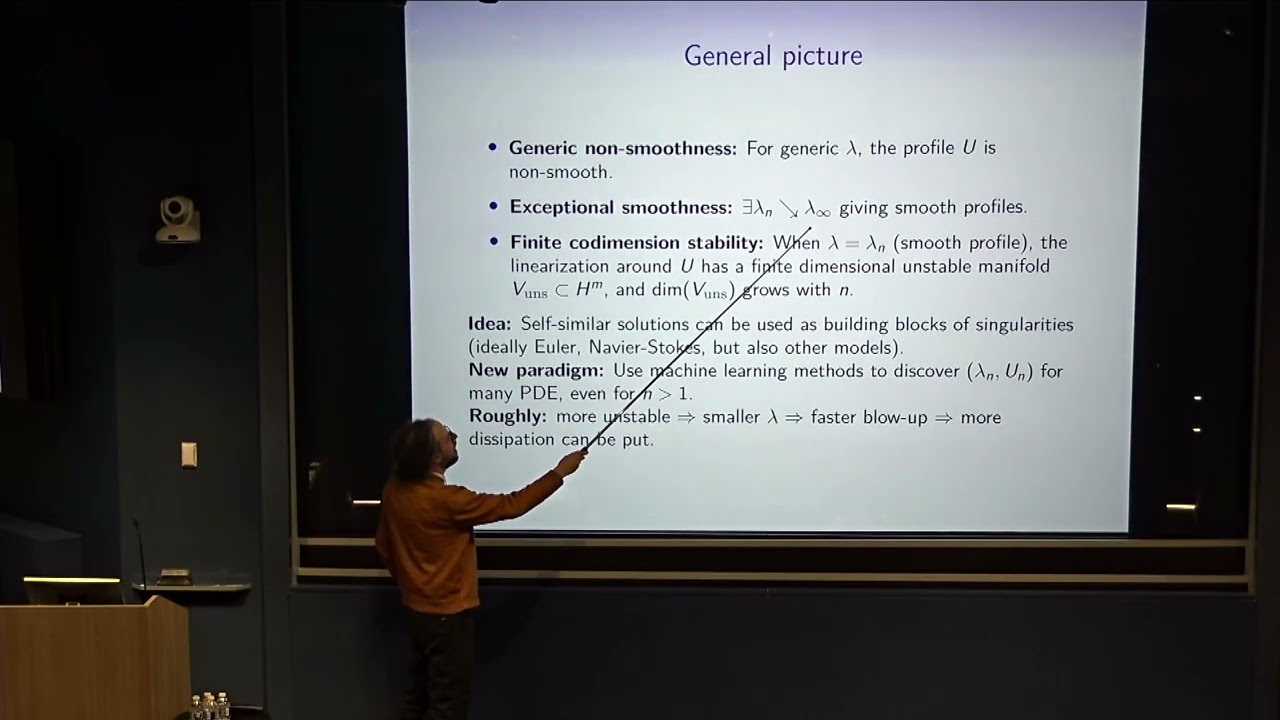
- Main takeaway: machine learning can lead to new discoveries in mathematics; paradigm shifts every 6-12 months.
- Personal journey: from denial to acceptance, starting with small models.
- Application to fluid mechanics: using PINNs to find self-similar solutions for Burgers equation.
- Boussinesq equation: first self-similar profile obtained in 2022 with errors ~10^-4.
- Collaboration with string theorists on Calabi-Yau metrics.
- Vortex patch problem: using ML to find rotating solutions, improving on literature.
- Systematic discovery of unstable solutions in 2025, achieving machine precision (10^-13).
- Shift to large language models: examples of LLMs suggesting novel ideas in math.
- Acceleration of research: two-week project in algebraic geometry using LLMs.
- Release of benchmark problems by prominent mathematicians for AI systems.
Cited Sources
- 2026 Simons Collaboration on the Localization of Waves Annual Meeting — The talk was given at this event, providing context for the presentation.
Concurring Sources
- Simons Foundation — The talk was hosted by the Simons Foundation, which supports research in mathematics and science.
Contribution & Novelties
The talk provides a unique perspective on the integration of AI into mathematical research, highlighting both small-scale neural networks and large language models. It showcases concrete successes in solving PDEs and discovering new mathematical structures, while also discussing the challenges and rapid evolution of the field. The speaker’s emphasis on achieving machine precision and the potential for rigorous proofs on top of AI-generated solutions is particularly novel.
Pour aller plus loin :
- Physics-informed neural networks — A key technique discussed for solving PDEs.
- Navier–Stokes existence and smoothness — The open problem mentioned in the talk.
- Large language models in mathematics — The role of LLMs in mathematical discovery.
108 words
Radar Profile
The radar profile shows high scores in information quantity, quality, and reliability, with a slightly lower technical level. This indicates a talk that is rich in content, well-supported, and accessible to a broad audience, though some technical details may require background knowledge.