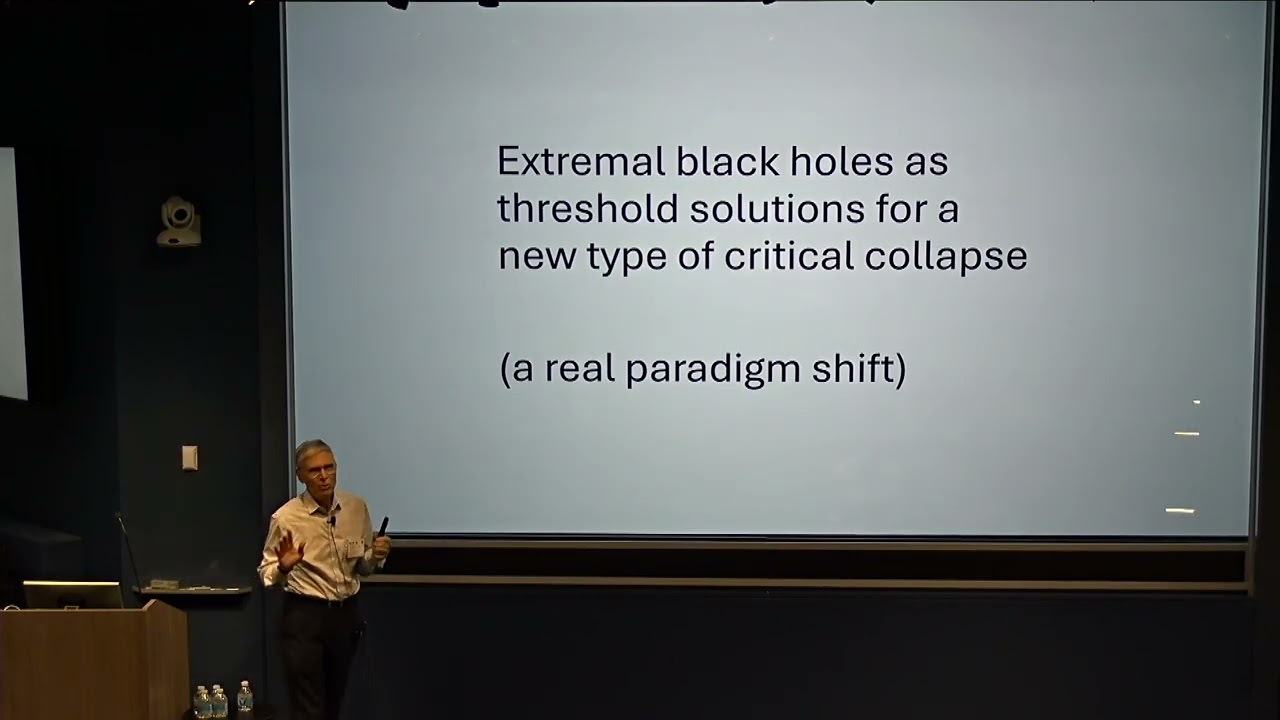
Gary Horowitz: Update on Extremal and Near-Extremal Black Holes
Keywords
Summary
211 words
Critical Evaluation
Value of the Information & Strength of the Argument
The talk provides a high-value overview of recent research on extremal black holes, synthesizing results from multiple lines of inquiry. The argumentation is solid, based on rigorous mathematical results and numerical simulations, and the speaker clearly distinguishes established results from conjectures. The presentation is well-structured, with clear explanations of the physical significance of each result. The speaker also engages with questions from the audience, clarifying points and acknowledging open issues.
Scientific Rigor, Source Quality, Title Accuracy
The talk demonstrates high scientific rigor, with the speaker referencing specific papers and authors (e.g., Kelly and Unger, Aretakis, Rial et al., Will East, Gela and Pretorius) and providing context for the results. The sources are primarily recent research papers, and the talk is part of a Simons Foundation collaboration meeting, indicating a high level of expertise. The title accurately reflects the content, which is an update on the topic. The description provides a link to the event page, which is a reliable source for the conference.
172 words
Title / Content Match
The title accurately reflects the content, which is an update on recent developments in the study of extremal and near-extremal black holes.
Quality & Reliability
8/10
Talk by a leading expert in gravitational physics, presenting recent research results from the Simons Collaboration. The content is technical and appears accurate, but as a conference talk it is not peer-reviewed and some claims are presented as ongoing research.
Key Moments
Markers derived by PSI from the transcript: the creator did not define chapters.
- Introduction: unique properties of rapidly rotating black holes, extremal limit, and overview of four research directions.
- Discussion of Aretakis instability and its implications for extremal black holes.
- Quantum effects of extremal black holes: Schwartzen mode, entropy, and absorption.
- Critical collapse to extremal black holes: analogy with Choptuik, scaling exponents, and formation in finite time.
- Formation of exact extremal black holes in five dimensions and phase diagram for collapse with different matter.
- Singular horizons due to higher-derivative corrections: tidal force singularities and implications for near-extremal black holes.
- Open questions: naked singularities, Kerr case, and interplay of quantum effects and superradiance.
Cited Sources
- 2026 Simons Collaboration on Black Holes and Strong Gravity Annual Meeting — Event page for the conference where this talk was given.
Concurring Sources
- Simons Foundation Event Page — Confirms the event and the speaker's participation.
Contribution & Novelties
This talk provides a concise update on the rapidly evolving field of extremal black holes, highlighting recent breakthroughs such as the formation of extremal black holes in finite time, the discovery of singular horizons due to higher-derivative corrections, and the quantum nature of these objects. It synthesizes results from multiple research groups and clarifies the current understanding and open questions.
Pour aller plus loin :
- Aretakis instability — The instability of extremal black holes under perturbations, a key concept discussed in the talk.
- Choptuik critical collapse — The phenomenon of critical collapse and universal scaling, which is analogous to the extremal black hole threshold.
- Hawking radiation — Quantum effects near black holes, relevant to the discussion of quantum behavior of extremal black holes.
123 words
Radar Profile
The radar profile shows high scores in all dimensions, with a particularly strong level of technical detail and information quality. This indicates a dense, expert-level presentation with substantial scientific content, though the narrow focus may limit its accessibility to a broader audience.