A Merger of Elliptic Cohomology and Global Categorical Symmetries
Keywords
Summary
186 words
Critical Evaluation
Value of the Information & Strength of the Argument
The talk provides substantial value by addressing open questions in the intersection of elliptic cohomology and categorical symmetries. The argumentation is rigorous, building on established frameworks like the Stolz-Teichner conjecture and the theory of VOAs. The speaker clearly explains the distinctions between different variants of TMF and motivates the need for equivariant refinements. The presentation of both a yes-go and a no-go theorem demonstrates a balanced and critical approach. The construction of equivariant small TMF using VOAs is a novel contribution, and the no-go theorem on string orientation is an important negative result that clarifies the limitations of the approach. The argumentation is logically structured, with clear connections between the mathematical objects and their physical interpretations.
Scientific Rigor, Source Quality, Title Accuracy
The talk demonstrates high scientific rigor, with careful definitions and attention to technical details. The speaker cites the Segal-Stolz-Teichner paradigm and mentions joint work with Theo Johnson-Freyd and Daniel Berwick-Evans, but no specific external sources are referenced in the description or transcript. The title accurately reflects the content, which indeed merges elliptic cohomology and global categorical symmetries. The talk is part of a Simons Foundation collaboration, indicating institutional support and peer context. However, as a conference talk, it lacks the formal peer-review process of a published paper. The adequacy between title and content is strong, with the talk directly addressing the merger of the two fields.
237 words
Title / Content Match
The title accurately reflects the content, which merges elliptic cohomology and global categorical symmetries.
Quality & Reliability
8/10
Presentation of original research by a specialist, with rigorous mathematical content, but limited external verification and no peer-reviewed publication cited.
Key Moments
Markers derived by PSI from the transcript: the creator did not define chapters.
- Introduction to topological modular forms (TMF) and its variants: large TMF, small TMF, and connective TMF.
- Discussion of the Segal-Stolz-Teichner paradigm relating TMF to 2D supersymmetric quantum field theories.
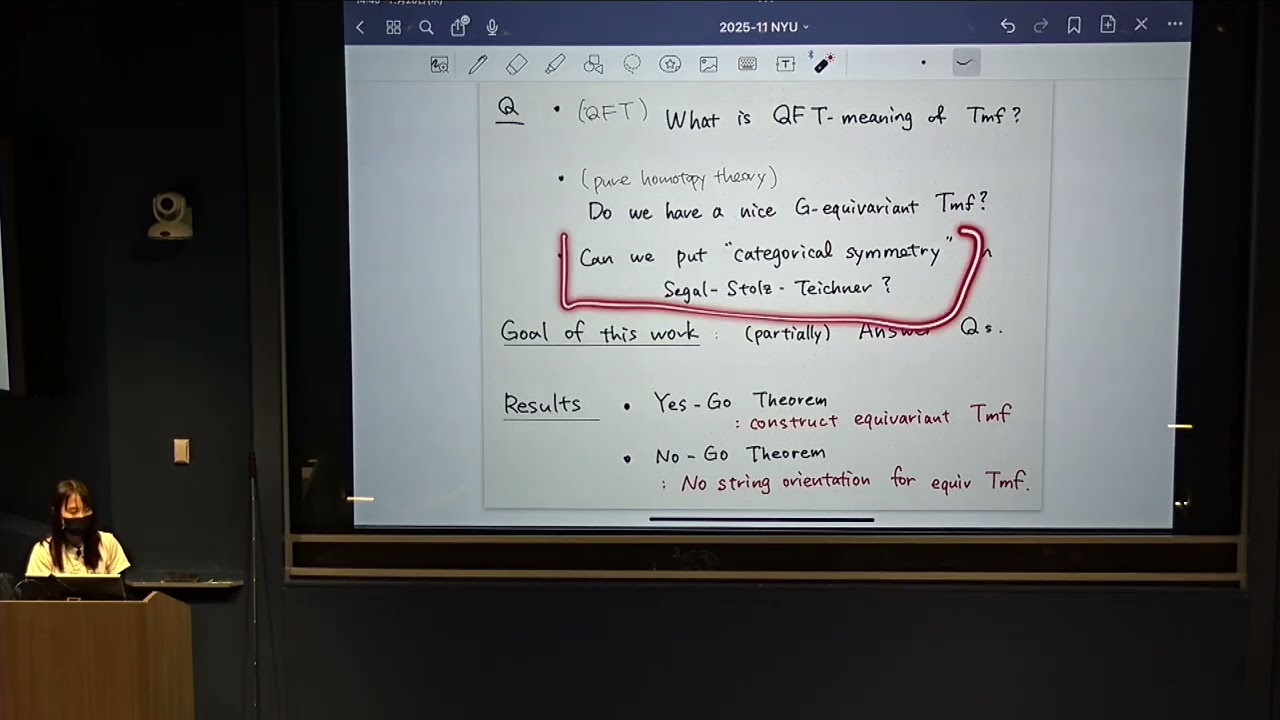
- Presentation of the main questions: physical meaning of small TMF and construction of equivariant small TMF.
- Introduction of the diagram summarizing the relationships between modular forms, VOAs, MTCs, and equivariant TMF.
- Explanation of the difference between having a modular tensor category and an underlying vertex operator algebra.
- Discussion on the non-canonical nature of holomorphicity and the role of the T-matrix in defining holomorphic vector-valued modular forms.
- Presentation of the yes-go theorem: construction of equivariant small TMF using VOAs.
- Presentation of the no-go theorem: equivariant small TMF lacks a string orientation.
Cited Sources
- Simons Collaboration on Global Categorical Symmetries — The talk is part of this collaboration, which provides context for the research.
Concurring Sources
- Simons Collaboration on Global Categorical Symmetries — The talk is part of this collaboration, which supports the research direction.
Contribution & Novelties
The talk presents original research that constructs an equivariant version of small TMF using vertex operator algebras, addressing a gap in the literature. It also provides a no-go theorem showing the absence of a string orientation for this equivariant small TMF, which is a significant negative result. The work merges the Segal-Stolz-Teichner paradigm with global categorical symmetries, offering new insights into the physical interpretation of small TMF.
Pour aller plus loin :
- Topological modular forms — Background on TMF and its variants.
- Vertex operator algebra — Mathematical structure used in the construction.
- Modular tensor category — Related to the representation categories of VOAs.
- Segal–Stolz–Teichner conjecture — The paradigm relating TMF to supersymmetric field theories.
114 words
Radar Profile
The radar profile shows high scores in technical level and information quality, reflecting the advanced mathematical content and rigorous presentation. The lower score in information quantity is due to the focused scope of the talk, which is appropriate for a specialized audience.