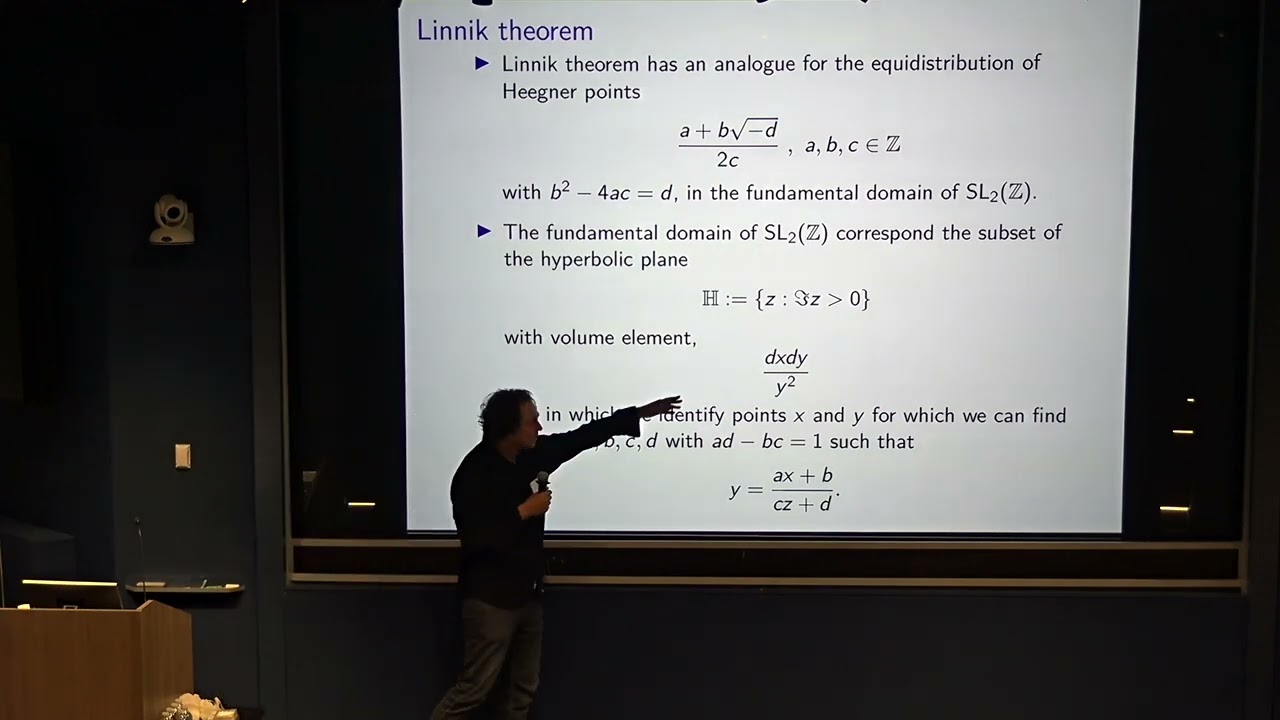
Maksym Radziwill: Joint Linnik Problems and Siegel Zeros (September 11, 2025)
Keywords
Summary
203 words
Critical Evaluation
Value of the Information & Strength of the Argument
The talk provides a valuable overview of a sophisticated area of number theory, connecting classical results with modern research. The argumentation is solid, as Radziwill carefully explains the historical context and the technical motivations behind each step. He clearly delineates what is known, what is conjectured, and what his new results contribute. The presentation is rigorous, with explicit references to theorems and methods, and he acknowledges the limitations of his approach. The value lies in the synthesis of diverse techniques (analytic, ergodic, algebraic) and the clear articulation of the role of Siegel zeros in these problems.
Scientific Rigor, Source Quality, Title Accuracy
The talk is scientifically rigorous, with the speaker citing specific theorems and authors (e.g., Linnik, Duke, Michel-Venkatesh, Aka-Einsiedler-Shapira, Blomer-Brumley). The sources are primarily the mathematical literature, and the speaker does not rely on external references. The title accurately reflects the content, as the talk indeed focuses on joint Linnik problems and their connection to Siegel zeros. The presentation is well-structured, and the speaker is careful to distinguish between proven results and conjectures. No comments were provided for analysis.
189 words
Title / Content Match
The title accurately reflects the content: the talk focuses on joint Linnik problems and their connection to Siegel zeros, as announced.
Quality & Reliability
8/10
Talk by a leading expert in analytic number theory, presenting original research with rigorous mathematical arguments. The presentation is technical and assumes advanced knowledge, but the reasoning is clear and the claims are supported by known results and the speaker's own work. Some informal remarks and lack of detailed proofs in the talk limit the score slightly.
Key Moments
Markers derived by PSI from the transcript: the creator did not define chapters.
- Introduction and overview of the talk's topic.
- Discussion of the classical problem of sums of three squares and the role of quaternions.
- Explanation of the action of the class group on solutions and its connection to Linnik's theorem.
- Introduction of Heegner points and the analogy with Linnik's theorem.
- Discussion of the Michel-Venkatesh mixing conjecture and related results.
- Presentation of the speaker's main result, replacing congruence conditions with Siegel zero conditions.
- Conclusion and discussion of open problems.
Cited Sources
- Simons Foundation event page — The talk was part of this conference, and the page provides context for the workshop.
Concurring Sources
- Simons Foundation event page — The talk is part of this conference, and the page provides context for the workshop.
Contribution & Novelties
The talk presents new research that improves on previous results in the field of joint equidistribution problems. The main novelty is the replacement of restrictive congruence conditions with a Siegel zero condition, which is a more natural and general assumption. This is achieved through an analytic approach that avoids the use of ergodic methods, providing a new perspective on the problem. The talk also highlights connections to random multiplicative functions, suggesting potential for further research.
Pour aller plus loin :
- Linnik’s theorem on equidistribution — Provides background on the classical equidistribution result.
- Subconvexity bounds for L-functions — Discusses the analytic techniques used to remove congruence conditions.
- Michel-Venkatesh mixing conjecture — The conjecture addressed in the talk, though the page may be sparse.
- Siegel zeros — Background on the exceptional zeros that are central to the talk.
136 words
Radar Profile
The radar profile shows high scores in technical level and information quality, reflecting the advanced and rigorous nature of the talk. The lower score in quantity of information is due to the focused scope, while the fiabilite_globale score is high, indicating confidence in the presented results.