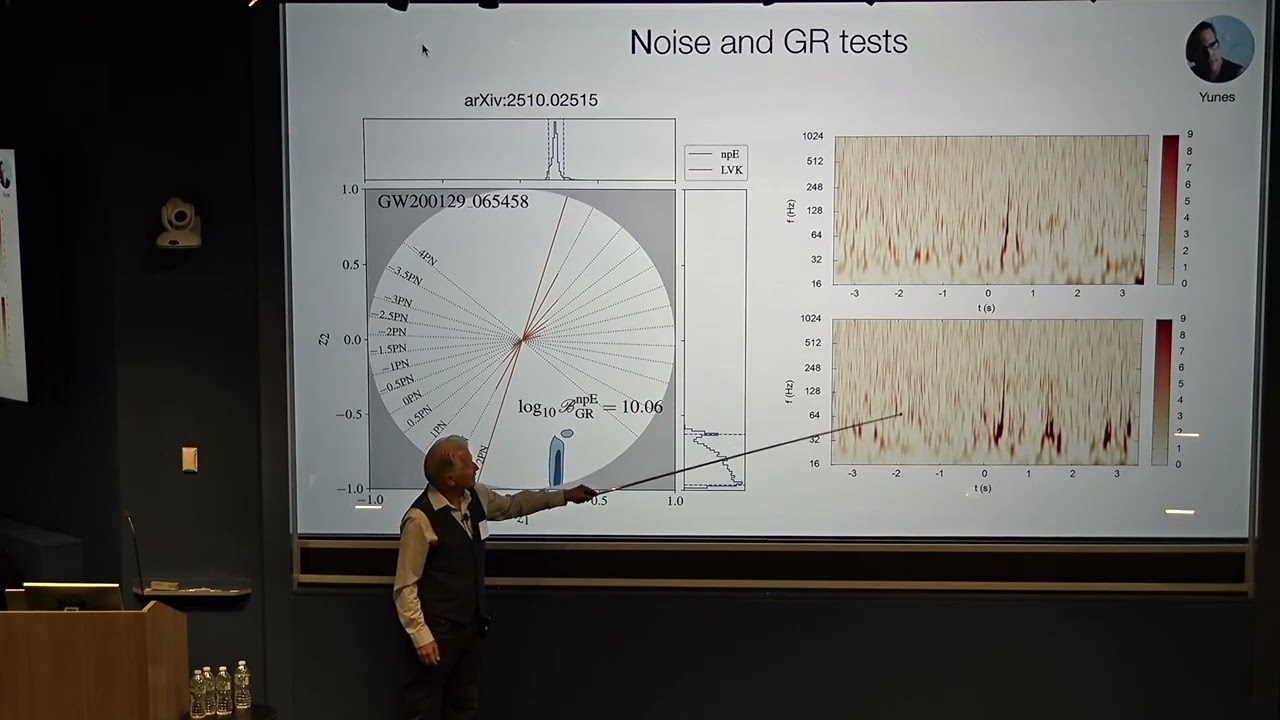
Neil Cornish: Observing Strong Gravity Phenomena: Dissecting Signals and Separating Interesting Effects From Noise
Keywords
Summary
121 words
Critical Evaluation
Value of the Information & Strength of the Argument
The talk provides valuable insights into the complexities of gravitational wave data analysis, emphasizing the need for careful treatment of noise. Cornish argues convincingly that glitches can significantly bias parameter estimation, even at low signal-to-noise ratios, and that current methods may mistake glitches for beyond-GR effects. He supports his arguments with specific examples and ongoing research, making a strong case for improved noise modeling and signal dissection techniques. The argumentation is solid, grounded in Bayesian inference and practical experience with LIGO data.
91 words
Title / Content Match
The title accurately reflects the content, focusing on dissecting gravitational wave signals and separating genuine effects from instrumental noise.
Quality & Reliability
8/10
Presentation by a leading expert in gravitational wave data analysis, based on established Bayesian methods and recent collaborative work. Claims are supported by references to ongoing research and specific events, though not all details are peer-reviewed yet.
Key Moments
Markers derived by PSI from the transcript: the creator did not define chapters.
- Introduction and goals of the collaboration
- Discussion of Bayesian inference and likelihood
- Examples of noise transients (glitches) in LIGO data
- Impact of glitches on spin estimation
- Signal dissection to locate precession information
- Line removal algorithm and its benefits
- Analysis of subsolar mass candidates
- Discussion of outlier event GW231123
- Comparison of waveform models and conclusions
Cited Sources
- Simons Collaboration on Black Holes and Strong Gravity Annual Meeting 2026 — Event page for the meeting where this talk was presented.
Concurring Sources
- LIGO Scientific Collaboration — Official LIGO website, providing information on the detectors and data.
Contribution & Novelties
The talk presents novel approaches to gravitational wave data analysis, including a line removal algorithm that operates purely on strain data, and a method to dissect signals to identify the origin of specific features like precession. It also highlights the dangers of low-SNR glitches and the need for robust noise modeling.
Pour aller plus loin :
- Bayesian inference — Core statistical framework used in gravitational wave data analysis.
- LIGO — The Laser Interferometer Gravitational-Wave Observatory, whose data is central to the talk.
- Gravitational wave — The fundamental phenomenon being studied.
- Numerical relativity — Used to model waveforms for comparison with data.
101 words
Radar Profile
The radar profile shows high scores across all dimensions, indicating a technically deep and reliable presentation. The talk is rich in information and demonstrates strong scientific rigor, with a balanced emphasis on data analysis techniques and their application to gravitational wave astronomy.