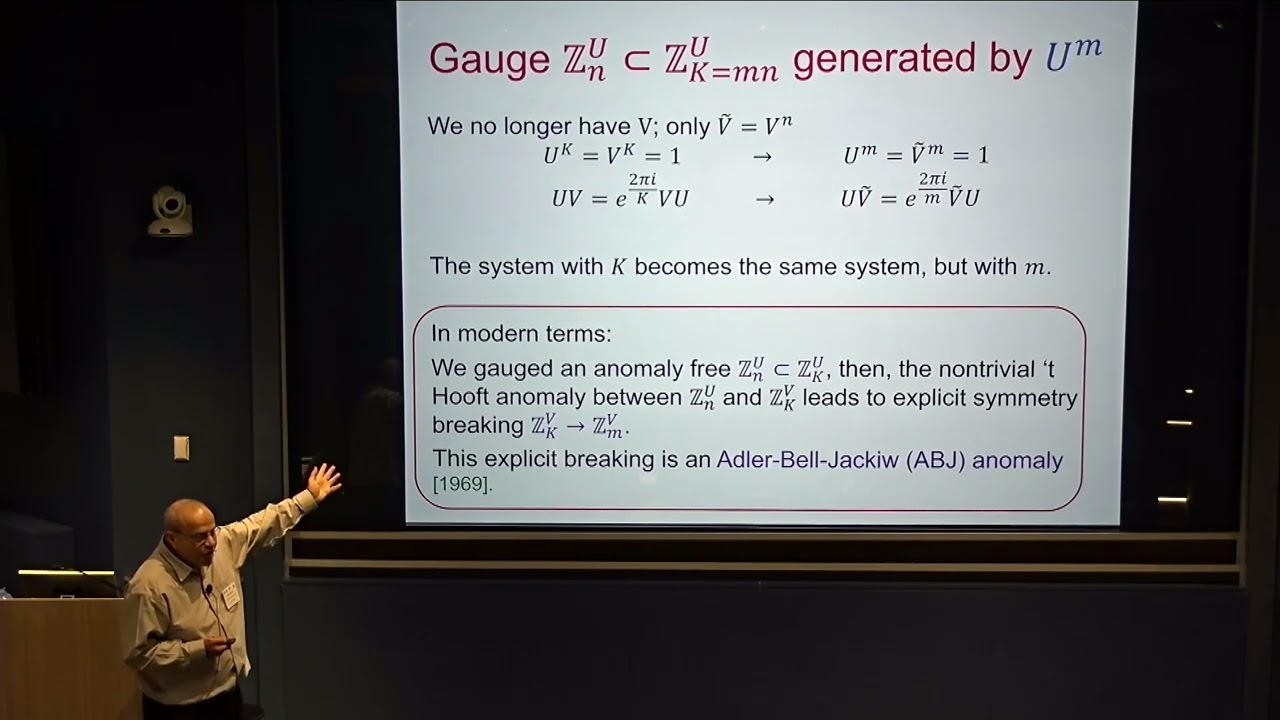
Nathan Seiberg: Symmetry, Anomaly, Gauging, Proliferation, and Condensation
Keywords
Summary
166 words
Critical Evaluation
Value of the Information & Strength of the Argument
The talk provides high value by clarifying terminology that is often used inconsistently across different subfields, and by demonstrating that precise definitions can lead to physical insights. Seiberg’s argumentation is rigorous, building from a trivial example to more complex systems, and he explicitly addresses common misconceptions. He supports his points with references to known results and his own work, making a compelling case for the importance of precise language in theoretical physics.
Scientific Rigor, Source Quality, Title Accuracy
The talk is scientifically rigorous, with Seiberg drawing on his extensive expertise and referencing established work, including his own 1989 paper with Greg Moore. The sources cited are appropriate and credible, though the talk itself is not a formal publication. The title accurately reflects the content, and the talk is well-structured. No comments were provided for analysis.
144 words
Title / Content Match
The title accurately reflects the content, which systematically discusses symmetry, anomaly, gauging, proliferation, and condensation, and their interrelations.
Quality & Reliability
9/10
Talk by a leading theoretical physicist at a specialized workshop, presenting a conceptual synthesis of symmetry, anomalies, and gauging in quantum field theory and condensed matter. The content is rigorous and based on established physics, though it is a presentation of ideas rather than a peer-reviewed publication.
Key Moments
Markers derived by PSI from the transcript: the creator did not define chapters.
- Introduction: Seiberg outlines the talk's structure and the importance of terminology.
- Introduces the trivial quantum mechanical system: a K-dimensional Hilbert space with vanishing Hamiltonian.
- Discusses the projective representation and 't Hooft anomaly in the simple system.
- Explains gauging in the quantum mechanics example, including Gauss' law and identification.
- Contrasts proliferation with condensation, emphasizing that proliferation explicitly breaks symmetry.
- Introduces generalized global symmetries and higher-form symmetries.
- Applies the ideas to TQFTs in 2+1 dimensions, discussing anyons and braiding.
- Details the three rules of gauging for one-form symmetries, including twisted sectors.
- Clarifies the distinction between confinement and gauge invariance, referencing Fradkin-Shenker.
- Concludes with a summary and acknowledges the Simons Foundation's support.
Cited Sources
- 2026 Simons Collaboration on Ultra Quantum Matter Annual Meeting — Event page for the meeting where this talk was given.
Concurring Sources
- 2026 Simons Collaboration on Ultra Quantum Matter Annual Meeting — Event page for the meeting where this talk was given.
Contribution & Novelties
The talk provides a novel synthesis of concepts that are often used inconsistently across quantum field theory and condensed matter physics. By illustrating them in a trivial quantum mechanical system, Seiberg clarifies the distinctions between proliferation and condensation, and between gauging and confinement. He extends these ideas to higher-form symmetries, offering a unified framework. The talk emphasizes that precise terminology can lead to physical insights and avoids common pitfalls.
Pour aller plus loin :
- Higher-form symmetry — Wikipedia article on generalized global symmetries, relevant to the concept of higher-form symmetries.
- Anomaly (physics) — Wikipedia article on anomalies in quantum field theory, including ’t Hooft and ABJ anomalies.
- Topological quantum field theory — Wikipedia article on TQFTs, which are central to the discussion of anyons and braiding.
126 words
Radar Profile
The radar profile shows high scores in quality of information, technical level, and global reliability, with a slightly lower score in quantity of information, reflecting the talk's depth over breadth.