Alex Pouget - Brain wide representation of prior information (May 6, 2025)
Keywords
Summary
145 words
Critical Evaluation
Value of the Information & Strength of the Argument
The talk provides valuable insights into the neural basis of Bayesian inference, presenting a large-scale dataset and rigorous decoding analysis. The argumentation is solid, with clear hypotheses and controls. The speaker effectively contrasts two models (late inference vs. Bayesian network) and uses behavioral and neural data to support the latter. The discovery of the action kernel model is intriguing and well-supported by model comparison and neural decoding. The presentation is compelling and addresses key questions in neuroscience.
Scientific Rigor, Source Quality, Title Accuracy
The talk is based on original research from the IBL, with a large dataset and stringent quality controls. The speaker cites relevant literature and acknowledges limitations. The title accurately reflects the content. The talk is part of a conference, so it is not peer-reviewed, but the methodology appears rigorous. The description provides a link to the IBL website for further information.
153 words
Title / Content Match
The title accurately reflects the content, which focuses on the brain-wide representation of prior information.
Quality & Reliability
8/10
The talk presents original research from the International Brain Laboratory, with a large dataset (600,000 neurons, 242 regions) and rigorous controls. The speaker is a recognized expert. However, the talk is a conference presentation, not a peer-reviewed publication, and some details are omitted.
Key Moments
Markers derived by PSI from the transcript: the creator did not define chapters.
- Introduction and overview of the talk
- Introduction to the International Brain Laboratory and its goals
- Description of the behavioral task and prior manipulation
- Overview of the brain-wide recording dataset
- Explanation of Bayesian observer theory and two models
- Psychometric curves showing animals use the prior
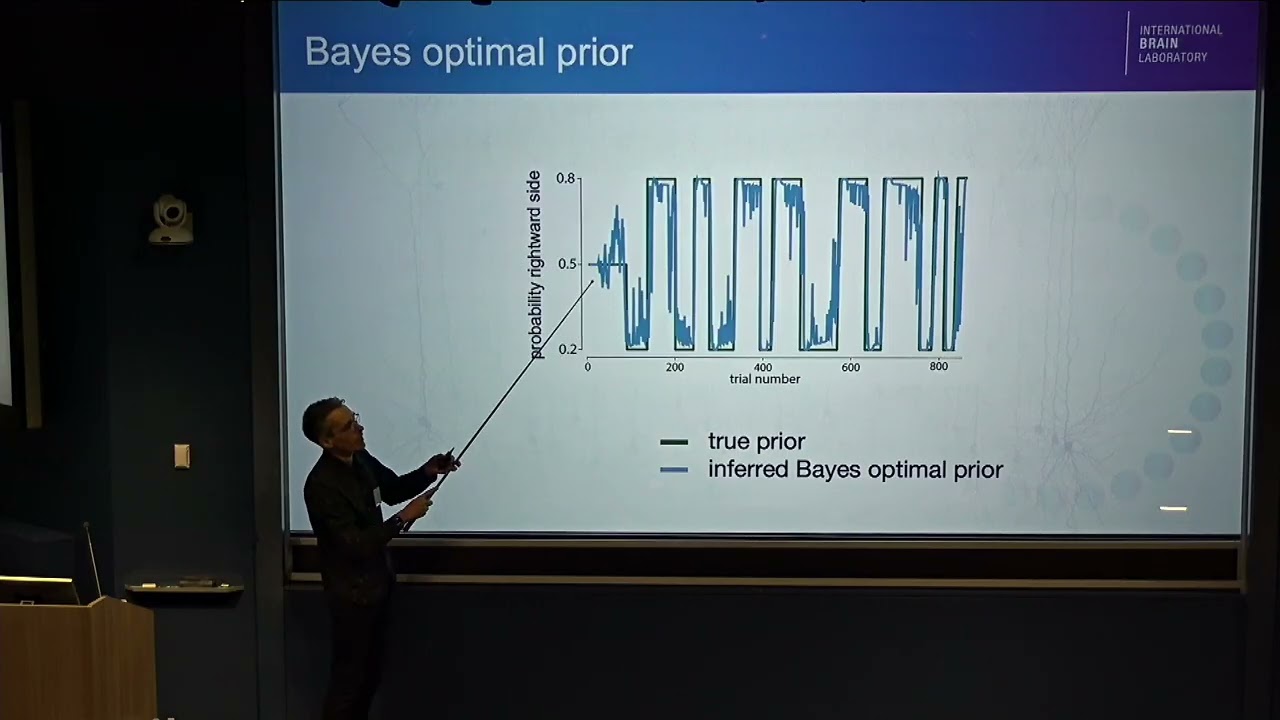
- Decoding the Bayesian optimal prior from neural activity
- Brain-wide map of prior representation
- Controls and validation of prior decoding
- Model comparison reveals action kernel strategy
- Neural evidence for action kernel model
- Conclusions and Q&A
Cited Sources
- Simons Collaboration on the Global Brain — The talk is part of the SCGB conference, and the link provides information about the collaboration.
Concurring Sources
- Simons Collaboration on the Global Brain — The talk is part of the SCGB conference, which supports research on brain-wide activity.
Contribution & Novelties
This talk presents novel findings from the International Brain Laboratory, providing the first brain-wide map of prior information representation. The discovery that prior information is widespread across the brain supports a Bayesian network model of brain function. Additionally, the identification of an action kernel strategy in mice, where prior updates are based on recent actions, offers new insights into how animals learn and use priors. The talk also emphasizes the value of large-scale, open-source datasets in neuroscience.
Pour aller plus loin :
- Bayesian inference in the brain — Overview of Bayesian approaches to brain function.
- International Brain Laboratory — Official website of the IBL, with data and publications.
- Predictive coding — A related theory of brain function based on prediction errors.
121 words
Radar Profile
The radar profile shows high scores across all dimensions, indicating a well-balanced and rigorous presentation. The talk provides substantial information, high technical depth, and strong reliability, with a slight emphasis on information quantity and quality.