Will Sawin: A Refined Random Matrix Model for Function Field L-functions (September 10, 2025)
Keywords
Summary
102 words
Critical Evaluation
Value of the Information & Strength of the Argument
The talk presents a novel and significant contribution to probabilistic models of L-functions. The argumentation is rigorous, with clear definitions and theorems. The speaker motivates the need for a better model by highlighting limitations of existing ones. The chimera measure is well-defined and its properties are proven. The results are substantial, providing a new tool for studying moments of L-functions.
Scientific Rigor, Source Quality, Title Accuracy
The talk is based on original research, with references to standard works in the field (e.g., Conrey-Farmer-Keating-Rubinstein-Snaith). The title accurately reflects the content. The presentation is rigorous, with precise statements and proofs. The description provides a link to the Simons Foundation event page for further context.
121 words
Title / Content Match
The title accurately reflects the content: a refined random matrix model for function field L-functions.
Quality & Reliability
8/10
Presentation by a leading expert in number theory, based on original research with rigorous mathematical proofs. The talk is technical and assumes advanced knowledge, but the methodology is sound and the results are clearly stated.
Key Moments
Markers derived by PSI from the transcript: the creator did not define chapters.
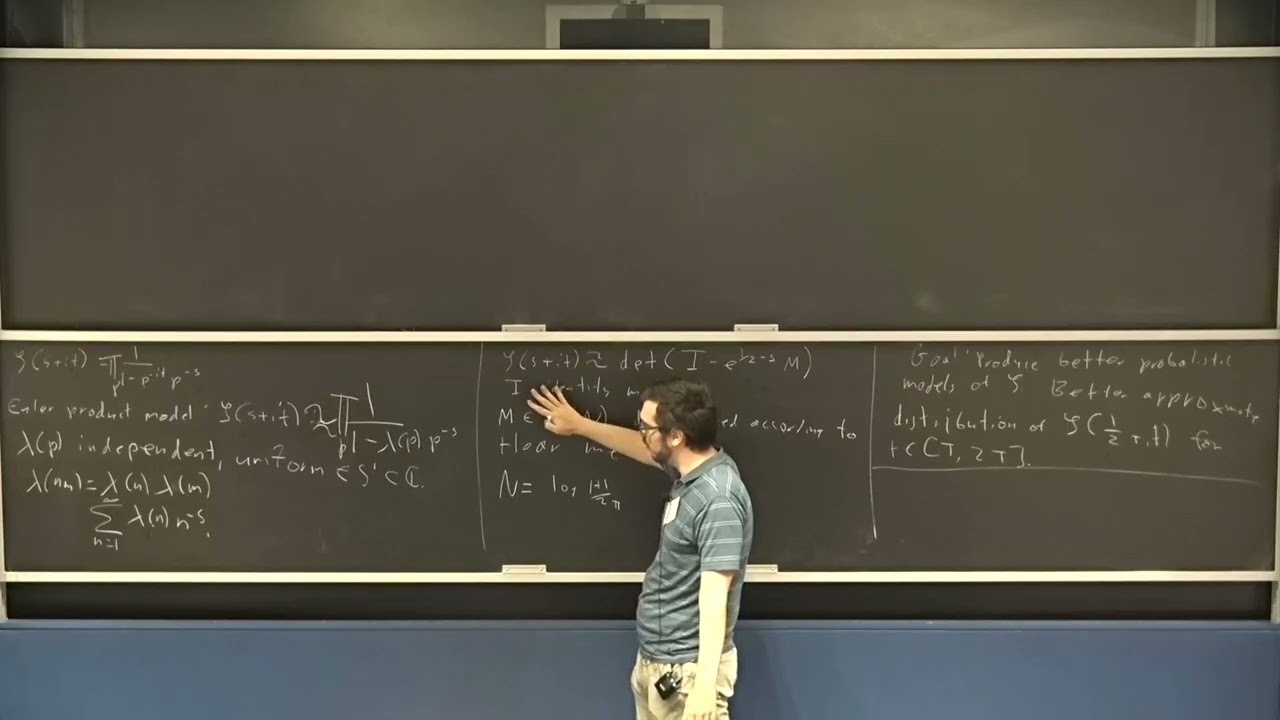
- Introduction: two fundamental probabilistic models of the Riemann zeta function (Euler product and random matrix).
- Limitations of the Euler product model on the critical line and of the random matrix model away from it.
- Goal: combine the two models to better approximate zeta. Mention of the Euler-Hadamard product model.
- Introduction of the function field setting and definition of the Euler product measure for function fields.
- Definition of the Gaussian measure and its role as a common approximation.
- Construction of the chimera measure by multiplying the random matrix measure by a density ratio.
- Statement of Theorem 1: low-degree test functions behave like the Euler product measure.
- Statement of Theorem 2: high-degree orthogonal test functions behave like the random matrix measure.
- Application to moments: recovering predictions from the CFKRS recipe.
Cited Sources
- Simons Foundation Event Page — Conference page for the talk, providing context and related information.
Concurring Sources
- Simons Foundation Event Page — Official event page, consistent with the talk's content.
Contribution & Novelties
The talk introduces a novel probabilistic model (chimera measure) that combines the Euler product and random matrix models in a non-trivial way, allowing for improved predictions of moments of function field L-functions. This is a significant advance over previous models.
Pour aller plus loin :
- Random matrix theory — Background on random matrix theory.
- L-function — General concept of L-functions.
- Function field — Function fields in number theory.
68 words
Radar Profile
The radar profile shows high scores in information quality and technical level, with slightly lower but still strong scores in quantity and reliability, indicating a dense, expert-level presentation with solid foundations.