More Exotic Constructions and More Alpha-Type Invariants II
Keywords
Summary
166 words
Critical Evaluation
Value of the Information & Strength of the Argument
The talk presents original research with high value for the field of low-dimensional topology. The constructions are novel and the proofs are rigorous, relying on established theories such as Heegaard Floer homology and ideal BLS structures. The argumentation is clear and logical, with a step-by-step explanation of the constructions and the detection of exoticness. The speakers also provide context by comparing their results to prior work, such as that of Finashin-Stern and Byas-Torres-Zudus. The emphasis on the formal nature of the proofs and the potential for generalization to other TQFT-like structures adds to the value of the presentation.
Scientific Rigor, Source Quality, Title Accuracy
The scientific rigor is high, as the talk is based on original research by the speakers, who are established experts in the field. The sources cited include prior work by the speakers themselves (with Levine) and other researchers (Byas-Torres-Zudus, Finashin-Stern, Conway-Powell, etc.). The talk is well-structured and the arguments are carefully presented. The title accurately reflects the content, which is a continuation of previous work on alpha-type invariants and exotic constructions. The talk is part of a conference, and the description provides a link to the event page for further information.
204 words
Title / Content Match
The title accurately reflects the content: the talk presents new exotic constructions in dimension 4 and further develops alpha-type invariants.
Quality & Reliability
8/10
Talk by leading researchers in low-dimensional topology, presenting original research with rigorous mathematical arguments. The content is highly technical and relies on established theories (Heegaard Floer homology, ideal BLS structures). The presentation is clear and includes proofs and references to prior work.
Key Moments
Markers derived by PSI from the transcript: the creator did not define chapters.
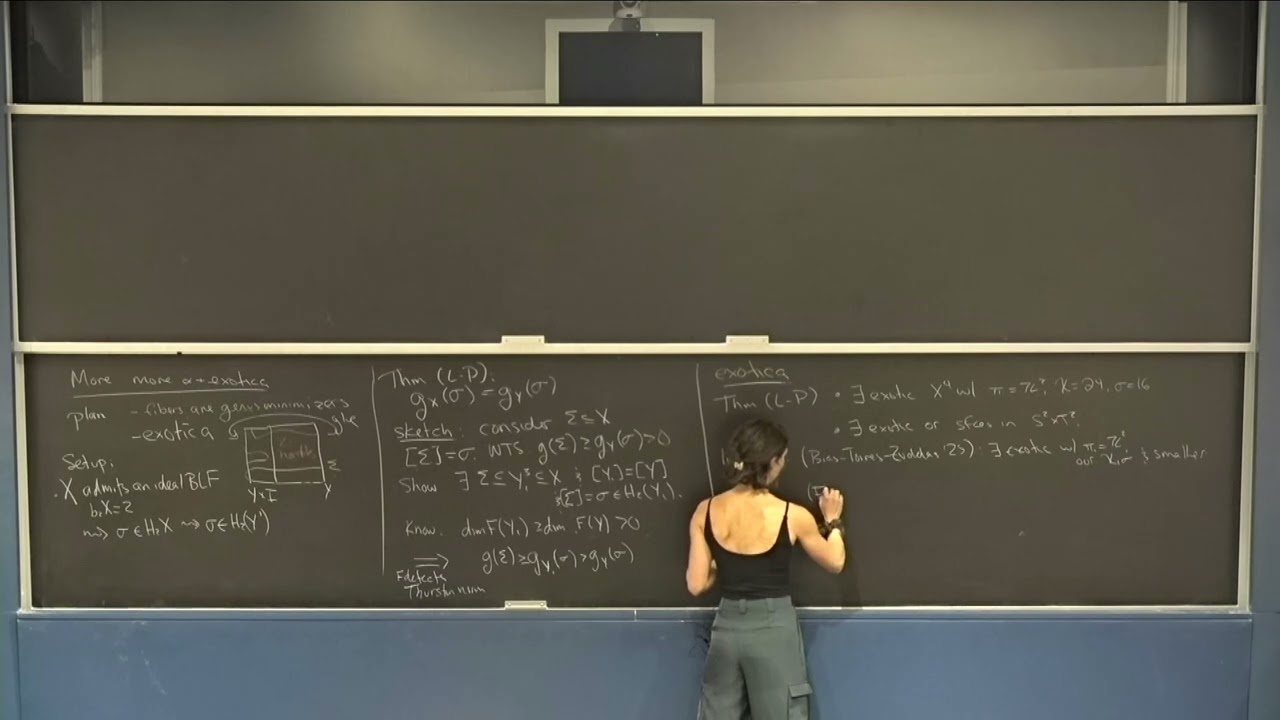
- Introduction and plan for the talk: sketch of the final result on genus minimizers in ideal BLS.
- Statement of the theorem: fiber surfaces are genus minimizers in ideal BLS. Sketch of proof begins.
- Discussion of the proof: using Heegaard Floer homology to compare genus bounds.
- Transition to exotic constructions. Statement of theorems: exotic 4-manifolds with pi1=Z^2 and exotic surfaces in S^2 × T^2.
- Construction of surfaces in S^2 × T^2 via band surgeries on links in S^1 × S^2.
- Construction of 4-manifolds via double branched covers. Introduction of tangles T and T'.
- Detection of exoticness using alpha invariants. Computation for identity tangle and non-braid tangle.
- Topological equivalence via disc cut-and-paste operations. Use of Conway-Powell result.
- Discussion of improvements and future directions, including Khovanov homology and smaller ambient manifolds.
- Questions and answers, including discussion of genus of exotic surfaces and potential for exotic surfaces in S^4.
Cited Sources
- Simons Foundation Event Page — Official event page for the conference where this talk was given.
Concurring Sources
- Simons Foundation Event Page — Official event page for the conference, confirming the context of the talk.
Contribution & Novelties
The talk presents new exotic 4-manifolds and surfaces, constructed using ideal BLS structures and alpha invariants. The key novelty is the formal and easy nature of the proofs, relying on basic properties of Heegaard Floer homology. This approach may allow for further generalizations and improvements. The talk also discusses potential applications of Khovanov homology to define similar invariants.
Pour aller plus loin :
- Heegaard Floer homology — Foundational theory used in the talk.
- Exotic 4-manifolds — Background on exotic structures in dimension 4.
- Branched covering — Construction technique used in the talk.
- Khovanov homology — Potential alternative invariant mentioned in the talk.
102 words
Radar Profile
The radar profile shows high scores in technical level and information quality, reflecting the advanced and rigorous nature of the talk. The lower score in fiabilite_globale is due to the lack of external verification and the highly specialized content.