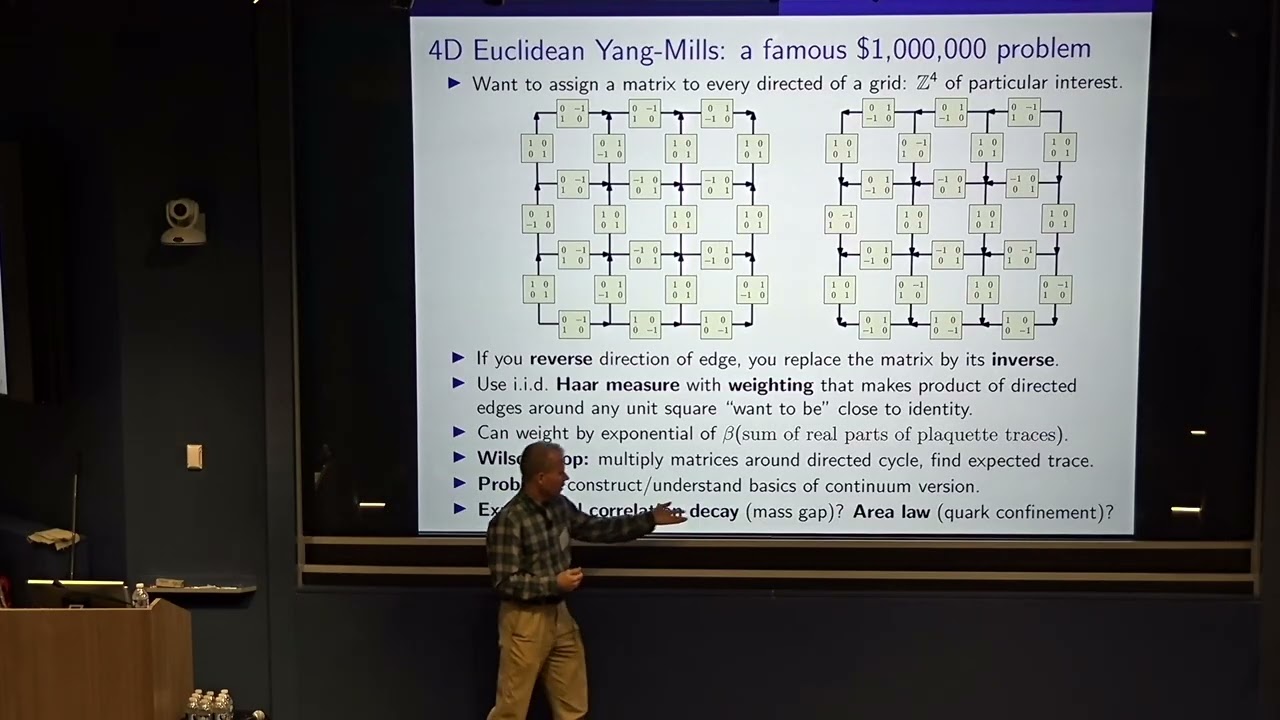
Scott Sheffield: Yang–Mills Gauge Theory and Random Geometry in 2 and 4 Dimensions (April 30, 2026)
Keywords
Summary
149 words
Critical Evaluation
Value of the Information & Strength of the Argument
The talk provides valuable insights into the mathematical structures underlying Yang–Mills theory and random geometry. Sheffield’s argumentation is clear and logical, building from simple lattice models to more complex continuum limits. He effectively uses analogies between 2D and 4D to motivate the study of these problems. The presentation is rigorous, with precise definitions and references to known results, though it is aimed at a specialized audience.
Scientific Rigor, Source Quality, Title Accuracy
The talk demonstrates high scientific rigor, with careful definitions and explanations. Sheffield references several key results and conjectures, such as Smirnov’s proof of Cardy’s formula and the Polyakov conjecture, but does not provide detailed citations. The title accurately reflects the content, focusing on Yang–Mills theory and random geometry in two and four dimensions. The description provides a link to the Simons Foundation event page, which is the only external source mentioned.
152 words
Title / Content Match
The title accurately reflects the content, which focuses on Yang–Mills gauge theory and random geometry in two and four dimensions.
Quality & Reliability
8/10
Talk by a leading mathematician (Scott Sheffield) at a Simons Foundation event, presenting advanced mathematical concepts with rigor. The content is based on established theories and open problems, but as a lecture, it lacks peer-reviewed detail and is not a formal publication.
Key Moments
Markers derived by PSI from the transcript: the creator did not define chapters.
- Introduction to lattice Yang-Mills model and Wilson loops.
- Discussion of the mass gap and area law problems.
- Introduction of the 2D sigma model and Polyakov conjecture.
- Explanation of why 1+1=2 leads to conformal invariance and SLE.
- Discussion of self-duality of forms in 2D and 4D.
- Overview of the Simons Collaboration and open problems.
Cited Sources
- Simons Collaboration on Probabilistic Paths to Quantum Field Theory Annual Meeting 2026 — Event page for the talk, providing context and related information.
Concurring Sources
- Simons Foundation event page — Official event page, consistent with the talk's content.
Contribution & Novelties
The talk provides a synthesis of recent developments in 2D random geometry and their potential applications to 4D Yang-Mills theory. It highlights the role of conformal invariance and SLE in understanding scaling limits, and suggests that techniques from 2D may be extended to 4D. The presentation is original in its emphasis on the analogy between 1+1=2 and 2+2=4, and it outlines several open problems for future research.
Pour aller plus loin :
- Schramm-Loewner Evolution (SLE) — Central concept in 2D random geometry, used to describe scaling limits of interfaces.
- Gaussian free field — A key object in 2D, related to SLE and conformal field theory.
- Yang-Mills existence and mass gap — One of the Millennium Prize Problems, directly relevant to the talk’s main topic.
- Conformal field theory — Framework for understanding critical phenomena in 2D, with connections to SLE and random geometry.
142 words
Radar Profile
The radar profile shows high scores in all dimensions, indicating a technically deep and reliable presentation. The talk is particularly strong in technical level and information quality, with slightly lower scores in quantity and global reliability due to its nature as a lecture rather than a formal publication.