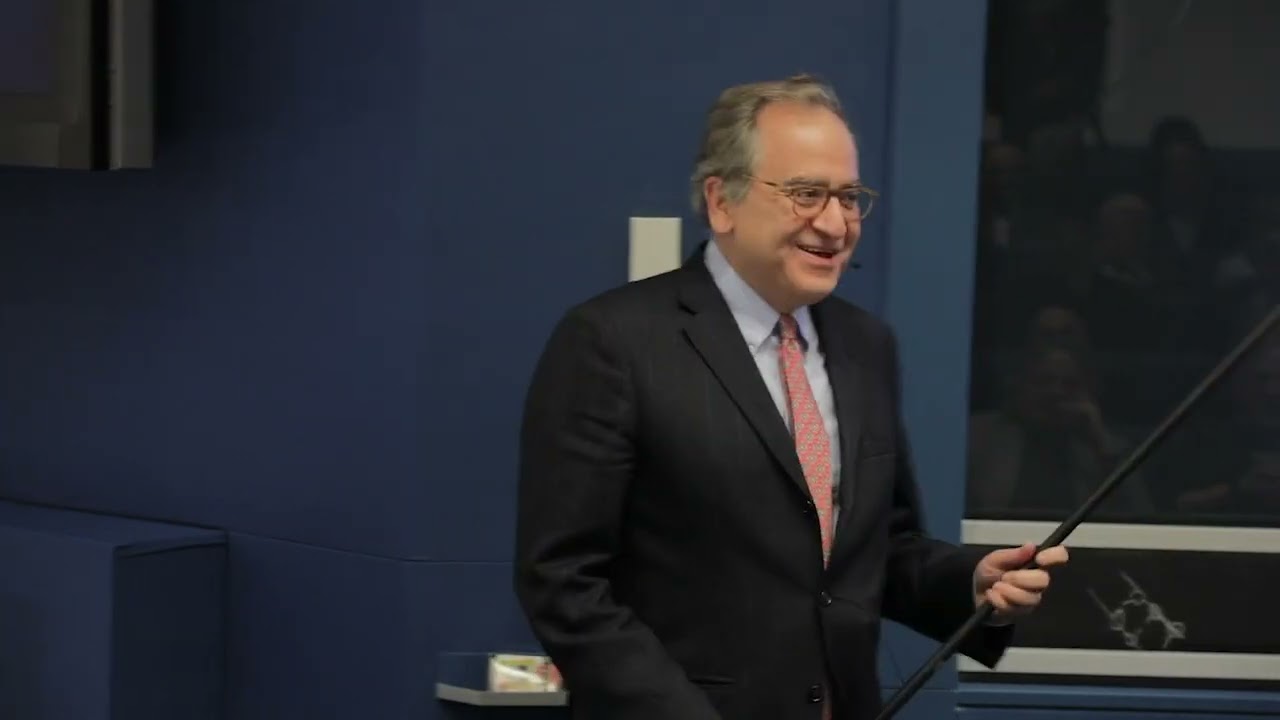
C. Vafa, M. Freedman, C. Kane, Jim Simons - Applications of Chern-Simons Theory (April 25, 2018)
Keywords
Summary
163 words
Critical Evaluation
Value of the Information & Strength of the Argument
The value of the information is exceptionally high, as it provides a first-hand account of the discovery of Chern-Simons theory by Jim Simons and its subsequent development by leading physicists. The argumentation is rigorous, with mathematical derivations and clear explanations of physical concepts. The speakers present a coherent narrative connecting pure mathematics to modern physics, demonstrating the theory’s broad applicability. The lecture is well-structured, with each speaker building on the previous one, and the technical level is appropriate for an expert audience.
Scientific Rigor, Source Quality, Title Accuracy
The scientific rigor is high, with the speakers referencing their own published work and well-known results in the field. The sources cited are primarily the speakers’ own papers and seminal works by others, such as Witten’s work on Chern-Simons theory. The title accurately reflects the content, focusing on applications of Chern-Simons theory. The lecture is not a formal review but rather a series of expert perspectives, which is appropriate for a presidential lecture. The audience appears to be experts, as indicated by the technical depth and lack of introductory material.
187 words
Title / Content Match
The title accurately reflects the content: a panel of experts discussing applications of Chern-Simons theory.
Quality & Reliability
8/10
High-level presentation by leading experts (Simons, Vafa, Freedman, Kane) on Chern-Simons theory and its applications. The content is mathematically rigorous, with clear derivations and references to established work. However, it is a lecture rather than a peer-reviewed publication, and some statements are informal.
Key Moments
Markers derived by PSI from the transcript: the creator did not define chapters.
- Introduction by Jim Simons, recounting his early work on characteristic classes and the discovery of the Chern-Simons form.
- Simons presents the definition of the Chern-Simons form and its properties, including conformal invariance and integrality.
- Simons discusses the theorem on conformal immersion and the example of RP^3.
- Simons mentions the connection to the Poincaré conjecture and the critical points of the functional.
- Cumrun Vafa begins his talk, showing the prevalence of Chern-Simons theory in the literature.
- Vafa explains the Chern-Simons action and its gauge invariance.
- Vafa discusses Witten's topological quantum field theory and its connection to knot invariants.
- Vafa introduces applications to string theory, including topological string theory and D-branes.
- Vafa explains the connection between Chern-Simons theory and holography, referencing Maldacena's work.
- Michael Freedman and Charles Kane discuss applications to topological phases of matter.
Cited Sources
- Chern-Simons form — Mentioned by Jim Simons as the mathematical object he discovered.
- Chern-Simons theory — Discussed extensively by Cumrun Vafa as a topological quantum field theory.
- Witten's knot invariants — Referenced by Vafa in the context of knot invariants from Chern-Simons theory.
- Topological string theory — Mentioned by Vafa as an application of Chern-Simons theory.
- AdS/CFT correspondence — Referenced by Vafa in the context of holography and large N limit.
Concurring Sources
- Chern-Simons theory — Provides a comprehensive overview consistent with the lecture's content.
- Witten's knot invariants — Supports the discussion of knot invariants from Chern-Simons theory.
- AdS/CFT correspondence — Supports the holography discussion.
Contribution & Novelties
This lecture provides a unique historical perspective on the discovery of Chern-Simons theory and its evolution into a central tool in modern physics. The speakers offer insights into the mathematical foundations and the wide range of applications, from knot invariants to string theory and condensed matter physics. The presentation is valuable for its synthesis of ideas and the personal anecdotes from the discoverer himself.
Pour aller plus loin :
- Chern-Simons theory — Overview of the theory and its applications.
- Topological quantum field theory — Framework in which Chern-Simons theory is a prime example.
- Knot invariant — Related to the Jones polynomial and Witten’s invariants.
- String theory — Context for many applications mentioned.
- Topological order — Relevant to condensed matter applications discussed by Kane.
123 words
Radar Profile
The radar profile shows very high scores in quantity and quality of information, and technical level, reflecting the depth and expertise of the speakers. The slightly lower reliability score is due to the informal nature of a lecture, but overall the profile indicates a highly informative and rigorous presentation.