Bin Yu — Understanding Deep Learning Models via Interaction Importance (Sept. 25, 2025)
Keywords
Summary
139 words
Critical Evaluation
Value of the Information & Strength of the Argument
The talk provides valuable insights into the importance of interaction effects in complex systems and presents a coherent framework for evaluating interpretability. The argumentation is strong, grounded in the speaker’s extensive research experience and supported by published results. She clearly explains the motivation, methods, and validation steps, making a compelling case for the utility of interaction importance. The four-level framework is a useful contribution, though it is presented as a proposal rather than a fully validated taxonomy. The speaker is honest about limitations, such as the low predictive accuracy in the HCM study and the need for scalability.
Scientific Rigor, Source Quality, Title Accuracy
The talk demonstrates scientific rigor through its emphasis on stability, validation, and replicability. The speaker cites specific publications and experimental validations, and the description provides a link to the Simons Foundation event page. The title accurately reflects the content, focusing on understanding deep learning models via interaction importance. The talk is well-structured and the speaker’s expertise is evident. No comments were provided for analysis.
177 words
Title / Content Match
The title accurately reflects the content: the talk focuses on understanding deep learning models through interaction importance, with a strong emphasis on the speaker's own research trajectory.
Quality & Reliability
8/10
The talk is given by a leading statistician (Bin Yu, UC Berkeley) at a Simons Foundation meeting. It presents a coherent research program with published results in peer-reviewed venues (Nature Cardiovascular Research, NeurIPS). The methods are described at a high level, but the speaker is transparent about limitations and open questions. The content is reliable, though not a formal peer-reviewed presentation.
Key Moments
Markers derived by PSI from the transcript: the creator did not define chapters.
- Introduction: interaction importance in nature and science, examples from biology and AI.
- Proposal of four-level framework for evaluating interpretability: stability, reality check, external utility, replicability.
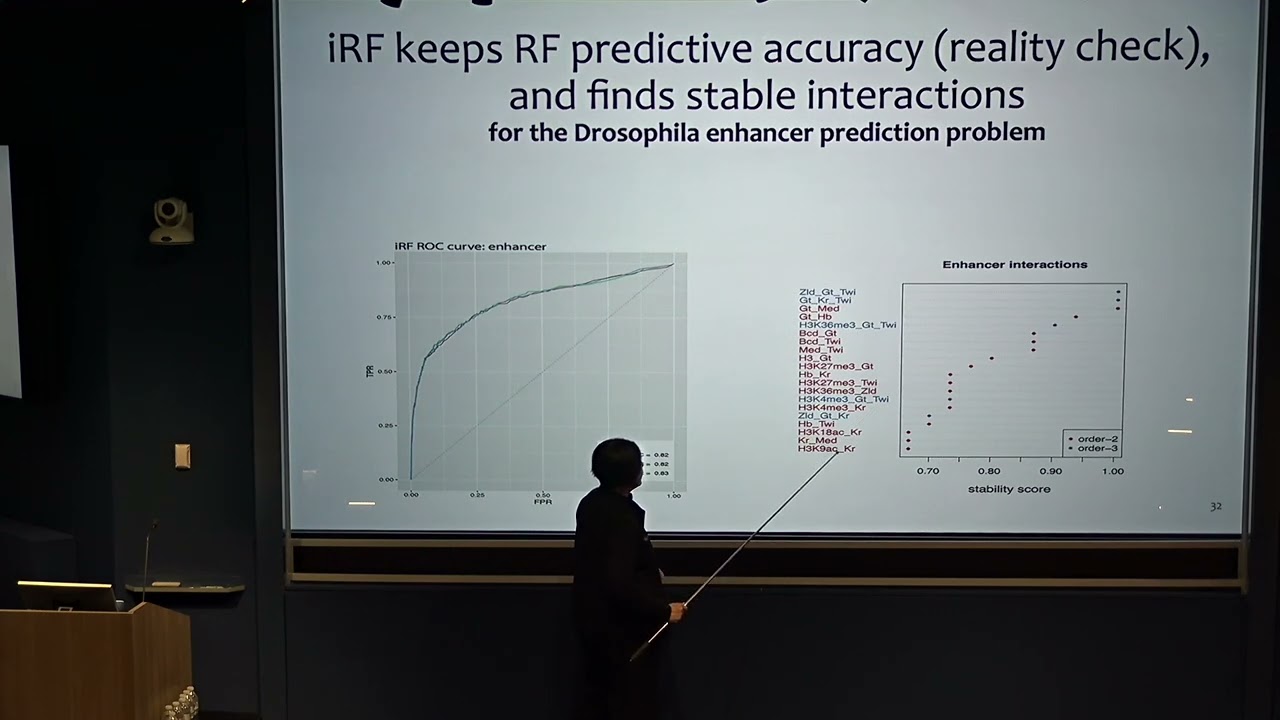
- Random forests for interaction detection in Drosophila, with experimental validation.
- Application to human heart disease (HCM) using UK Biobank data, with experimental validation.
- Contextual decomposition for transformers, identifying attention heads and circuits.
- Search for higher-order interactions using error-correcting codes (SPECS, Proxy SPECS).
- Conclusion and future directions: scaling to higher-order interactions, integrating boolean thinking.
Cited Sources
- 2025 Mathematical and Scientific Foundations of Deep Learning Annual Meeting — Event page for the talk, providing context and related resources.
Concurring Sources
- Random forest — Provides background on the random forest algorithm, which is central to the talk.
- Contextual decomposition — Original paper on contextual decomposition, a method discussed in the talk.
Contribution & Novelties
The talk synthesizes a decade of research on interaction importance, proposing a unified framework (PDR) and a four-level quality control for interpretability. It bridges genomics and deep learning, showing how methods developed for biological interactions can be adapted to neural networks. The introduction of SPECS and Proxy SPECS for efficient higher-order interaction search is a novel contribution.
Pour aller plus loin :
- Random forest — Foundational algorithm for the interaction detection methods discussed.
- Contextual decomposition — Original paper on contextual decomposition for NLP models.
- Interpretability in machine learning — Overview of interpretability concepts and challenges.
95 words
Radar Profile
The radar profile shows high scores in information quantity, quality, and reliability, with a slightly lower technical level, indicating a talk that is rich in content and well-supported, but accessible to a broader audience.