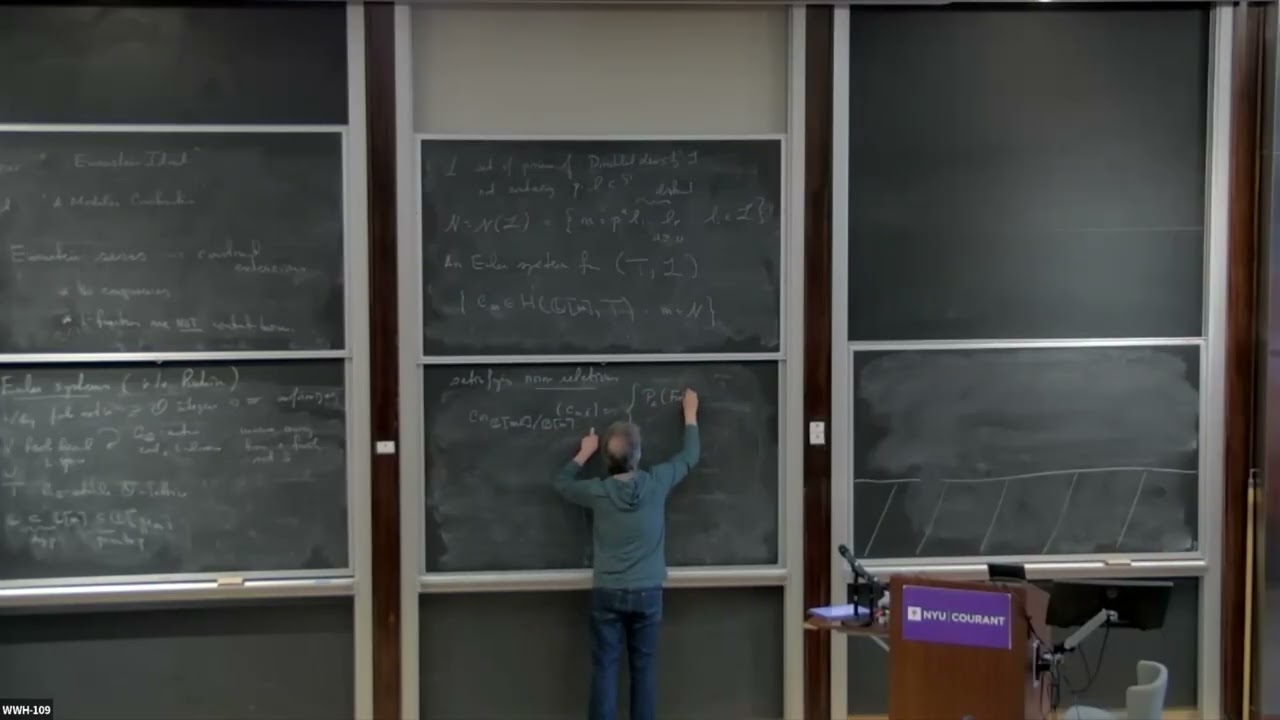
Christopher Skinner: Eisenstein Series and Iwasawa Theory
Keywords
Summary
161 words
Critical Evaluation
Value of the Information & Strength of the Argument
The talk presents a novel approach to constructing Euler systems, which is a central problem in Iwasawa theory. The value lies in the potential to generate new Euler systems beyond the classical examples from units. The argumentation is rigorous, building from foundational definitions to a concrete example and then to a general framework. Skinner carefully explains the role of Eisenstein series and how they can be used to produce extensions of Galois representations. He also addresses potential objections, such as the use of known formulas, and clarifies the novelty of his method. The connection to Rankin-Selberg integrals is particularly insightful, as it ties the construction to L-functions in a natural way.
Scientific Rigor, Source Quality, Title Accuracy
The lecture is scientifically rigorous, with clear logical progression and precise definitions. However, no specific sources are cited during the talk, which limits the ability to verify claims directly. The institutional context (Simons Foundation conference) and the speaker’s reputation as a leading expert lend credibility. The title accurately reflects the content, focusing on Eisenstein series and their application to Iwasawa theory. The talk is self-contained in its argumentation, but assumes a high level of background knowledge. No comments were provided, so no public reception analysis is possible.
213 words
Title / Content Match
The title accurately reflects the content: the talk focuses on Eisenstein series and their role in constructing Euler systems, with connections to Iwasawa theory.
Quality & Reliability
8/10
Lecture by a leading expert in number theory, presenting original research at a specialized conference. The content is highly technical and assumes advanced knowledge. No sources are cited in the talk itself, but the institutional context (Simons Foundation) and the speaker's reputation lend credibility. The arguments are logically structured and rigorous, though not peer-reviewed in this format.
Key Moments
Markers derived by PSI from the transcript: the creator did not define chapters.
- Introduction: Skinner reflects on the influence of the two celebrated papers on his career.
- Overview of Euler systems and their role in bounding Selmer groups via Kolyvagin's method.
- Simple example: P1 minus two points, construction of a Galois extension and its non-splitness.
- General framework: using relative cohomology and Eisenstein series to construct Euler systems.
- Discussion of norm relations and their connection to local multiplicity one.
- Challenges and open problems, including the A3 case.
Cited Sources
- MPS Conference on The Eisenstein Ideal and Galois Representations: Looking Forward after 50 Years — Conference page providing context for the lecture.
Concurring Sources
- Mazur and Wiles on the Iwasawa main conjecture — Mentioned in the talk as further development of the Eisenstein ideal paper.
- Wiles on the Iwasawa main conjecture for totally real fields — Mentioned as using Ribet's construction.
Contribution & Novelties
The lecture proposes a new method for constructing Euler systems using Eisenstein series, which is a significant contribution to Iwasawa theory. The approach avoids relying on congruences and instead uses extensions of Galois representations arising from relative cohomology. This could lead to new Euler systems beyond classical examples. The connection to Rankin-Selberg integrals provides a natural link to L-functions.
Pour aller plus loin :
- Euler system — Overview of Euler systems and their applications.
- Iwasawa theory — Background on Iwasawa theory and main conjectures.
- Rankin–Selberg method — Explanation of the integral representation method.
93 words
Radar Profile
The radar profile shows very high technical level and information quality, but lower scores in quantity of information and reliability due to the specialized nature and lack of cited sources. This reflects a dense, expert-level lecture with limited accessibility.